St. Joseph’s Health Services of Rhode Island and Roger Williams Medical Center have signed a “memorandum of understanding” setting a framework to pursue a formal affiliation and set up joint parent holding company.
If the affiliation is completed, the two said last week, the new holding company would operate a total of 579 licensed hospital beds, employ about 3,650 people and have about $350 million in annual operating revenue.
While the memorandum is just the first step in a lengthy process – a formal agreement must still be forged, and then approvals from the R.I. Department of Health and the state attorney general must be obtained – the deal is well past the early-discussions, tentative stage.
“Our organizations are deeply committed to move forward with this process,” said Kenneth H. Belcher, president and CEO of Roger Williams, in an interview.
“Even though this is preliminary, we have put a lot of time into going through with this, so absent a big setback or a big surprise, our intent is to move forward with this,” added John M. Fogarty, who became St. Joseph’s president and CEO earlier this month.
This is the third pair of hospital organizations in Rhode Island to pursue a merger or affiliation in the last year.
Last July, the state’s two largest health care systems, Lifespan and Care New England, announced they wished to merge, though a formal application has yet to be filed with the state. And in April, Memorial Hospital of Rhode Island and Landmark Medical Center said they were discussing a possible merger, though only tentatively at this point.
“I think it’s a sign of the times,” said Edward J. Quinlan, president of the Hospital Association of Rhode Island. Hospitals in the state “are always talking about the value of partners,” he added, and right now, with the entire hospital industry in Rhode Island “under unprecedented stress” due to low reimbursements, a large elderly population, staffing difficulties and other problems, hospitals are more publicly discussing potential deals.
State Health Director Dr. David R. Gifford, for his part, noted through a spokeswoman that an analysis by the state Community Hospital Task Force last year had “showed a need for greater collaboration, given the size of our state and the potential for economies of scale.”
Yet while the notions of “centers of excellence,” efficiency, coordination, etc. are “good possible outcomes that the state needs to consider,” the spokeswoman noted, Gifford also believes each merger must be evaluated in terms of how it will affect access to care, quality of care and costs, because some mergers may be good for the hospitals but not for the state.
Belcher and Fogarty stressed that their organizations’ plan is to pursue an affiliation, not a merger. Each partner will retain its identity and continue to be governed by its own board, while the parent company will have a 15-member board of its own and focus on oversight of system finances and strategic planning.
Each hospital will maintain its own license and medical staff, Fogarty said, and St. Joseph’s will retain its pastoral care, hospital chapel, religious symbols and Catholic health care practices, while Roger Williams will continue to be secular. The affiliation will be structured to meet the requirements of Catholic canonical law, and will follow models that have been used successfully in other religious-secular hospital affiliations, Fogarty said.
Both hospitals have talked about affiliating for many years, the CEOs said, and though they’ve both talked with other organizations as well, this particular match works best because the facilities are close to one another, they have some overlap in their medical staff, and they have other “positive synergies” – not the least of which is that coincidentally, they both use the same IT platform, Meditech.
St. Joseph’s operates a community hospital, the 226-bed Our Lady of Fatima Hospital in North Providence, as well as the 110-bed St. Joseph Hospital for Specialty Care in Providence and St. Joseph Living Center, an assisted-living facility in Providence. It has an annual operating budget of more than $180 million, and more than 1,900 employees.
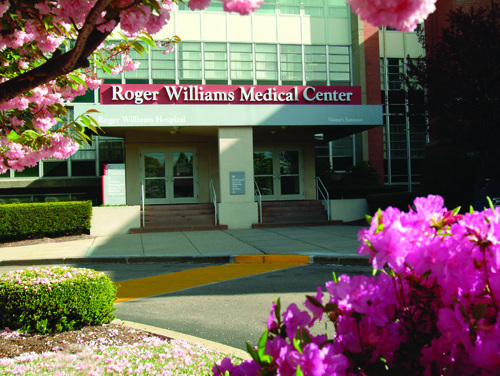
Roger Williams operates a 220-bed hospital affiliated with Boston University School of Medicine that combines general medical/surgical services and highly specialized services, as well as Elmhurst Extended Care and Home Care. It has an annual operating budget of more than $168 million, and 1,750 employees.
The two have a combined market share of about 20 percent of the Greater Providence area and 15 percent of the entire state.
Along with creating “efficiencies,” the two said in a news release, joining forces “creates the size and scale required by hospital providers to compete in today’s health care economy.”
In addition, they said, an affiliation would “strengthen the finances of both organizations, allowing them to continue fulfilling their missions of providing care to those in need.”
The memorandum of understanding is a non-binding document, the two organizations said, but it lays out the foundation for the drafting of a formal, binding document that they expect to complete by the end of the summer.
Getting the state’s approval could take several months beyond that. In anticipation of the Lifespan-Care New England merger, the Department of Health and the attorney general’s office set up a new joint process that involves a preliminary stage when an application is evaluated for completeness, then a 180-day review process, including public hearings.
It’s a rigorous process. Asked how much it would cost, Fogarty replied, “That’s something we’ll be working through over the next few months.”
Asked whether they perceive the deal as necessary to their organizations’ financial viability in the next few years, however, Belcher said this is more of a “proactive” move.
“One of the reasons that we’re moving ahead with this now at this time is to avoid what could be a financial crisis in the future,” he said. “I’m not suggesting that there would necessarily be one … but you see the challenges that the state is facing. We want to ensure that access to care for the communities that we serve is preserved.” •