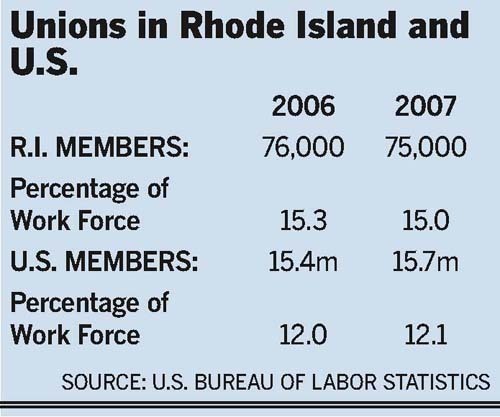
While the percentage of American workers that are union members rose slightly during 2007 – the first year since 1983 that has happened – membership in Rhode Island unions fell by 1,000, to 75,000, according to the U.S. Bureau of Labor Statistics.
The Rhode Island decline might be a response to slowing construction rates, said Tom Savoie, business representative and organizer of the Ocean State’s United Brotherhood of Carpenters and Joiners Local 94.
“When the construction boom was happening a few years ago, we were growing,” he told Providence Business News in a recent interview. “I would say lately it’s been at least stagnant with us. We’ve been at the same number, within 50 members, for the last two years within Rhode Island.”
Local 94 has about 2,000 members now. Membership peaked about two years ago with 2,200, Savoie said. Nationally, there are about 520,000 members; an amount that hasn’t varied much year-to-year, he said.
Michael F. Sabitoni, business manager of Construction and General Laborers’ Local 271, said that within the next few years, Rhode Island will likely have a deficit of union construction workers because many young workers aren’t interested in construction trades.
“Over the next 10 to 15 years in the construction trades, we do see shortages due to the fact that the older guys are retiring and the guidance counselors don’t necessarily try to steer kids into the construction industry,” he said.
Local 271’s membership grew by about 300 during 2007, but that was because two locals merged. The union now boasts about 2,500 members, but slow construction rates will affect whether it grows during 2008, Sabitoni said.
“Obviously it’s supply and demand,” said Sabitoni, who is also president of R.I. Building Trades, a construction trades group comprised of 17 unions. “When the demand flattens out, we don’t train as much. And we don’t bring in as many members if the need and the workload, the work outlook, are not there. It’s definitely relevant to the market demands for the need for skilled labor.”
That’s why construction unions in Rhode Island invest about $8 million each year into training, apprenticeship and outreach programs, he said. “I think that’s what sets the unionized sector of the construction industry apart from the non-unionized sector,” Sabitoni said. “We invest.”
One outreach program, Building Futures, was started about eight months ago by BuildRI, R.I. Building Trades and YouthBuild. It’s a pre-apprenticeship program that reaches out to inner city and minority youth that may not otherwise be interested in union construction jobs, Sabitoni said.
To date, about 15 people have passed through the program and are now in apprenticeship programs, including working at the Capitol Cove development and Brown University construction sites, Sabitoni said.
That program, Building Futures, got its start about eight months ago and has since earned the support of Providence Mayor David N. Cicilline, said Greg Mancini, BuildRI executive director.
In Rhode Island, union members numbered 76,000 during 2006. That was 15.3 percent of the state’s work force. Last year, that number dropped by 1,000 members to 75,000, which is 15 percent of those employed in the Ocean State, according to U.S. Bureau of Labor statistics.
During 2007 only 11 states had higher percentages of union workers. And last year, Rhode Island had the second highest percentage of union workers in New England. In Connecticut, the highest, 15.6 percent of workers were union members. New Hampshire had the lowest percentage, with 9.7 percent, according to the R.I. Department of Labor and Training.
Nationally, though, union membership increased during 2007 by 311,000 to 15.7 million, which is 12.1 percent of the full-time work force in the United States. During 2006, 12.0 percent of workers were union members.
With that slim gain, 2007 was the first time in 25 years that the percentage of union membership increased. Each year since 1983 – when 20.1 percent of U.S. workers were union members – year-over-year percentages have fallen or stayed the same, according to the U.S. Bureau of Labor Statistics.
UNITE-HERE is an international union with about 500,000 members, including about 1,500 local members. The union represents workers in the food service and hospitality industries, including valets.
Unlike Rhode Island construction unions, that union doesn’t depend as highly on new construction and businesses opening, said Jenna Karlin, director of the union’s Providence-based Local 217.
Providence’s expanding hotel industry hasn’t much affected membership of the union – which represents workers at both The Biltmore and The Westin – during the last two years, though during 2007 the union picked up about 300 food-service members from Twin Rivers, said Karlin.
“In our industry there are always hotels opening and closing,” Karlin said, adding that that business turnover usually leads membership to even out.
But with construction-based unions, membership relies heavily on the amount of construction in the state and outreach programs, Sabitoni said.
“Bringing people into the union is weird if you don’t have work for them,” said Savoie, of Local 94. •