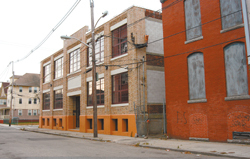
The South Providence Development Corp. runs this "green" building at 17 Gordon Ave. The building has solar panels and environmentally friendly features.
The South Providence Development Corporation’s business incubator at 17 Gordon Ave. has solar panels for electricity, a rooftop spread of living sedum, a porous parking lot that absorbs rainwater, and carpets made from natural fibers.
MacMillan Hall, Brown University’s newest science building, has high-performance windows, sensors that adjust lights to the natural light supply, a variable-speed lab ventilation system, and a point-of-use water filtering system.
A modernized health plan: Supporting cost management and the employee experience.
The Surest health plan came from a group of innovators wondering: What if health care…
Learn More
And the Apeiron Institute’s model house, in Coventry, is a showcase for more than 50 environmental technologies from solar heating, electricity and hot water, to super-insulated walls, radiant flooring, a composting toilet, and an indoor greenhouse.
All three are “green” buildings, designed to conserve energy, reduce waste and produce a healthier environment inside and out. Also known as “high-performance” or “sustainable” construction, the concept is still in its infancy in Rhode Island, but is rapidly taking hold in parts of Europe, Canada and several U.S. cities and states.
At least 11 U.S. cities, including Boston, Chicago and San Francisco, have adopted a U.S. Green Building Council standard for all new public buildings, and several building codes now include “green” mandates.
In Boston, Mayor Thomas M. Menino this month endorsed green building after a task force of industry, business and nonprofit leaders he convened found it not only protects the environment, but produces substantial long-term cost savings and contributes to occupants’ health and productivity.
“High-performance green building is good for your wallet,” Menino said. “It is good for the environment. And it is good for people.”
But are the upfront costs of green building still too high?
That is certainly the perception, as its advocates are the first to admit. A February 2003 U.S. Green Building Council white paper found people involved in green projects thought they cost an extra 14 percent, and outsiders thought the premium was 20 percent.
Recent studies, however, have pegged the cost at about 2 percent for commercial and institutional buildings, or a range of 0 percent to 3 percent. A report last month, by the national consulting firm Davis Langdon, said many projects “can achieve sustainable design within their initial budget, or with very small supplemental funding.”
Several factors affect the cost, local and national experts say: Building green from scratch is cheaper and easier than adapting an old structure. It also helps to incorporate green features from the start, rather than adding them later, and to use contractors who have the knowledge, skill and comfort level to build green.
In places where green building is still rare, Davis Langdon found, contractors are “likely to be more wary” and add contingency or risk premiums to their bids, and some will not bid at all, resulting in poorer competition and higher prices.
“As bidding communities become more familiar with sustainable buildings, the risk premiums decrease, and the competition increases, reducing or eliminating the green premium,” the firm found. Another study showed in Seattle, where several green buildings have been erected, the premium has dropped from 3 percent to 4 percent to 1 or 2.
Though Rhode Island now has several buildings with green features, and several more going up, the concept “has not caught on like wildfire,” as advocate Bradley Hyson, executive director of the Apeiron Institute, put it.
Asked for names of builders involved in green projects, Roger Warren, executive director of the Rhode Island Builders Association, couldn’t come up with any, though he did say many members are building energy-efficient homes.
“As Yankee builders, we don’t adopt things until they’re tried and true, and we’re reluctant to be leaders,” Warren said.
Hyson said the problem is a “lack of education” about green builders, as well as a fear that extra costs will make a contractor uncompetitive. “Builders are trying to save every nickel so someone can’t underbid them,” he said.
Harold Ward, a retired professor of environmental studies at Brown University and longtime advocate of green building, said most builders already build better-insulated and more energy-efficient buildings than the Rhode Island code requires, and many green concepts, such as maximizing natural light or using high-quality windows, are widely used. But the more investment is required, he said, the less a builder will embrace it. And for large projects with fixed budgets, enhancements are the first things to be cut.
“On larger buildings, there almost always seems to be a cost overrun,” he said. “And when the crunch comes, they eliminate the things that won’t lead to a code violation, so they cut back on the very things that would save money in the long run.”
That’s where the client’s attitude makes all the difference, the Davis Langdon report says. And more and more clients are demanding green buildings. A survey this summer by Turner Construction Co., the nation’s largest general builder, showed 88 percent of industry executives involved in green projects had seen the volume increase in the last three years, and more than half expected “substantial” increases. Of those not doing green projects now, 30 percent thought it very likely that they soon would.
Locally, high-profile clients such as Brown and the University of Rhode Island have embraced green building, and environmentalists are working with public school leaders to get them onboard, citing the benefits for children, for example, of having non-toxic carpets, cleaner indoor air and brighter classrooms.
Interest among architects is also strong, leading the local chapter of the American Institute of Architects and URI to co-sponsor a seminar on the U.S. Green Building Council’s LEED (Leadership in Energy and Environmental Design) certification program, the most widely accepted standard for green building.
“It’s becoming a big issue,” said J. Michael Abbott, of Newport Collaborative Architects, which is designing a green facility for the private Meadowbrook Waldorf School. “Many people are getting LEED-certified; we have several here. It’s going to be a whole other direction for the industry. … I think we’re probably going to see green in maybe a third of all buildings in the next few years. It’s really coming on strong.”