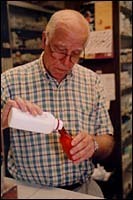
fills a prescription
(Brian McDonald)
The slumping economy and shaky job market are of little concern to graduates of the University of Rhode Island College of Pharmacy.
“These students won’t have any trouble finding a job,” said Joan M. Lausier, associate dean of the pharmacy school. “Companies come from all over the country to recruit here.”
Your Business Has Gone Global. Has Your Insurance?
A decade ago, “doing business internationally” was mostly a large-company concern. Today, a manufacturer in…
Learn More
Lausier said students graduating from the six-year program can expect annual salaries in excess of $80,000 – often padded with signing bonuses, stock options and loan-repayment money.
The reason: A nationwide shortage of pharmacists.
Sen. Jack Reed, D-RI, said he plans to introduce legislation next month that would provide federal funding to help pharmacy students pay back loans and to lure pharmacists to join faculty at pharmacy schools.
“The demand (for prescription drugs) is overwhelming the supply of pharmacists in this country,” Reed said at an Aug. 23rd press conference in front of the CVS store on Pontiac Avenue in Cranston.
Reed said federal statistics show that while the number of retail prescriptions jumped 44 percent nationally between 1992 and 1999, the number of pharmacists filling those prescriptions grew by just 1.6 percent. The number of vacant positions at pharmacies nationally has swelled from 2,500 in 1998 to 7,000 in 2000, according to the National Association of Chain Drug Stores.
Meanwhile, enrollment in pharmacy schools is dropping, with applications down 33 percent nationally between 1994 and 1999, according to the U.S. Department of Health and Human Services.
The shortage is affecting retail pharmacies as well as pharmaceutical companies, hospitals and other health-care providers, Reed said.
CVS spokesman Michael J. DeAngelis said the Woonsocket-based pharmacy chain has had to curtail hours in some markets because of the pharmacist shortage.
Reed’s legislation would earmark scholarship and loan-repayment money for incoming pharmacy students and recent graduates who agree to work in areas where pharmacist shortages are most severe, such as rural communities.
The bill also would offer loan-repayment help for students or practicing pharmacists who teach two years at pharmacy schools. And it would provide grants to schools of pharmacy for expansions and renovations.
Lausier said high tuition costs are a key deterrent for many students, especially since pharmacy schools in 2000 were required to change from a five-year undergraduate program to a six-year doctoral curriculum. The cost of that extra year of tuition is compounded by the fact that students don’t qualify for federal financial aid after four years, she said.
“They’re eligible for federal loan money, but it’s not subsidized so it’s very expensive to pay back,” said Lausier.
She added, however, that URI’s College of Pharmacy enrollment has remained strong despite decreases at other schools.
Brandee Kelley, a sixth-year student at URI’s College of Pharmacy, said she doesn’t worry about getting a good job after she graduates next May. But she will shop around for the best offer.
“I’m leaning toward retail, because that’s where the best money is and I need to pay back my (student) loans,” Kelley said.
The pharmacist shortage in Rhode Island is relatively mild compared with other areas of the country. The Ocean State has more pharmacists per capita – about 95 per 100,000 residents – than any state in the country, according to the HHS’ Health Resources and Services Administration.
John DePasquale, owner of DePasquale’s Pharmacy at 319 Broadway in Providence, said he’s been able to keep a full staff, although the shortage has increased his employment costs.
“If you want to keep somebody good you have to pay more. That’s what the market dictates,” he said.
Although DePasquale expects the shortage to get worse, he said the industry can help itself by attracting more women to the profession.
“It’s a great field for women, because you can pick your hours,” he said. “If (women) have a family they still can work 20 to 30 hours a week.”