
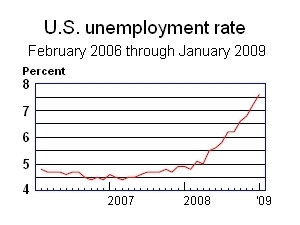
WASHINGTON – U.S. payrolls last month shrank for the 13th consecutive month, boosting the nation’s unemployment rate to a 16-year high of 7.6 percent, according to data released today by the U.S. Department of Labor’s Bureau of Labor Statistics.
“The labor market continued to weaken dramatically in January,” BLS Commissioner Keith Hall told Congress’ Joint Economic Committee this morning. Analysts had expected the employment situation to weaken, but not so sharply as it did.
Last month’s jobless rate had been expected to come in at 7.5 percent – up from 7.2 percent in December and 6.7 percent in November – based on the median estimate from a Bloomberg News survey of 75 economists. (The analysts’ estimates of the January unemployment rate ranged from 7.3 percent to 7.6 percent.) “Since December 2007, the rate has risen by 2.7 percentage points, with the increase widespread across demographic groups,” Hall said.
Non-farm payrolls had been expected to shed 540,000 jobs last month – after losing the originally estimated 524,000 jobs in December (READ MORE) and 533,000 in November – the analyst survey found. (The economists’ estimates of January job losses ranged from 400,000 to 750,000 positions nationwide.)
Instead, non-farm payrolls shrank by an estimated 598,000 positions – after losing an upwardly revised 577,000 jobs in December and 597,000 in November – in what Econoday analysts said was the first three-month streak of half-million-plus job losses since government recordkeeping began in 1939.
Last month’s actual monthly decline was the steepest since December 1974. It brought total job losses since the recession’s official beginning in December 2007 to 3.57 million, making this the deepest employment slump since World War II. “About half of the decline occurred in the past three months,” Hall noted.
“Job losses in January were large and widespread across the major industry sectors,” he said.
“Manufacturing employment fell by 207,000 over the month, bringing the job loss in this industry to 1.1 million since the start of the recession,” with nearly half of those losses coming in the past three months. Last month’s manufacturing job-losses “were spread throughout the sector, but were especially large in fabricated metal products (-37,000), motor vehicles and parts (-31,000) and machinery (-22,000),” Hall said.
“Construction shed 111,000 jobs over the month,” he said. “The pace of job loss in this sector has accelerated in recent months. Employment has declined by 781,000 since the beginning of the recession, with about 40 percent of the decrease occurring in the past 3 months.”
Job losses also were seen “throughout most of the service-providing sector,” the BLS commissioner said. “Since the start of the recession, this sector has lost 1.8 million jobs, with over half of the decline occurring in the past 3 months. Employment in temporary help agencies fell by 76,000 in January and has declined by 605,000 since December 2007. Other large over-the-month job losses occurred in retail trade (-45,000), transportation and warehousing (-44,000), financial activities (-42,000), wholesale trade (-31,000) and professional and technical services (-29,000).
Adding jobs last month, Hall said, were the health care sector, where employment “was up by 19,000 over the month compared with an average of 30,000 a month in 2008,”and private education.
Meanwhile, manufacturing production workers still on the job saw their average work week shrink to 39.8 hours from 39.9 in December and 40.2 in November, while average overtime fell to 2.9 hours in January from 3.0 hours in December and 3.2 in November, the bureau said.
Building a Strong Data Foundation in the Age of AI
Artificial intelligence (AI) has become a key priority in the boardroom and across management —…
Learn More
The average work week of private-sector production and nonsupervisory workers was 33.3 hours, unchanged from December but down from 33.4 hours in November, the BLS said. But their average hourly earnings rose 0.3 percent in January – to $18.46 per hour from $18.41 the month before – after rising 0.3 percent in December and 0.4 percent in November. (That statistic may be somewhat misleading, several analysts noted, since last-hired, first-fired policies at many workplaces ensure that when job cuts begin, the lowest-paid workers are the first to go.) That raised their average weekly earnings to $614.72, from $613.05 the month before and $612.56 in November.
“Over the past 12 months, average hourly earnings have increased by 3.9 percent,” Hall said. But the “real” increase adjusted for inflation was steeper, since from December 2007 to December 2008, the seasonally adjusted Consumer Price Index for Urban Wage Earners and Clerical Workers (CPI-W) dipped 0.7 percent.
“Measures from our household survey also reflected the weak labor market conditions in January,” the BLS commissioner said.
Last month, “the employment-population ratio dropped to 60.5 percent, 2.2 percentage points lower than at the beginning of the recession. This is the lowest level since May 1986. The labor force participation rate, at 65.5 percent in January, has [also] edged down in recent months,” Hall said.
“We’re losing jobs at an alarming pace and bracing for more weakness,” Scott Anderson, senior economist at Wells Fargo & Co. in Minneapolis, told Bloomberg News. “The private sector is flat on its back at this point. The government needs to step in with a stimulus, the sooner the better.”
Ken Simonson, chief economist for The Associated General Contractors of America, called it “tragic that 3.5 million jobs have been lost in the past 12 months and the unemployment rate has climbed to 7.6 percent.
But, he said, “construction workers have suffered far more than their share of that pain, accounting for 747,000 – or more than one-fifth – of the job cuts and [the sector had] an unemployment rate of 18.2 percent in January.” That pain is no longer confined to homebuilders, he added in a statement this morning.
“In the past 12 months, nonresidential builders and specialty trade contractors, along with heavy and civil engineering construction firms, have had to lay off 309,000 workers, or nearly 7 percent of their workforce. Many of these workers would be re-employed within weeks if Congress passes a stimulus bill with at least $150 billion of construction spending.”
The BLS Office of Disability Employment Policy today began reporting separate data for people with disabilities, Hall noted.
The jobless rate among people with disabilities in January was 13.2 percent before seasonal adjustment, compared with the rate of 8.3 percent before adjustment for people with no disability, ODEP data show. The unadjusted employment-population ratio was 20.0 percent last month among persons with disabilities, compared with the unadjusted rate of 65.0 percent among persons with no disability.
Additional information, including the 30-page Employment Situation Summary for January and the BLS Commissioner’s Statement on the Employment Situation release, is available from the U.S. Department of Labor’s Bureau of Labor Statistics at www.bls.gov.











Yes, but this means that 92 % + of the country still has a job…..I’m tired of the doom and gloom; there are many, many companies and idustries that are going and growing in th egood OL US of A.
John Seraichk
CEO
Browninig Associates
http://www.professionaljojbchange.com