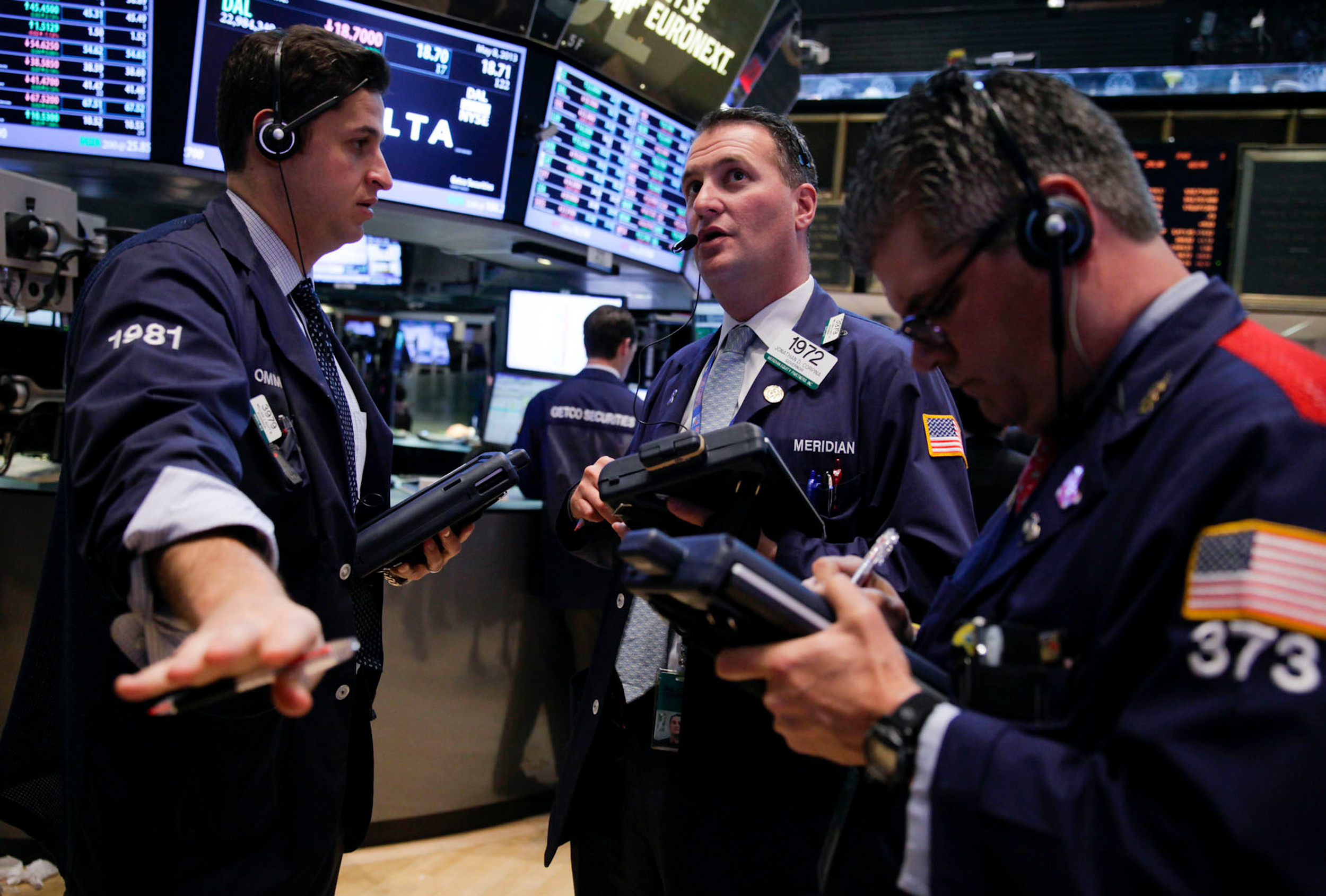
NEW YORK – U.S. stocks rose, as the Standard & Poor’s 500 Index rebounded from a nine-week low, as data showed durable-good orders and home sales increased more than forecast and consumer confidence rose.
PulteGroup Inc. rallied 6 percent, as an S&P index of homebuilders jumped 3.8 percent. JPMorgan Chase & Co. and Bank of America Corp. gained at least 1.5 percent as financial companies rallied. Walgreen Co. sank 7.2 percent after posting quarterly profit that missed estimates. Netflix Inc. slid 2.5 percent after Sanford C. Bernstein & Co. cut its rating on the company to underperform.
The S&P 500 climbed 0.6 percent to 1,581.97 at 10:15 a.m. in New York. The benchmark index sank 2.1 percent last week as Federal Reserve Chairman Ben S. Bernanke said the central bank may start paring quantitative-easing measures this year. The Dow Jones Industrial Average rose 77.51 points, or 0.5 percent, to 14,737.07 today.
“QE lifted all boats,” Witold Bahrke, who helps oversee $55 billion as a senior strategist at PFA Pension A/S in Copenhagen, wrote in an e-mail. “Equally, its removal will shake all markets. The recent comments from central-bank officials show that they are a bit scared about the consequences of their own words and do not want to see a cold-turkey reaction in markets in the context of a still-fragile world economy.”
Fisher, Kocherlakota
The S&P 500 dropped 1.2 percent yesterday as Chinese equities entered a bear market amid concern a cash crunch will hurt growth. The index pared an earlier drop of as much as 2 percent as Richard Fisher, president of the Fed Bank of Dallas, and Minneapolis Fed President Narayana Kocherlakota emphasized that U.S. monetary policy is still accommodative.
China’s central bank will keep money-market rates at a reasonable level and seasonal forces that have driven them up will fade, Ling Tao, deputy director of the PBOC’s Shanghai branch, said at a briefing in Shanghai today. The overnight repurchase rate dropped 47 basis points to 6 percent, according to a daily fixing compiled by the National Interbank Funding Center. It reached a record 12.85 percent on June 20.
The Shanghai Composite Index closed 0.2 percent lower today, paring an earlier plunge of as much as 5.8 percent.
U.S. equities climbed today as the Conference Board’s index of U.S. consumer confidence increased to 81.4 in June from 74.3 a month earlier. Another report showed bookings for U.S. goods meant to last at least three years climbed 3.6 percent for a second month, topping economist forecasts. Excluding transportation equipment, where demand is volatile month to month, orders advanced 0.7 percent, also beating projections.
Home sales
Sales of new U.S. homes climbed more than forecast in May to the highest level in almost five years, a sign of continued strength in a market that’s helping fuel economic expansion. A separate report showed home prices increased more than forecast in the 12 months through April, rising by the most in more than seven years.
PulteGroup rallied 6 percent to $19.40. All 11 members of S&P Supercomposite Homebuilding Index advanced more than 1.7 percent. The homebuilder index fell 19.6 percent from a May 14 peak through yesterday, close to the 20 percent threshold considered to be a bear market.
Lennar Corp., the third-largest U.S. homebuilder by revenue, added 4.3 percent to $36.50. The company posted second- quarter sales of $1.43 billion, beating analyst estimates of $1.31 billion. Adjusted earnings were 43 cents a share, compared with projections of 33 cents.
JPMorgan, the largest U.S. bank by assets, rose 1.5 percent to $51.67. Bank of America, the second-biggest, gained 1.7 percent to $12.51. and Citigroup Inc. added 2.6 percent to $46.63.
Valero Energy Corp. rose 2.5 percent to $34.61 after Goldman Sachs Group Inc. boosted the world’s biggest independent refiner to neutral from sell.
Walgreen sank 7.2 percent to $44.57. The largest U.S. drugstore chain reported third-quarter adjusted earnings of 85 cents a share, missing the average analyst estimate by 6 cents. Revenue during the period also fell short of analysts’ projections.
Netflix slid 2.5 percent to $210.14. The biggest online subscription video service was cut to underperform from market perform by Sanford C. Bernstein analyst Carlos Kirjner.
Slower pace
Building a Strong Data Foundation in the Age of AI
Artificial intelligence (AI) has become a key priority in the boardroom and across management —…
Learn More
While investors in U.S. stocks have suffered losses amid signs the Fed will pare stimulus measures, the declines look small when compared with the rout elsewhere in the world. U.S. shares have dropped at a slower pace than those in Asia and Europe since May 22, when Bernanke signaled that the central bank could taper quantitative easing as the economy improves.
The S&P 500 fell 4.6 percent from its May high through the end of last week. That compares with 9.7 percent for the Stoxx Europe 600 Index and 12 percent for the MSCI Asia Pacific Index.
“The U.S. is regarded as a safe haven and as an economy that’s just beginning to get up and running, which has produced this relative outperformance in stocks in the short term,” said Nick Skiming, who helps manage about $2 billion at Ashburton Ltd. in Jersey, the Channel Islands.