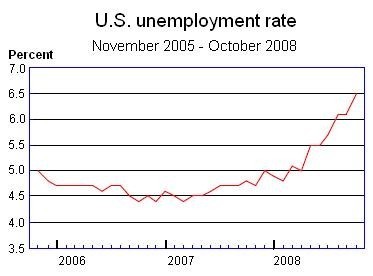
WASHINGTON – The nation’s unemployment rate last month surged to a 14-year high of 6.5 percent, from 6.1 percent in September and 4.8 percent a year ago, as non-farm payroll employment fell for the 10th consecutive month and the number of people listed as unemployed hit its highest level in 25 years, the U.S. Department of Labor’s Bureau of Labor Statistics reported today.
U.S. job losses slowed in October to 240,000 non-farm payroll jobs from September’s sharper than previously thought loss of 284,000 jobs, the BLS said. The bureau also boosted its estimate of August job losses to 127,000 from the original 84,000.
Analysts had expected payrolls would shrink by 200,000 last month – accelerating from a September decline the BLS originally pegged at 159,000 (READ MORE) – based on a survey of 78 economists by Bloomberg News that also predicted an October jobless rate of 6.3 percent.
“Job losses over the last 3 months totaled 651,000, after accounting for downward revisions to employment estimates for August and September,” BLS Commissioner Keith Hall told Congress today in an address before the Joint Economic Committee that accompanied the release of the monthly Employment Situation report. “So far this year, payroll employment has decreased by 1.2 million,” or 120,000 jobs per month.
“In October, manufacturing employment continued to fall, with declines occurring throughout the sector,” Hall said.
Total manufacturing payrolls shrank by 90,000 jobs last month, led by a 40,000-job decline in transportation equipment, reflecting “continued weakness in motor vehicles and parts as well as a strike involving 27,000 workers in the aerospace industry,” he said. “Other sizable job losses occurred in fabricated metal products (-11,000), furniture (-10,000), wood products (-7,000) and plastics and rubber products (-6,000).”
Meanwhile, average weekly manufacturing hours and overtime both were unchanged from September, at 40.6 hours and 3.6 hours, respectively.
Construction payrolls shrank by 49,000 jobs, Hall said, bringing the sector’s losses since its peak in September 2006 to 663,000. “Most of the declines over this period occurred in residential specialty trades (-349,000) and in residential building (-199,000),” he added.
Retail trade payrolls shrank by 38,000 jobs in October, led by auto dealers (-20,000 jobs) and department stores (-18,000), Hall said. “Wholesale trade employment fell by 22,000 over the month, with most of the loss occurring in durable goods distribution.
“Employment in financial activities declined by 24,000 in October; credit intermediation, which includes banking, accounted for about half of the loss. The securities industry shed 6,000 jobs in October,” slowing from September’s 9,000-job decline.
“The employment services industry, which includes temporary help agencies, continued to contract,” losing 51,000 jobs in October, “and has lost about half a million jobs since the most recent peak in August 2006,” the BLS commissioner said.
Yet there were some bright spots, he noted. “Health care employment rose by 26,000 in October and by 348,000 over the past 12 months. Mining added 7,000 jobs over the month,” bringing the industry’s total gains since April 2003 to 246,000 or nearly 50 percent.
“Average hourly earnings for production and nonsupervisory workers in the private sector increased by 4 cents, or 0.2 percent, in October, Hall said. “Over the past 12 months, average hourly earnings have increased by 3.5 percent.”
Yet “real” wages adjusted for inflation have fallen over the past year, as prices have outpaced earnings. “From September 2007 to September 2008,” the most recent period for which data are available, “the Consumer Price Index for Urban Wage Earners and Clerical Workers (CPI-W) rose by 5.4 percent,” Hall said.
Building a Strong Data Foundation in the Age of AI
Artificial intelligence (AI) has become a key priority in the boardroom and across management —…
Learn More
The number of unemployed persons nationwide rose to nearly 10.1 million, an increase of about 603,000 people from September and 2.8 million over the past 12 months, he said. Long-term unemployment rose 12.1 percent compared with September and 69.4 percent compared with a year ago: “About 2.3 million individuals had been unemployed for 27 weeks or more, an increase of 249,000 over the month and 942,000 over the past 12 months,” Hall said.
Underemployment also increased sharply, the BLS found. “The number of persons working part time who would have preferred full-time employment increased by 645,000 in October to 6.7 million,” Hall said. That represented an increase of about 10.6 percent compared with September and 52.3 percent compared with the 4.4 million of October 2007.
“We’re heading for a deep recession,” Nariman Behravesh, chief economist at IHS Global Insight in Lexington, Mass. told Bloomberg News. “Banish the word mild from your vocabulary. It’s big, it’s bad and it’s broad-based.”
“These numbers imply a [need for a federal] stimulus package of closer to $500 billion, ranging over the remainder of this year and through 2009,” added John Herrmann, president of Herrmann Forecasting LLC in Summit, N.J.
Additional information, including the 28-page Employment Situation Summary for October and the BLS Commissioner’s Statement on the Employment Situation release, is available from the U.S. Department of Labor’s Bureau of Labor Statistics at www.bls.gov.