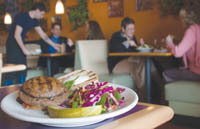
NO MEAT NEEDED: The Garden Grille in Pawtucket offers all-vegetarian fare such as this 'Garden Griller Bella' sandwich.
Since Melanie’s Vegan Eden opened in January 2005, co-owner Kimberly Burtt has seen regular customers come from as far as Boston and New York to eat at the seven-table Providence restaurant.
The patrons, who include many artists and musicians, come looking for dishes such as “steak and cheese” made out of mushrooms and soy and bowties tossed with walnut and basil pesto – all made without any animal-derived products.
Your Business Has Gone Global. Has Your Insurance?
A decade ago, “doing business internationally” was mostly a large-company concern. Today, a manufacturer in…
Learn More
For Burtt, who co-owns the restaurant with her vegan daughter, Melanie, the reason for her customers’ travel is simple – there aren’t enough vegetarian and vegan restaurants to meet the demand.
In Rhode Island, Melanie’s, Garden Grille in Pawtucket, and Spice of Life in Charlestown have the all-vegetarian market cornered, though other eateries, including Crazy Burger in Narragansett and Lucia Italian Restaurant in Newport, are considered “vegetarian-friendly” because meatless items are a large portion of their menus.
Only Melanie’s is strictly vegan.
“Melanie keeps saying she hopes someone else opens another restaurant so she can go out to eat every once in a while,” said Burtt, who is not vegan or vegetarian herself.
According to a 2003 Vegetarian Resource Group/Harris Interactive survey, 2.8 percent of Americans never eat meat, poultry, fish or seafood; the group estimates one-third of them are vegan. But based on other research, the group estimates that one-fifth of U.S. adults are “vegetarian inclined,” meaning that they replace meat with meat substitutes for some meals and go through periods where they don’t eat meat.
At Madhouse Café, a new restaurant in Pawtucket co-owned by Crazy Burger founder Michael Maxon, about 30 percent of the burgers sold contain no meat, said co-owner Len Jackson. Many are purchased by non-vegitarians.
“It’s not a trend that’s particularly new,” Jackson said. “The audience is growing, for sure. But I think the demand for it has always existed.”
Elaine Cwynar, an associate professor at Johnson & Wales University who teaches vegetarian cooking, said vegetarian kitchens have to work hard to ensure consistent flavors. “You have to have tight control of all aspects of your restaurant, and you have to keep your recipes consistent,” Cwynar said.
Burtt said the high cost of supplies is a challenge. Many of the ingredients used at Melanie’s are expensive and come from California.
Robert Yaffe, the owner of Garden Grille, said the lack of competition in New England’s market also stems from the “ethnic, provincial” history of the state. With cultural ties to Italy and Portugal, many people have grown up only knowing meals with meat, he said.
Before opening Garden Grille in 1996, Yaffe had been working in the organic and vegetarian food industry for most of his life. From 1971 until 1990, Yaffe and his mother ran a natural food market and café called The Golden Sheaf on North Main Street in Providence.
When the store closed, he went to work for vegetarian food producers, including larger companies like Garden Burger.
In conversations with other people in the industry, Yaffe said he decided to open a fast-food style restaurant on East Avenue in Pawtucket, on the edge of Providence’s East Side. Over time, as demand for the foods have grown, the restaurant has become more upscale.
Only about 20 to 25 percent of Garden Grille customers are vegetarians, said Yaffe, who doesn’t subscribe to a strict meatless diet himself. Most people, he said, are looking for healthier food or for a different type of dining experience.
“You can get vegan or vegetarian food and still have that complete flavor,” Yaffe said. “The key is to make vegetarian food for everyone, not just vegetarians.”
At Johnson & Wales, Cwynar’s vegetarian cooking class teaches how to make tofu, use soy as a main ingredient, and cook with fruits and nuts.
A number of Cwynar’s students have gone to work in restaurants and as personal chefs for celebrities.
“There’s always going to be a thread in the industry for this, because there are always going to be vegetarians,” Cwynar said. “But if it’s going to be big, I don’t know.”