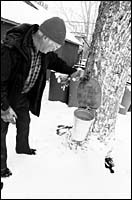
runoff in one of his trees.
It’s a sign of spring many New Englanders don’t expect to see in Rhode Island, but the number of sap-catching buckets hanging from trees in rural areas throughout the state is growing.
There are only four maple syrup farms that have officially registered with the state’s Department of Environ-mental Management, but those in the industry know this is one trade that’s hard to track because for many operations it is less about being a business, and more about furthering a hobby.
"It’s not very well known that you can even make maple syrup in Rhode Island," said Gibby Fountain, who runs the Spring Hill Sugarhouse in Richmond. "I think that we are up to 12 people that are making it now. It’s definitely a smaller scale when you consider other New England states, but it seems to be growing. Basically what this is, is a hobby that has grown into a business, though I still consider it a hobby because in Rhode Island (you) wouldn’t be able to make a living at it."
Building a Strong Data Foundation in the Age of AI
Artificial intelligence (AI) has become a key priority in the boardroom and across management —…
Learn More
Fountain is retired, but his sugarhouse has become more than just a hobby for him.
One reason you can’t make a living making maple sugar in Rhode Island is that the state lacks a major source of maple syrup – the sugar maple tree.
"We definitely don’t have the volume of trees that other New England states have," said Ken Ayars, chief of the division of Agriculture at the Rhode Island Department of Environmental Management. "In places like Vermont you have farms that spread over 1,000 acres. You just don’t have that here."
What local syrup farmers do have is a sense of camaraderie.
"When I wanted to expand my business last year, all I had to do was knock on doors," said Charlie Chase owner of Charlie’s Sugarhouse in Coventry. "We use all sugar maples. All of our trees are rented from other people. I just knock on their door and ask, sometimes they say no, but most of the time they don’t mind."
Fountain agreed.
"We have trees within a 10-mile radius of our farm," he said. "They are on nearby farms, in neighborhoods. People don’t seem to mind. Many just want a little maple syrup in return."
Fountain has also started garnering sap from a different type of tree – the Norway maple. While the sugar maple is ideal because for every 40 gallons of sap comes one gallon of syrup, he said, the Norway is the next best thing in Rhode Island producing one gallon of syrup from 60 gallons of sap.
"There aren’t enough trees to just use the sugar maples," he said. "It has a different flavor. Most people like the flavor because we do have some sugar maples that we blend with the Norway. It’s nice."
Chase, who is a sales representative for Polar Beverages in Rhode Island, vividly remembers boiling his first batch of maple syrup.
"It was for a 4-H project," he said. "My father and I tapped a tree in the front yard and boiled it on the kitchen stove. I remember because it boiled over and my mother was really angry."
The following year he and his father tapped a few more trees and moved their boiling operations outside to an open hearth. By high school he had tapped more than 200 trees from which he would continue extracting sap for the next 15 years.
Two years ago he grew again.
"Once my dad and I started outside, every year it just got bigger and bigger," he said. "After high school I started doing it on bigger scale. Then a few years ago after my wife complained that the business wasn’t making any money, I got bigger again."
But finding sap and making syrup isn’t as easy as some other hobbies. Each year’s crop is dependent on two things – the trees and the weather, neither of which is easily controlled.
"We don’t have good sap weather," Chase said. "We need warm days and below freezing nights. That doesn’t always happen."
In fact this year has been one of the worst in recent history.
"It appears as though it’s going to be a poor year," Fountain said. "We tap 1,000 trees every years, and should make a quart of syrup per sap per season. But we just haven’t had the temperature ranges that we need."
What both Chase and Fountain need are 20-degree nights, and 45-degree days where the sunshine warms the trees. So far this year, they have been rare.
"The tap holes are actually drying up," Chase said. "We have been compensating by putting out more buckets in early February, but they are drying up fast."
Fountain agreed.
"There is no record that we have ever had a drought like this during the tapping season," he said. "Because of this year’s warm winter we started tapping in January, earlier than we ever had before. But it’s hard to know what will happen."
For these hobbyists turned businessmen, it’s just another drop in the bucket.
"This is a novelty," Chase said. "A lot of people do this as a backyard hobby So do I. The idea is the same. It’s matter of scale."