In many ways, it’s been business as usual for Christopher Sanford.
Solving front-line problems at work and in the military is second nature for the U.S. Navy veteran and reservist.
From helping people recover from the Rhode Island floods of 2010 as the owner of a PuroClean Disaster Restoration Services LLC franchise in Warwick to serving as a reservist deployed to Uganda in 2011, to now dealing with the effects of a pandemic, Sanford has powered through.
In other ways, however, leading his business and his employees through the coronavirus crisis has been complex, including jostling with other businesses for a piece of the $349 billion Paycheck Protection Program.
“It’s definitely something that no one could have anticipated,” Sanford said of the crushing blow to the economy.
His focus has been somewhat divided: Business was down 10% between January and April for Sanford’s Puroclean franchise, compared with the same period a year earlier. Meanwhile, as the chairman of Employer Support for the Guard and Reserve in Rhode Island, Sanford has been trying to ensure that National Guardsmen activated as part of the pandemic fight will still have their civilian job when the danger passes.
So far, Sanford, 42, has not only been able to keep his 10 employees on payroll, he’s been able to hire an additional worker.
‘It’s definitely something that no one could have anticipated.’
CHRISTOPHER SANFORD, PuroClean Disaster Restoration Services LLC franchise owner
That’s thanks, in part, to a Paycheck Protection Program loan Puroclean received with the help of the company’s bank, Bank Rhode Island. The U.S Small Business Administration program, part of the $2 trillion federal stimulus approved in March, has been offering loans of up to $10 million to small businesses with fewer than 500 employees. The loans are forgivable if companies meet certain guidelines.
Lisa Ducharme, executive director of the New England Veterans Chamber of Commerce, said Sanford’s experience highlights the importance of veteran-owned businesses developing a strong relationship with a bank when the venture is launched.
Many businesses were initially left out of the Paycheck Protection Program because they lacked a long-standing relationship with a lending institution. In the rush to get applications to the SBA, many banks prioritized established business customers.
For inexperienced business owners who are veterans, Ducharme said, a relationship with a bank means more than opening a checking account. If a loan is needed, the bank’s familiarity with the business can make a big difference, as it did with applying for PPP help, she said.
In Sanford’s case, he built connections with BankRI when he opened his franchise in October 2007, opening a line of credit with the Providence-based bank. And it paid off when vying for PPP aid.
“I think they really went to bat for us,” Sanford said of the bank. “[The PPP loan has] been a nice cushion for us and a backstop for us.”
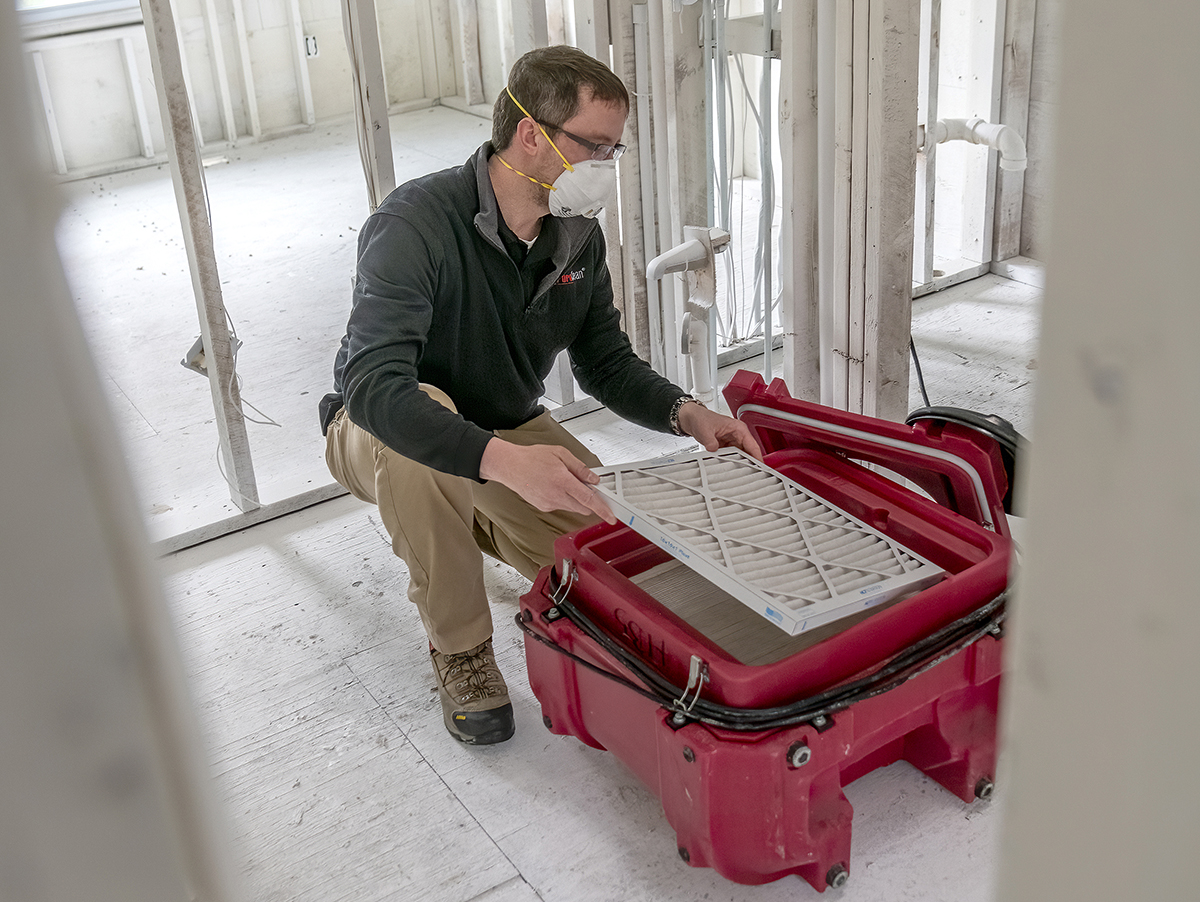
Some PuroClean employees are on the front line of the pandemic, providing deep cleaning, sanitizing and disinfecting services for businesses, institutions and residences. PuroClean was recently awarded a municipal contract to clean and disinfect a public housing complex comprising six buildings with multiple floors.
Sanford’s background and military training have helped him deal with the crisis.
He graduated from the College of the Holy Cross in 2000 and enlisted in the Navy, serving seven years as an anti-submarine warfare division head and as weapons department head aboard the destroyer USS Pinckney.
Since 2007, he has served in the Naval Reserves. While earning his MBA at the University of Rhode Island from 2007 to 2009, a discussion with a professor led him to decide to become a franchise owner. He excelled at disaster restoration, in part, because it had similarities to his military service: Every day is different.
Except now he’s fighting against water and fire damage, mold and other biohazards.
“We never know what kind of call we’ll walk into,” said Sanford, whose franchise was named Rhode Island and New England veteran-owned small business of the year in 2019 by the SBA.
The needs of a particular cleanup dictate when it will be handled during the coronavirus, Sanford said. Coronavirus cleanups have opened Sanford’s eyes to consider adding more restoration work to his company’s services. For now, priorities are set so that properties deemed the most crucial to act on are swiftly completed.
Some employees continue to work at job sites around Rhode Island, while others in marketing, sales and accounting, including the company’s comptroller, are working remotely.
Donning masks may be unusual for others during the pandemic, but not for disaster-restoration workers. “We wear personal protective equipment – that’s been part and parcel of what we do,” Sanford said.
Still, Sanford knows there’s some anxiety about continuing to work despite the possibility of exposure.
“They’re anxious; their families are anxious, it’s what’s expected,” he said. “I’m taking it in stride.”