Isabella China is slim and petite like her mom, and a little shy. Six years after immigrating from Peru, she’s fluent in English and is comfortable speaking with the doctor who’s doing her annual exam this late-summer afternoon at St. Joseph Hospital’s pediatric clinic.
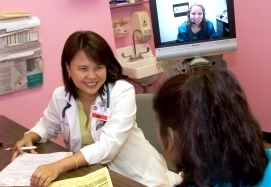
But at 13, she’s not quite ready to go through a checkup by herself. Her mom, Luisa China, sits close to her in the bright-pink examination room, just outside the privacy curtain, and Dr. Carolina Cerezo talks with them both at once, as she does with all her patients and their parents.
Selling Luxury Real Estate Requires More Than Exposure
By Emilio DiSpirito IV License Partner | Private Office Advisor Engel & Völkers Oceanside www.DiSpiritoteam.com…
Learn More
Luisa China doesn’t speak English, and Cerezo’s Spanish is limited. Yet with the help of interpreter Ana Marin, they communicate seamlessly, going over everything from Isabella’s weight to the immunizations she’ll get today to those delicate subjects you must bring up with teens: sex, drinking, smoking, drugs.
As Rhode Island’s immigrant populations have grown, health care providers have come to depend on interpreters like Marin to help them exchange crucial information with patients and their families. Many have interpreters on staff, and others rely on third-party services.
Now Neighborhood Health Plan of Rhode Island – the state’s largest HMO covering Medicaid beneficiaries – is trying a new approach: video conference interpreting.
Unlike her colleagues, Marin isn’t at the bedside, but back at Neighborhood Health. When a patient needs her, she puts on her headset, faces the camera, and comes up on monitor in the examination room. On a busy day, she’ll help as many as seven patients from her desk.
Neighborhood Health, which spent just more than $50,000 to install two Videre video conference systems at partner sites – St. Joseph’s pediatric clinic and the Women’s Primary Care Center at Women & Infants Hospital – isn’t the first to use such technology for medical interpreting. Hospitals across the country have done it, said Lisa D. Kirschenbaum, manager of the project.
But Neighborhood, the first health insurer in Rhode Island to cover interpreting services, is also the first insurer to set up a remote interpreter program.
Financed by a federal grant, the health plan’s video interpreting project is part of the larger “Su Salud” initiative, which aims to overcome the language barriers that hinder immigrants’ access to health care.
Across the United States, more than 22 million people have limited English proficiency, according to the 2000 U.S. Census, and their number is rising. When they seek medical care, many studies and reports have shown, the language barriers and the common reliance on children and bystanders to interpret can result in serious medical errors.
That’s what first led Neighborhood– which has thousands of non-English speakers among its 75,500 members – both to cover interpreting services and to work to increase the number of trained interpreters in the state. In part through the health plan’s advocacy, Rhode Island has come to be a leader in this area, not only covering interpreting services through Medicaid, but also requiring, per a 2001 law, that hospitals make interpreters available to patients whenever needed, at no additional cost.
Since 2002, Neighborhood has been part of an initiative funded by the Robert Wood Johnson Foundation, “Hablamos Juntos,” that focuses on bridging language gaps. Last year, U.S. Sen. Jack Reed helped the company obtain a $245,500 federal grant to explore technological approaches to the issue. Part of that grant was used for hand-held translation devices called “Phraselators.” Another part went to video interpreting.
“We view our role as really trying to improve health care access and health care quality for the members we serve, and really, for the whole community,” said Neighborhood Health CEO Mark Reynolds, “so this very much aligns with the work we try to do.”
The program went live in March, after extensive training and preparations with Marin – a seven-year veteran of medical interpreting – and the staff at St. Joseph’s pediatric clinic.
For the South Providence hospital, it was a big leap, cushioned by a measure of familiarity: Marin used to work there, so everyone knew her. The hospital already had some experience with video conferencing through its dental residency program, which uses the technology to provide coursework for the residents. And St. Joseph also has worked with Neighborhood on other language-related initiatives.
Christine Vallee, administrative director of the St. Joseph Center for Health and Human Services, said the hospital has tried to find innovative ways to serve its increasingly diverse patient base. St. Joseph has several interpreters on staff, as well as bilingual doctors, nurses and clerical employees, she said, but for the pediatric clinic, which couldn’t quite support a full-time interpreter, this is a great alternative.
Dr. Cerezo said about 90 percent of her patients are Spanish speakers, and of those, about one-third need an interpreter – often for the parent, not the child. Before the Neighborhood Health program started, the clinic had to request an interpreter from the hospital and then wait, she said. With Marin, if she’s available, she’s on immediately, so the clinic runs more smoothly and on schedule.
The clinic books Marin in advance, to the extent possible, and prepares patients and their families by giving them a pamphlet that explains how the video system works. Vallee said she’d expected some bumps at first, but patients embraced the program right away.
The children love it, Cerezo said.
“They’re just fascinated,” she said. “They feel that it’s a cool thing. And I’ve never seen anybody who says, ‘I’d rather have a real person.’ ”
Asked how they liked the setup, Isabella and Luisa China said it was as good as an in-the-flesh interpreter. “It’s almost the same, because you can hear her voice clearly,” China said.
In late May, Neighborhood Health added a second site to the pilot program, Women & Infants’ neonatal intensive-care unit.
The idea was to make Marin available for family conferences and discharge planning, said Renee Neri, the hospital’s director of community medical services.
It wasn’t a good fit, Neri said; in that kind of setting, you too often need the interpreter at the bedside. (Marin said she feels the same way about urgent-care facilities and emergency rooms.)
But after some discussion, the video conferencing machine was moved to the Women’s Primary Care Center, where Neri said it’s being used mostly by the nutrition staff.
“We learned a lesson, and we now feel that we have a good fit for the project,” Neri said. “It just seems to be very well received by both the staff and the patients.”
Just months into the project, both Neighborhood Health and the two partner sites are still very much in pilot mode, tracking patient and provider satisfaction and looking at ways to improve the service. But the results are promising – as of Aug. 31, the insurer had fulfilled more than 475 requests for video interpreting, and “we’ve never had a negative comment or a refusal,” Kirschenbaum said.
Vallee, at St. Joseph Hospital, sees the experiment as the beginning of something much bigger.
“What we hope is to be able to demonstrate to other health insurance companies that this is an important service for their members,” she said. “This is a model that could be replicated.”