As lawyer Keith Kyle listened to a presentation, the iPhone in his sport-jacket pocket vibrated and buzzed softly as client e-mails streamed in. Kyle slipped out the phone and fired off a few responses before returning his attention to speaker and fellow lawyer Ross Kodner, who was discussing the very thing Kyle was putting into practice: How the proliferation of smart phones and ubiquitous high-speed Internet connections provide an opportunity to work from virtually anywhere and stay on the clock longer.
That, of course, translates into more billable hours for an industry that typically charges by the hour.
“You fritter away, probably hemorrhage away, a lot of little bits of time every day,” Kodner told a room of lawyers at the Rhode Island Bar Association’s annual meeting in early June.
Kodner, who owns Milwaukee-based consulting business MicroLaw, said lawyers that use smart phones and laptop cards that connect to cell phone Internet networks capture an extra 15 to 30 minutes of billable time every day. At going rates, his clients have earned an additional $17,500 to $35,000 a year. For large law firms the total can top $3.5 million annually.
“The reality is these tools will pay for themselves,” Kodner said, heading off criticism that technology carries a large price tag.
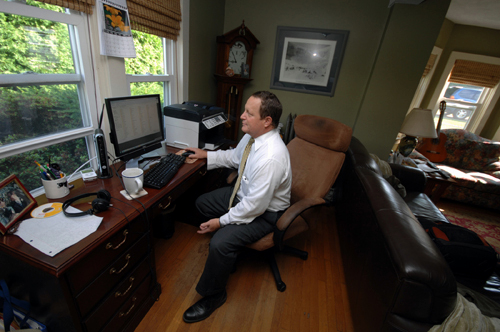
Kyle’s office, Houlihan, Managhan & Kyle, decided a few years ago to digitize its case files, allowing lawyers to pull up records from any computer in the world with an Internet connection. Kyle recently purchased a new Dell computer with hardware that provides a speedier connection to the Newport office than his old computer. Earlier this month he turned on the connection to work on cases while waiting for a building inspector to come to his Narragansett home. It was billable time that otherwise would have been lost.
“I think this is a bellwether of things to come,” Kodner said.
About 60 lawyers thought so too, or at least enough to turn out for the presentation at the R.I. Convention Center. They selected the talk over other topics offered at the same time, including those dealing with spinal injuries, collection remedies and depositions.
“Everybody is looking at a way to generate more revenue without putting in more time,” said Providence lawyer Peter Lacouture, who invited Kodner to speak.
Lacouture, who chairs the bar association’s technology committee, said such presentations serve as a way to introduce lawyers to business concepts not taught in law school. Personally Lacouture, a lawyer at Robinson & Cole, uses his home computer to access files at the Providence office in a pinch. It avoids the need for him to travel to Providence from his Exeter home to handle an emergency situation that may only take a few minutes.
Besides being more efficient, such setups improve quality of life said Kyle, the iPhone owner. Kyle said he can spend more time with his wife and two children by using his home computer to access thousands of pages of case information that would require a moving van to take home with him.
“If you don’t respond immediately the client wonders what happened,” Lacouture said.
That leads to an interesting dilemma for lawyers on vacation or at home when their phones buzz to announce the arrival of e-mail from a client. The very technology billed as improving quality of life can quickly overtake it.
Kyle said even though he officially took time off from work the day of the presentation, he felt the need to reply to the e-mails streaming into his iPhone. In the past, he’s considered setting up an automated reply but dropped the idea after speculating most e-mailers would simply ignore it and keep sending e-mails.
The only time Kyle finds himself away from the office, both physically and virtually, is when he vacations in Costa Rica to surf with fellow lawyers. The small village has no high-speed Internet connection or cell phone reception. He has to drive at least 40 minutes to find any high-speed connection to the virtual highway.
And even Kodner, who makes a living selling technology to lawyers, says there should be limits. He encourages lawyers to teach clients that just as they maintain physical office hours, so too do they maintain virtual hours. Lacouture took the advice to heart, setting his phone to automatically turn off between the hours of 11 p.m. and 6 a.m. •