You had to wonder, back in the spring of 2000, if city and state officials, along with the folks at the Veterans Memorial Auditorium knew what they were doing. But there they were, holding a full-fledged press conference to announce that Brownell Street, a short, crooked street running in front of the entrance to the auditorium, would henceforth be called the “Avenue of the Arts.”
It was a bold move, to say the least. Some might have seen it as over the top. Even, silly. After all, the neighboring Masonic Temple remained a dark and dormant shell.
Building a Strong Data Foundation in the Age of AI
Artificial intelligence (AI) has become a key priority in the boardroom and across management —…
Learn More
Yes, the Masonic Temple – where the story of yet another chapter of the Providence renaissance begins.
It is inarguably a part of Rhode Island lore – that unfinished Masonic Temple and its neighbor, the adjacent Veterans Memorial Auditorium.
Designed by the renowned architectural firm of Osgood & Osgood, the Masonic Temple was an ambitious project. But the Great Depression brought it to a stunning halt, with the Rhode Island Freemasons walking away from it in 1929. The project lay still until the mid-1940s, when the state took over the property. With the end of World War II came a groundswell of community support for a civic auditorium. By January 1950, Gov. John O. Pastore was presiding over the opening of a portion of the project, the Veterans Memorial Auditorium.
For three decades, the Veterans Memorial Auditorium served as the state’s original performing arts center. An impressive and diverse collection of performers graced its stage. Classical artists such as Luciano Pavarotti and Rudolph Nureyev, as well as folk and rock legends like The Doors, Van Morrison and Joan Baez all entertained crowds there.
But the economy delivered another blow to the auditorium and during the mid 1980s it was closed for several years. By 1990, it reopened.
Throughout the 1990s, there was action both on the Veterans Memorial Auditorium stage – and behind the scenes. The state-owned property was privatized, with a not-for-profit organization taking over the operation of the theater. In 1996, the Veterans Memorial Auditorium expanded its mission and formally became the Veterans Memorial Auditorium (VMA) Arts & Cultural Center.
That brings us to that afternoon in the spring of 2000. Now, just a few years later, renaming Brownell Street the “Avenue of the Arts” doesn’t seem so silly after all. In fact, if you have seen the plans for what it will look like by about this time next year, it makes perfect sense.
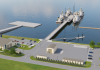
In the summer of 2006, the VMA will debut a new plaza across from the entrance to the auditorium, right there on the “Avenue of the Arts.” It will feature new sidewalks, streetlights, plantings and dramatic views of the State House.
There are big changes now under way – inside the VMA, as well. Already, a new curtain with rich tones of deep plum and antique gold adorns the historic Proscenium stage. By this fall, the theater’s existing seats will have been refurbished and new aisle space and carpeting will have been added. Also, thanks to the generosity of the Champlin Foundations, a new lobby elevator will be installed, providing accessibility to all three of the theater’s floors.
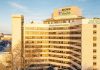
And along with the opening of the new plaza next summer comes the biggest news of all – the long-anticipated opening of the Renaissance Hotel. On the outside of the Masonic Temple, you have seen the work of the developer of the hotel project, Sage Hospitality. But inside the structure and below the adjacent VMA, workers are also busy at work in uniting the structures and refurbishing the lower level ballroom that will cater to hotel functions.
“The hotel’s niche – at least in part – will be that it is attached to a thriving arts and cultural center,” said Tereann Greenwood, executive director of the VMA.
Greenwood and the folks at the VMA are busy these days. In addition to all of the work being done to refurbish the theater, they’re busy attracting tenants to lease out commercial space opening up on four of the building’s six floors. Next door to Providence Place and sitting alongside Route 95, it’s an attractive location.
“It will be an arc of 80 years from when the Masons walked away and the hotel doors open,” said Greenwood.
And to think of how much will have been accomplished in just the last few.