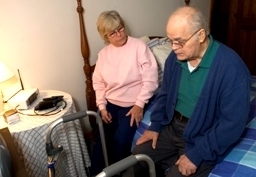
Mary Ann Patry has been caring for her husband, Paul, at home since June as he recovers from a stroke. Above, she prepares to test his vital signs with a HomMed monitor provided by the VNA of Rhode Island.
Paul Patry is on a long, hard road to recovery. Last February, after undergoing a cardiac catheterization and heart-valve replacement, he suffered a stroke.
He was kept in an induced coma for two weeks; when he emerged, he could barely speak and couldn’t sit up. He had night terrors and a deep sense of dread.
For Leaders Who Don't Have Time to Get Sick
Top performers guard their calendars, delegate relentlessly and optimize every hour of the day. Health,…
Learn More
Even after he was moved to a rehabilitation hospital, then a nursing home, he struggled to regain his speech, his strength and his muscle control. His legs felt like matchsticks holding an endlessly heavy, unwieldy body.
He never thought he’d make it home, but in June his wife, Mary Ann Patry, decided to give it a try. It was nerve-racking – they live in the woods in Chepachet, off a narrow, winding road, and all she knew about health care was what she’d learned by watching her husband’s nurses.
But at home, she knew, he’d do better: “He was relaxed when he came home. He felt safe.”
Paul Patry, 62, was in such a precarious situation, even four months into his recovery, that it would have been easy for him to end up back in the hospital. Along with the effects of the stroke, he’s battling high blood pressure and diabetes. Plus, he’s a lymphoma survivor.
Yet since June, Patry has not been hospitalized once. What’s made that possible, said his wife, is the help they’ve received from the VNA of Rhode Island, which not only sends a nurse, Maureen Ryan, to visit weekly, but also keeps tabs on her husband through a remote monitor.
The device, called HomMed, looks like a big, white alarm-clock radio. And like an alarm clock, it goes off every morning – at 7 o’clock sharp – to remind them it’s time to check Patry’s vital signs.
A recorded female voice instructs him to step on a scale, to check his weight. Then it provides instructions on how to check his blood pressure, his heart rate and his blood oxygen. Finally, it asks questions tailored to his situation: Is he having trouble breathing? Are his ankles more swollen than usual? To reply, Mary Ann Patry has to push a “yes” or “no” button.
She records all the data on a piece of paper, but the monitor also sends the information to the VNA’s office in Lincoln, where a supervisor reviews everything. If any vital signs are abnormal, she will call to follow up, maybe ask for a second test a few hours later. If needed, she’ll fax the data to her husband’s doctor, so he can adjust his treatment regimen.
The VNA has been using the monitors for about two years, said Mary Linn Hamilton, president and CEO of the agency, Rhode Island’s oldest visiting nurse association, which cares for about 550 to 600 patients at any given time, many of them elderly.
Hamilton said the VNA’s typical patients are well enough to not require around-the-clock nursing care, but sick enough to require actual nursing – not just help with daily activities such as bathing, eating and getting around their homes.
Patricia Fleming, the VNA’s chief clinical officer, said the cost of care varies, depending on the level of services – the number of visits per week, therapies provided, etc. – but an average 60-day episode of care costs about $2,300, which is almost always covered by Medicare or private insurers.
That’s a fraction of the cost of hospitalization or nursing home care – but money is only one of the reasons why home-based care is worthwhile, experts say.
“There are huge issues with transitions,” said Dr. Lynn McNicoll, a gerontologist at the University Medicine Foundation in Providence and a professor at Brown University School of Medicine. Every time a patient is hospitalized, his or her medications are changed, and the opportunities for errors increase, McNicoll said. There also can be complications, such as pressure ulcers. While at home, a patient is more inclined to move around, she added, whereas in the hospital, “they tend to be kept in bed, so they get deconditioned.”
There’s also a much higher risk with hospital care that a patient will become agitated and even delirious, requiring more medications. “So we try as much as possible to avoid getting patients into the hospital, not just for the cost but for the burden to the patient.”
Visiting nurses are not appropriate for all patients, McNicoll said, but they can make a big difference for many, and help keep patients at home.
“When you’re monitoring patients at home closely, such as with the technology the VNA is trying to use, it’s a great merger of practical patient care and technology,” she said.
For the VNA of Rhode Island, the HomMed monitors are part of a broader effort to reduce hospitalization rates that also includes educating patients and their families and providing 24/7 access to expert advice, Fleming said.
The results have been substantial: While from January to November of 2000, 26.5 percent of the VNA’s patients required urgent, unplanned medical care, and 27.3 percent were admitted to a hospital, in the last reporting period, March 2005 through February 2006, the rates were 18 percent and 16 percent, respectively, earning the VNA a three-diamond rating from the state.
Those rates have held steady now for three years (the urgent-care rate is the more typical of the two), while all other visiting nurse services in the state have been reporting hospitalization rates in the 20s and 30s.
Fleming and Hamilton both credit the HomMed monitors – the VNA now has 68 of the devices – with helping to prevent many hospitalizations. One woman who had been hospitalized at least six times in three months managed to rest at home for a whole two months, Fleming said, “which was unheard-of for her.”
The VNA gives the monitors to patients at no extra charge – and Ryan, the nurse who tends to Paul Patry, said they greatly enhance the care of people with heart trouble, lung disease and other conditions that require close monitoring.
Patry appreciates his, he said, because it makes his wife visibly calmer and happier. That’s because she feels they’re always connected to someone who can help them, she said – and the monitor reassures her that her husband is OK.
“You want to know, from day to day, if you’re doing the right thing,” she said. “That’s what it did for me.”