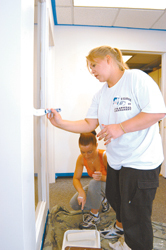
Edward Caron organized Rhode Island’s first Christmas in April a decade ago
after seeing how it unified Notre Dame University’s alumni. He wanted to do
the same for Providence College, where he is vice president for college relations
and planning. He invited students, faculty, staff and alumni, and a few businesses
with PC ties joined in.
He never imagined that 10 years later, well over 100 companies would be involved, with 2,500 volunteers working on 40 houses and community centers in a single day. The college has to limit student participation. And year after year, a good 95 percent of participating businesses return, always joined by some newcomers.
“Not even in our wildest dreams did we expect that to happen,” said Caron, who no longer runs the program, but remains closely involved.
ISO 9001:2026: A Practical Opportunity to Build for What’s Next
For Rhode Island manufacturers, ISO 9001 has been much more than a certificate on the…
Learn More
The impact has also defied expectations. In its first 10 years, Christmas in April – now called Rebuilding Together–Providence – provided nearly 116,000 volunteer hours and more than $4 million to complete major repairs at 311 private homes and nonprofits, affecting some 280,000 people directly and indirectly. The program has also grown nationally, from 35 agencies when Caron discovered it, to more than 250 affiliates now.
People’s kindness and generosity are clearly at the heart of this success. But Rebuilding Together has also thrived, Caron believes, because it’s good for Providence College and the participating companies.
Volunteering together builds personal relationships within organizations in ways that day-to-day work, or even traditional company outings, cannot do, Caron said.
“There’s a dynamic that happens when you put the lowest-ranking member of a corporate organization with one of the highest-ranking members, in the same ditch, digging the same hole,” he said. Hierarchies and corporate divisions fall by the wayside, and young and old, managers and staff, find common ground. “It’s hard to explain, but it’s absolutely real. They leave that day and their relationship is never the same.”
That insight isn’t lost on businesses across the United States and beyond. For large companies especially, volunteerism has become a key part of the corporate culture, the main way in which employees connect with one another outside the office.
At Blue Cross & Blue Shield of Rhode Island, for example, 778 employees – just over half the staff – were involved last year in the company’s “Blue Angels” volunteer programs, said Linda Newton, vice president for community relations. They gave more than 4,100 hours, she said, to Rebuilding Together, the Rhode Island Community Food Bank, the West Broadway Elementary School, and many other programs.
Fidelity Investments, which employs about 1,600 people in Rhode Island, is also deeply involved in volunteerism, from the Fidelity Investments MS150 Bike Tour – to support multiple sclerosis research and services – to school programs, the American Heart Association’s Heart Walk, cleaning historical cemeteries, and WaterFire.
Holly Jensen, who coordinates Fidelity’s volunteer programs, said volunteerism is an important part of the company’s effort to be a “good corporate citizen.” But it also has clear benefits: “It benefits the individual employee, because he or she can learn new skills. It’s networking, an opportunity to meet other people. It makes them feel good about the company, and it makes them feel they are contributing to the community.”
“It definitely improves employee morale,” Jensen added. “It fosters team spirit. And it gives us a human face. It makes people understand who we are and what we do.”
Jill Bonner, a copywriter and editor for Blue Cross, said volunteering has given the large company “more of a human feeling.” It has also greatly extended her connections, she said. While at regular functions, “you tend to sit with people you know,” at volunteer projects she always meets new people. After bonding and laughing together, it’s much easier to ask them for help at work. “I can call and not feel like I’m just approaching them out of the blue,” she said.
National surveys have shown companies credit volunteer programs with helping to attract and retain good employees, improving morale and employee loyalty, promoting innovation, and boosting individuals’ self-confidence. A British study also showed links to key professional-development goals such as improved organizational and time-management skills, better “people skills,” accountability, and leadership development.
Comprehensive figures on the number of employer-sponsored volunteer programs are not available, but a recent review by the Points of Light Foundation found that 47 of the Fortune 50 companies mentioned volunteerism on their Web sites. A sampling of 75 additional Fortune 500 companies found about 55 percent publicized such programs.
That fits with the experience of Kelly Nevins, executive director of the Volunteer Center of Rhode Island, which helps individuals and companies connect with agencies that need volunteers. The same names tend to come up year after year, Nevins said: major corporations, the big banks, Hasbro, Target.
“What I see is, it’s typically the same companies, your bigger companies, that are really pushing volunteerism to their employees,” she said. “The smaller companies, maybe they don’t have an interest, or they’re just trying to keep their heads above water. Whatever it is, we don’t see a lot of small businesses.”
Which is why Nevins and her team were thrilled when Koch Eye Associates asked for help to organize a volunteer day last year to honor the late Dr. Peter Koch, the company’s founder and father of the owners.
The second annual “Koch Eye Cares Day” was held on July 29. The business shut down so its 135 employees could volunteer for the day at 24 nonprofits statewide.
“They made a real commitment to do this,” said Nevins. “That’s why Koch Eye
Associates is so cool.”