Juli and Scott Chapin set out to solve a nagging problem with her wedding cake business, but the solution eventually turned into a solid venture in its own right when the couple realized many other bakers had the same conundrum of transporting intricate, multitiered cakes to their destinations without damage.
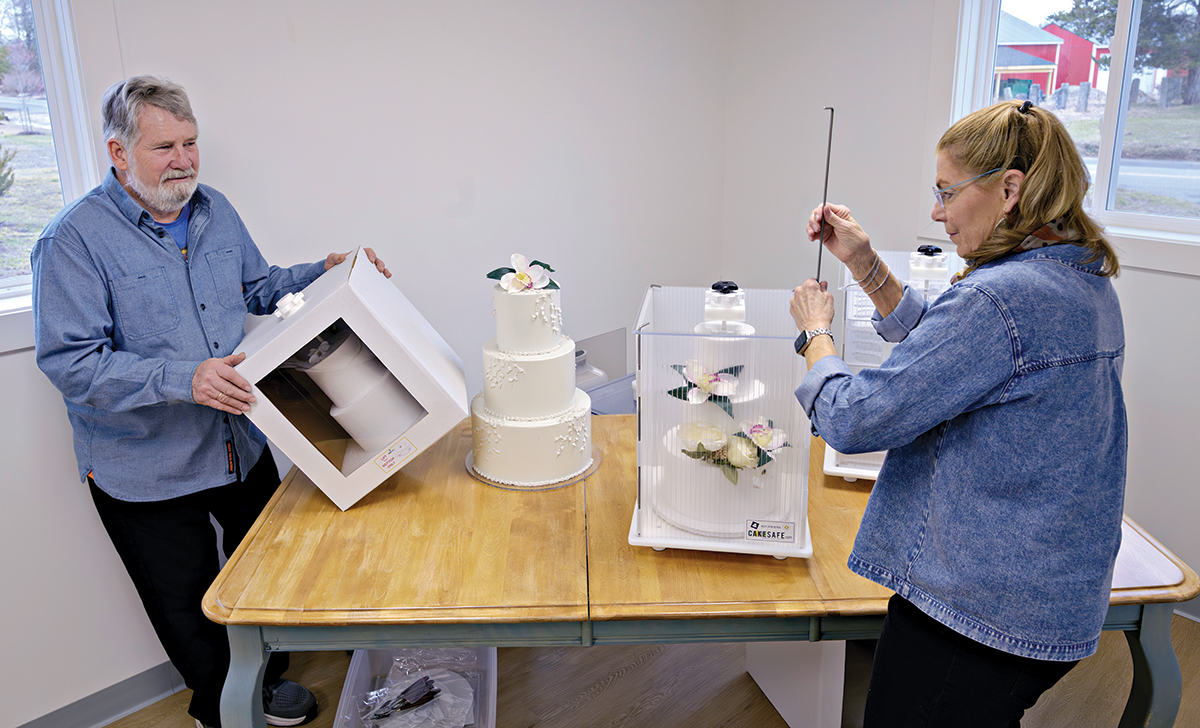
That’s what led to the creation of CakeSafe LLC, a family-owned South Kingstown manufacturer producing hundreds of specially designed boxes each year that the Chapins say can protect a cake from bumps, tipping and the potentially devastating effects of slammed brakes, in part, because of a stainless steel center dowel that runs through the cake.
“We know we are not creating world peace. But for people who move a cake, we solve a very real problem,” said Juli Chapin. “It’s not just a stress reducer.”
Still, the company was a while in the making.
The Chapins met in 1983 after Juli Chapin relocated to Rhode Island to attend Johnson & Wales University’s world-renowned culinary program. Then, after graduating and launching a wedding cake business in 1986, she discovered the logistical nightmare of transporting large cakes and how a catastrophe can be a simple misstep away.
Scott Chapin was employed as a biomedical engineer at the time and developed the first CakeSafe in 1989. “My initial goal was just to keep her happy,” Chapin said of his wife.
[caption id="attachment_519281" align="aligncenter" width="1200"]

LINING UP: Michael Brophy, foreground, head of production at CakeSafe LLC in South Kingstown, works on the computer numeric control router. He is accompanied by co-owners Juli and Scott Chapin.
PBN PHOTO/MICHAEL SALERNO[/caption]
It took the couple two decades before they officially marketed CakeSafe. After he was laid off by his engineering firm, Scott Chapin began to promote the product and other inventions that he had developed to help the baking business.
Their ambitions were modest at the time. At the start in 2009, Scott Chapin would cold call bakers throughout the country and offer a free CakeSafe.
“In the beginning, I just gave them away. Nobody knew what it was and nobody knew how it worked,” he said.
One baker from North Carolina seemed interested but then declined, saying he would find a better product elsewhere.
“Two years later, we are at a trade show, and he walks up to me,” Scott Chapin recalled. “I had no idea who he was. But he apologized and said that since using CakeSafe, he had doubled his revenues in a single year.”
In 2018, the company had grown enough to move into a commercial space equipped for manufacturing and shipping, and expanded its headquarters two years later.
Before CakeSafe, transported cakes – which can run several hundred dollars or more in the case of wedding cakes – were traditionally boxed in flimsy cardboard, and bakers used interior dowels that often failed if the cake slid or tipped. That method is still used.
In contrast, reusable CakeSafe products are made of double-walled, food-grade polycarbonate sides for insulation, a high-density plastic base, a Plexiglas top and a stainless steel dowel. The largest “safes” measure nearly 2 feet wide and deep, and 2 feet, 4 inches high.
With eight employees, the CakeSafe product line now includes acrylic discs that simplify the process of evenly icing the sides of cakes, frosting tools and a patented spray booth with filtration for bakers who use an airbrush to apply decorations such as chocolate.
The Chapins say the response to their products from bakers and food decorators has exceeded their expectations. Cakes have made successful drives across the country and flights to Europe, they said.
“You can literally tip it on its side, and it doesn’t go anywhere,” Juli Chapin said.
[caption id="attachment_519280" align="aligncenter" width="1200"]

READY TO GO: Patrick Carrigan prepares to ship several CakeSafe LLC products. The company produces specially designed boxes to protect cakes during transit.
PBN PHOTO/MICHAEL SALERNO[/caption]
While they declined to disclose annual revenue, the Chapins said they sold 15,000 total units and roughly 500 CakeSafes last year.
Utilizing two computer numerical control machines, workers can churn out products efficiently and as mass-produced as possible for a small operation. Scott Chapin said it takes four months for new workers to be fully trained.
“We can run a program that makes 15 bases,” he said. “You put down a full sheet [of plastic], and the machine will go and cut out everything.”
There are certainly imitators. When a Chinese-based knockoff appeared online, the Chapins purchased one to see how it compared. It was flimsy and useless, they concluded.
Although it employs a full-time marketer, CakeSafe has so far eschewed traditional advertising, but the Chapins said they would like to do more advertising to get the word out.
“For me, it’s still frustrating that we have so many people who have never heard of us,” Juli Chapin said. “For brides to be more aware that it ensures the safety of that part of their wedding day.”
A sizable percentage of its customer base is independent home bakers. The biggest challenge lately is the skittishness of consumers.
“People are afraid of what the economy is going to do tomorrow. They are tightening their belts and not spending money,” Scott Chapin said. “We are in the retail business.”
With retail prices ranging from $199 to $735, the latest product line addition is a cardboard-based box that is more economically feasible at about $60, which is helpful in today’s uncertain economic times.
“We wanted to get something in people’s hands for less than $100,” Juli Chapin said.
Rather than traveling to a site and constructing the cake tier by tier inside a venue, and paying money for transportation back and forth, Scott Chapin said the goal now is to get as many bakers and decorators as possible to understand that CakeSafe can be a transformative capital expense.
“Bakeries can really expand their business and increase profitability,” he said.