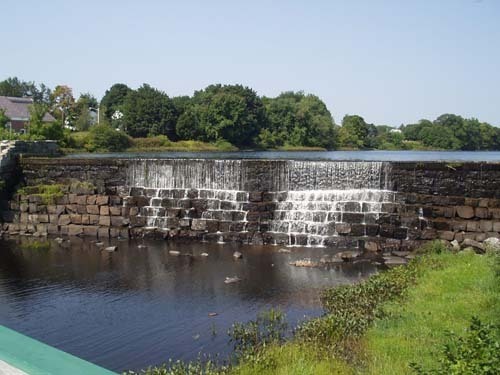
With 674 dams to inspect throughout the state, Paul Guglielmino, the R.I. Department of Environmental Management’s only dam inspector, is busy – too overworked to properly check them all.
That’s why the DEM on Dec. 20 put in place regulations that will change the way those dams are inspected. Now, for the first time, most will be inspected by private and municipal owners.
Guglielmino will continue to inspect 210 dams. Those include the “high-hazard” dams – to be inspected every two years because a failure would likely result in loss of human life. Every five years, he’ll also inspect “significant-hazard” dams – where a failure could cause major economic loss but would not be likely to result in loss of life.
Many of the dams in those two categories have not been properly maintained through the years, the DEM said in announcing the new regulations.
Inspection of “low-hazard” dams, along with the high- and significant-hazard dams that Guglielmino doesn’t have time to inspect, will now be the responsibility of the owners, who can hire consulting firms for about $3,000.
“We haven’t set the exact schedule yet, but I’m going to do what I can and then require the owners hire their own inspectors if the state can’t do them,” Guglielmino said recently.
The new regulations will allow all dams to be inspected on a timetable, said David Chopy, supervisor of the DEM Compliance and Inspection Office. Until now, the annual report listings – for dams inspected during that year – have been the only guide to “poor-condition” dams, Guglielmino said. But the regulations will allow the DEM to keep a more current and comprehensive list of all conditions.
In Coventry, there are 42 dams, four or which are owned by the town, said Public Works Director Sheila Barrett. Because the town doesn’t have an inspector, it will hire a consulting firm, which will be a new burden for taxpayers, she said. “This is something that has come into effect during our fiscal year,” Barrett said. “So this isn’t something we knew when we were preparing our budget last year. We’ll have to find out what it will cost and budget for it next year.”
Putting the regulations into place has actually been a lengthy process – the state has been working toward their implementation since 1998, said Chopy.
On the morning of Feb. 18, 1998, about 2.7 inches of rain fell in South Kingstown, according to National Oceanographic and Atmospheric Administration data. The rain caused a breach in California Jim’s Pond Dam, spilling water into Peace Dale village and damaging Route 108. That flooding caused $400,000 in damage – including $325,000 to town property – and prompted development of the statewide regulations.
A task force commissioned by then-Gov. Lincoln Almond met for six months, then released a report in 2000 with recommendations that proposed legislative changes that failed to win support due in part to concerns from dam owners.
Since then, DEM officials have worked on the new regulations, which were completed after multiple meetings with dam owners.
Because of California Jim’s Pond flooding, South Kingstown – with seven municipal dams – is already in compliance with the new regulations, said John Schock, the town director of public services. “I guess the concern that I have with the regulations is that with the three dams we’ve already reconstructed, the permitting process was extensive and exhaustive. The DEM needs to make the permitting process more streamlined.”
Permitting should include a categorical review, allowing renovations to move quickly if the dam meets certain criteria, Schock said. “And, the last I’ve checked, that isn’t being proposed by the state,” he said.
The new regulations will spur dam owners to take a look at neglected dams, but many of the state’s high-hazard dams are already well maintained. The Gainer Dam, at the base of the Scituate Reservoir, is the state’s largest and is in great condition, Guglielmino said.
In Lincoln, Guglielmino last year identified Lime Rock Dam as a high-hazard dam in poor condition and unsafe. The town, which accepted the earthen dam as part of a preservation land gift, has been working on engineering studies for almost a year, said Town Administrator T. Joseph Almond.
“Way back before the regulations, or any determinations, the town was given the property, including the dam,” Almond said. “So now the taxpayers are stuck with the classification of a high-hazard dam. So while we’re going ahead and doing what we have to do, we also feel like the town is being put in a very bad situation by the regulatory agencies.”
The renovation of that dam will cost the town between $1.5 million and $3 million, Almond said.
Some town tax rates might go up to cover dam inspections.
Guglielmino, for his part, isn’t expecting the state to hire another inspector to help him anytime soon.
He can inspect at least one dam per day – sometimes more if they are near each other.
According to 2006 statistics from the U.S. Association of Dam Safety Officials, Rhode Island’s dam-to-inspector ratio is worse than the national average. Nationally, each inspector is matched with an average of 354 dams. Even in states with similar dam counts, there is usually more than one inspector; Utah’s 667 dams are covered by six inspectors and Nevada’s 672 dams have two full-time inspectors, although both states are much larger in area than the Ocean State.
Guglielmino said those figures don’t necessarily mean Rhode Island is understaffed. “I don’t think that means necessarily that they inspect every one of those dams every year, or every two years,” Guglielmino said.
And there are states with ratios worse than Rhode Island. For the 3,325 dams in Iowa, there are only two inspectors.
The state DEM is in the process of inspecting and reconditioning the estimated 50 state-owned dams. The state-owned Curran Upper Reservoir, off Seven Mile Road in Cranston, is a high-hazard dam – with houses downstream – that’s in poor condition, Guglielmino said. The new regulations will allow the DEM to stay on top of such projects, he said.
But planners and engineers in South Kingstown, Coventry and Lincoln, all of whom must register their dams within 60 days, aren’t sure the regulations are an improvement.
“Now, there are 39 cities and towns responsible for all their dams, rather than one central agency,” Coventry’s Barrett said. “If cities and towns are capable of doing the inspections and the subsequent repair work, then it’s a good thing.” •