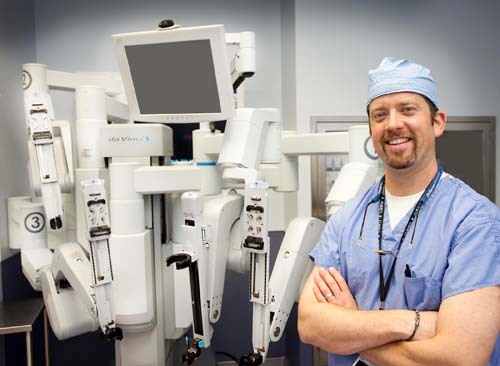
Most women will never experience it, but for those who do, gynecological surgery can be a pretty big deal. It’s deeply personal and intimate; their sexuality and ability to have children may be at stake. Plus, of course, their lives and their health.
This is why bringing a da Vinci Surgical System to Women & Infants Hospital is so valuable, said Dr. Christina Bandera: It will give women who need these procedures a far better alternative to open surgery, in a hospital built around their needs.
Bandera, a gynecological oncologist, is the director of Women & Infants’ new robotic-surgery program, which is slated to begin on a limited basis on April 26, and then fully in June.
It’s a big step up for Women & Infants, whose surgeons, especially Bandera, have been using a da Vinci system since late 2008 through a collaboration with The Miriam Hospital, which introduced the technology to the state in November 2006, for prostate surgeries.
For Women & Infants, it’s a big investment – $2 million to set up, including $1.9 million for the equipment. Plus the robotic surgeries take longer and require specialized instruments and materials, adding about $1,700 to the cost of each case.
Because payers treat robotic surgeries the same as standard laparoscopies, the difference will come out of Women & Infants’ bottom line; in its report approving the plan, the R.I. Health Services Council estimated the cost at $1.68 million over three years.
But as the hospital sees it – and the state council agreed – the case for the da Vinci robot is compelling. The Miriam has used its robot to establish itself as a “center of excellence” for prostate surgery, attracting patients who might otherwise have strayed to Boston.
Now Women & Infants, already a regional leader in gynecological surgeries, can raise the bar as well.
“We’re willing to take on more difficult cases with a robot,” she said. “It’s a better tool for operating on obese patients, and on women who have a lot of scar tissue from prior surgeries. It just allows us to do more cases avoiding the abdominal incision.”
The da Vinci system dramatically enhances laparoscopy, replacing the 2-D video feed with a console that provides 3-D vision, and the limited-motion, hard-to-use tools with remotely controlled instruments that have the same range of motion as a surgeon’s hands.
“We’re looking in three dimensions,” she said. “We have depth perception. We have magnification. Our movements are perfectly scaled, so if I move my hand 3 millimeters, the instrument moves exactly 1 millimeter.” And the range of movement is the same as a wrist’s, “so we can definitely do more delicate work around blood vessels and nerves.”
Research on robotic surgery has been limited – a point stressed in a February article in the New York Times – but it has been shown to have similar benefits as laparoscopy: fewer complications, less bleeding, fewer infections, faster recovery times, less pain, less scarring.
The state has approved Women & Infants’ program to do hysterectomies for uterine, ovarian and cervical cancer; complex surgeries for endometriosis; sacrocolpopexy, a urogynecology procedure to prevent prolapse and incontinence; myomectomy, the surgical removal of uterine fibroids to preserve fertility; and cancer staging.
The hospital projects that it will do 260 robotic procedures in fiscal 2011 (which begins Oct. 1), 330 in 2012, and 400 in 2013 – by which time the robot is expected to be used for 20 percent of hysterectomies, 51 percent of sacrocolpopexies and 70 percent of myomectomies.
Though Bandera stressed that the goal is to avoid open surgeries, not just to replace standard laparoscopies, Women & Infants’ projections do show a mix: With hysterectomies, for example, the open-surgery share is expected to drop from 59 to 49 percent, but standard laparoscopy is also expected to drop, from 41 to 32 percent.
For The Miriam, the new program will free up its robot to do more prostatectomies and urologic procedures. The hospital had originally planned to get a second robot to meet growing demand, but surgeon-in-chief Dr. William Cioffi said Miriam officials “fully understand and supported” Women & Infants’ move and chose not to proceed as a result.
Bandera said The Miriam has always provided “excellent” care to her patients, but having a whole team that specializes in women’s issues makes a big difference – whether it’s a pathologist during a cancer-staging procedure, or post-operative care nurses.
“These aren’t issues [The Miriam nurses] deal with on a daily basis,” she said. “And I think there’s also a psychological component. Our nurses are case managers and our discharge planners are all used to giving women a little extra TLC when they’ve been through these very personal and traumatic surgeries.” •