If a city isn’t perceived as clean and safe, the most ambitious efforts to attract tourists are likely to fail. Downtown Providence has a unique set of clean and safe ambassadors, devoted to making visitors feel welcome.
They are ready to assist out-of-towners when they need to know where to park, where to eat or where to shop, often with a smile and a personal word of welcome. Their domain is the 81-block area that makes up downtown and, armed with brooms and trash cans, they are on patrol seven days a week, 16 hours a day, except Christmas. Usually they’re on foot, but they can be on bikes or even Segways in the warm weather.
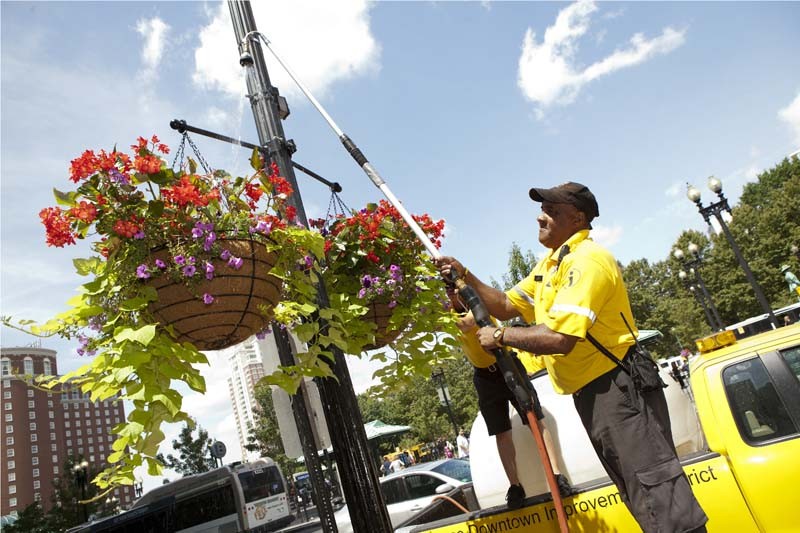
Commonly known as the “yellow jackets,” they are the 18 full-time employees – all local residents – who comprise the clean and safety teams of the Downtown Improvement District, an entity the city created seven years ago. They pick up litter, sweep streets and sidewalks, get rid of the snow, wipe away graffiti, tend to floral arrangements and even discourage panhandlers.
“What we do is provide a clean, safe and welcoming environment for people when they get here,” said Frank LaTorre, director of public space for DID who is in charge of the yellow jackets. “What can we do to make your experience a more positive one?”
The yellow jackets removed 189,917 pounds of trash from downtown during a five-month period in 2011 (from March 1 through July 31), removed 1,068 graffiti tags and 1,034 stickers and handbills, according to figures DID compiled. They provided pedestrian assistance or safety escorts 2,045 times, made 2,325 separate business contacts and discouraged 570 panhandlers, both passive and aggressive.
The DID, overseen by a board of directors, works with an operating budget of $1.2 million in the current fiscal year, the same as fiscal 2011. Public-space management that includes the work of the yellow jackets is the largest expense, responsible for 77 percent of the budget. Other costs are for administration, marketing, office expenses, capital-equipment reserves and special projects.
When the DID was created, a sunset provision called for reassessment of the program after three years of operation. The result revealed in surveys was that about 90 percent of the taxpaying supporters of DID wanted the program to continue, LaTorre said, a sign he interprets as a vote of confidence in the yellow jackets.
What perhaps makes the Providence yellow jackets different from other urban cleanup crews is the stress LaTorre said is placed on their ambassadorial role, which he called “a big part of the training process.
“It is very much of a people-oriented job,” LaTorre said of clean-and-safety team membership. “There is a personality component. It takes a certain kind of person.”
Yellow jackets are encouraged to make eye contact and to be “open to people,” LaTorre said. They are equipped with information about events taking place at the current time downtown, including conventions and special meetings, so they can direct people to specific locations and personalize conversations with visitors. In the next three or four months, the events list now printed on paper will be available through use of hand-held devices connected to the Internet, LaTorre revealed.
Regarding panhandlers, DID teams dealt with 366 cases of passive panhandling and 204 instances of aggressive panhandling, for a total of 570 from March through July last year. Aggressive panhandling, where the supplicant physically interferes with his/her target, is against the law, LaTorre said, and proper enforcement action is taken.
Dale J. Venturini, president and CEO of the Rhode Island Hospitality Association based in Cranston, can’t say enough in support of the yellow jackets, calling them “phenomenal” and “very important to the city. They send a clear message that our city is safe and clean,” she told Providence Business News. “People don’t want to come into a dirty city, especially when they’re from outside the state.”
Rhonda English, director of catering at Hotel Providence downtown, called herself a “huge fan” of the yellow jackets. “Coming down Westminster Street in the morning, you see them out there with their trash cans and brooms, clearing the sidewalks,” she said. “They’ve actually helped me across the street and I probably know most of them by name.”
Visitors in the hotel’s lounge area, overlooking Westminster Street and Freedom Park, often comment favorably on the work of the DID teams, English said. Their presence is “especially important when you come into a city you are not familiar with,” she added, noting that a lot of out-of-town hotel guests walk the city , so feeling safe is a critical factor to them.
At the Homestyle gift store on Westminster, owner and operator Lisa Newman Paratore (a member of the DID board), said when she’s asked a question she can’t answer, she refers visitors to the yellow jackets.
“They are incredibly identifiable,” Paratore said, “because of their uniforms.” She described them as having a “professional polish,” but without being off-putting. “They’re very friendly,” she said. “They refer to themselves as ‘ambassadors’ and my observation has been that they take that role very seriously.” •