Behind the Brutalist, concrete Fine Arts Center on the University of Rhode Island’s South Kingstown campus, there will soon be a Hellenic studies center, complete with replications of the pillars from the Acropolis of Rhodes and an outdoor amphitheater constructed out of marble.
The $5 million Hellenic Studies Center Paideia will sit on land leased by Paideia – a cultural organization for people of Greek descent in the U.S. – from URI and the state. The no-cost lease will last for 500 years, John Lyssikatos, president of the Rhode Island Paideia chapter, said recently.
The plan to build the 22,000-square-foot center was set in motion almost a decade ago and came to fruition last week with the June 30 groundbreaking for the building, called the Rodos Center – “Rodos” is another spelling for “Rhodes.”
“It has been planned for years,” Lyssikatos said. “However, we had difficulties with the area because it was a wetland. Then we had to go through a lot of technicalities.”
Construction has begun, but it’s unclear how long it will take, Lyssikatos added. “We’ve raised the funds for the foundation, but for the rest we’ll raise the [money] as we go.” The funding has and will come in the form of “donations from private individuals who are lovers of Hellenism and the Orthodox faith,” he said. That includes people of Greek ancestry from Rhode Island and southeastern New England, but also national Greek organizations.
URI said the construction should take about two years.
Stephanos Nousiopoulos, a Connecticut-based architect who has worked on Paideia’ centers around the country, designed the URI center pro bono, Lyssikatos said.
“The center was a vision by the founder of Paideia, who is Elias Tomazos, a professor at the University of Connecticut. Back in 1977, he came up with the idea of promoting Hellenic civilization through American universities,” Lyssikatos said. “He started with UConn, where he has built a cultural center, an Orthodox chapel, a library and museum.”
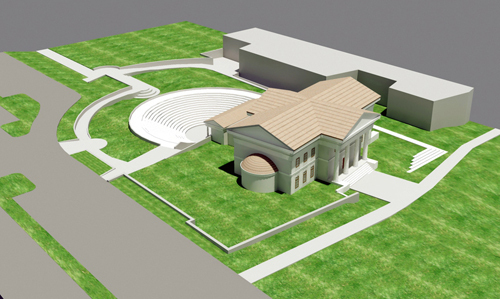
The ornate building will sit just behind the concrete, bunker-like Fine Arts Center on the western edge of the campus and will take up a portion of what is currently a parking lot.
In architectural renderings supplied by URI, the Rodos Center has curved walkways of varying elevations that break up the landscaping and connect the building to the Fine Arts Center, the parking lot and nearby walkways. The amphitheater is recessed and connected to the rear of a main building. The main two-story building, fronted with four columns and called the Rodos Educational Building, faces Flagg Road.
“At 22,000 square feet, it will house an Orthodox chapel inside the center, not outside, with an outside amphitheater the style of Epidauros with a Socratic Center,” Lyssikatos said. “The amphitheater will be facing toward the east and it’s going to be all marble and we suspect that this is going to be used for drama and plays in the whole area, for high schools, URI and so on … similar to the one in Epidauros, it will have terrific acoustics.”
The main building will also have classrooms, a small lecture hall, offices, a library, archival storage and exhibit space, according to URI. There will also be a replica of the three pillars of the Acropolis of Rhodes in “prominent” display. There will also be a “Socratic corner,” with steps and a small park-like green.
There are Hellenic centers on campuses around the United States. Paideia now has buildings at the University of Maine, the University of New Hampshire and in Boca Raton, Fla. But this will be only the second American university to house an Orthodox chapel – the Ayios Loukas Greek Orthodox Chapel – inside it, Lyssikatos said, adding that the first is on the University of Connecticut’s campus.
In a statement, former URI President Robert L. Carothers, whose last day was marked by the groundbreaking, said the “study of classical Hellenic thought and art will give us a richer appreciation of the past and help shape more thoughtful and reflective graduates for the future. We are very proud of our continuing relationship with the Greek American community in Rhode Island.”
Lyssikatos said there are about 5,000 people of Greek ancestry in Rhode Island. The largest concentrations of Greeks in the United States are in New York – Astoria, with about 200,000 people – followed by Chicago, Boston, Philadelphia and Los Angeles.
About 20 years ago, when Mayor Joseph Paolino was in office, Providence and the Isle of Rhodes became sister cities, “so there is a cultural identification between Rhode Island and the Isle of Rhodes,” Lyssikatos said.
Paideia has approximately 100 Rhode Island members and about 2,000 throughout the country. •