PROVIDENCE – Fraud-prevention company SEON has noted Rhode Island as a “business fraud hot spot.”
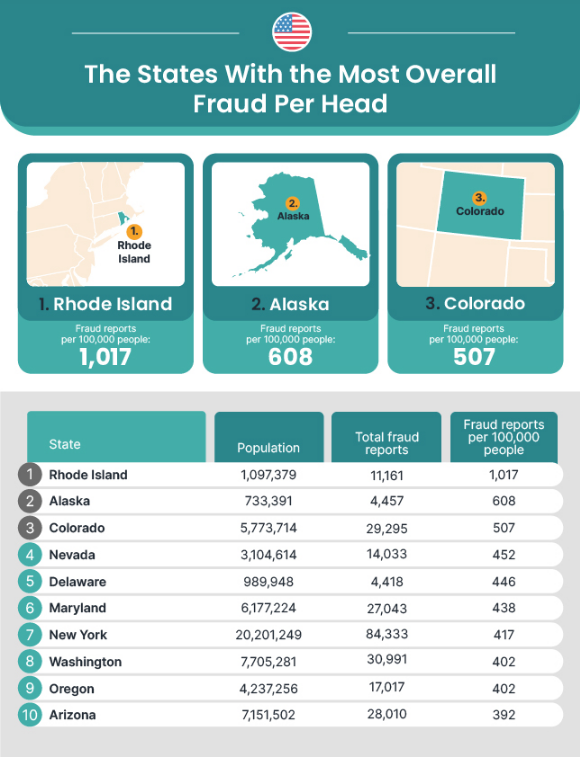
SEON, a fraud monitoring and prevention company with offices in Texas, Europe and Indonesia, ranked Rhode Island No. 1 on its list of states with the highest number of fraud reports per 100,000 people, at 1,017. The rankings draw from Federal Trade Commission data.
Building a Strong Data Foundation in the Age of AI
Artificial intelligence (AI) has become a key priority in the boardroom and across management —…
Learn More
Alaska and California trailed Rhode Island, with the second- and third-highest fraud report rates, respectively.
The Ocean State came in at No. 6 on SEON’s list of the 10 U.S. states with the highest business fraud rates, with a rate of 15.04 business and job opportunity fraud reports per 100,000 people. The top three states for business fraud were Nevada, Maryland and Arkansas, according to the report.
Evan Lemoine, president of the Rhode Island chapter of the Association of Certified Fraud Examiners, said a high number of fraudulent unemployment claims was the major driver in Rhode Island fraud rates.
This high incidence of fraud likely ties back to high unemployment rates in the state, Lemoine said. In August 2020, Rhode Island had the second-highest unemployment rate in the U.S., at 12.8%, according to the U.S. Bureau of Labor Statistics, trailing only Nevada.
Earlier this year, the R.I. Department of Labor and Training reported that between March 2020 and March 2021, around 43% of the approximately 900,000 unemployment claims filed in the state were suspected as fraudulent.
Because the state relies heavily on the tourism industry, which was particularly hard-hit by the pandemic, “we’ve had more people applying for unemployment assistance,” Lemoine said, “coupled with the fact that you have a lot of fraudsters trying to take advantage of a system that is becoming overwhelmed with unemployment claims as it was.”
The state received “an overwhelming number of requests” for unemployment claims, Lemoine said, which inundated the state’s understaffed system and led to belated vetting of claims.
Rhode Island was the only state in New England to make either list.
The study, which also reported on fraud in the United Kingdom, uses the U.K. Metropolitan Police definition of fraud as “any act of misrepresentation whereby a scammer lies about themselves, their actions or their services to cause a gain or loss.”
(Update: ADDS paragraphs 5-9 with comment from Evan Lemoine, president of the Rhode Island chapter of the Association of Certified Fraud Examiners, and data from the R.I. Department of Labor and Training.)
Jacquelyn Voghel is a PBN staff writer. Contact her at Voghel@PBN.com.