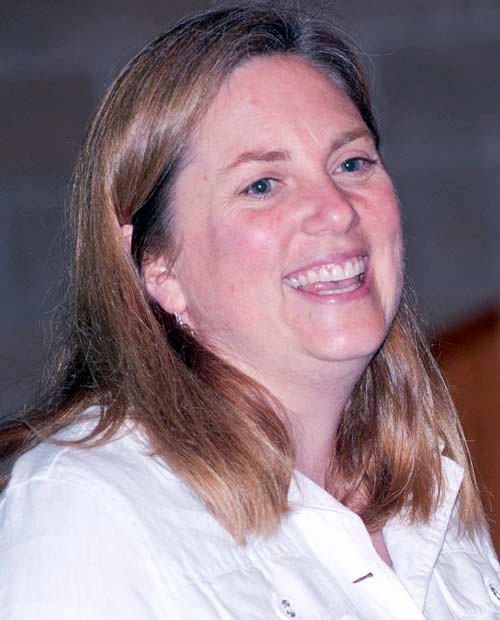
After making the jump from Jamestown elementary school teacher to teacher trainer at the University of Rhode Island, Sara Sweetman recently got a call from the producers of public television’s “Sesame Street” program to advise them on the content and teaching methods used in episodes involving science.
The show’s producers were impressed enough that she was asked to appear on camera in four episodes that filmed this summer. While she continues to work as an adviser for “Sesame Street,” Sweetman’s main focus is helping teachers and administrators in the eight southern Rhode Island school districts served by URI’s Guiding Education in Math and Science Network. She’s also finishing her PhD. in education.
PBN: “Sesame Street” brings to mind Cookie Monster and teaching children to count or read. How did they end up looking for a science adviser and how did they choose you?
SWEETMAN: “Sesame Street” three years ago joined President Barack Obama on his STEM (science, technology, engineering and math) initiative “Educate to Innovate.” It was around this time of year last year I got a call from “Sesame Street” and after a conversation [they] asked me to become an adviser for their STEM-based shows.
Like everything in life, it’s who you know. I definitely have no acting bones, but a friend of mine … had worked there previously and was in contact with them. When they joined the STEM initiative she was the one who said she knew somebody who works in the schools all the time on science.
Beyond Cash Donations: How New Forms of Giving Are Transforming Not-for-Profit Accounting
Evolving Funding Landscape for Not-for-Profits Not-for-profit organizations are being asked to do more with less,…
Learn More
PBN: From behind-the-camera adviser, how did you end up on air talking to Murray the Muppet and what was it like? PBN: Are you a big believer in technology assisting teachers and students’ learning? PBN: Anything in particular that Rhode Island needs to work on in STEM education? INTERVIEW
SWEETMAN: After the phone call last December, in I went to New York to present to 100 employees from “Sesame Street,” from producers to actors, to education, researchers [and] multimedia game designers about what STEM means to young learners. They also sent me a couple of scripts that I reviewed for science accuracy and age appropriateness. A couple times I was asked to come down and oversee the filming of shows, especially the filming on shows where the content was challenging.
Being on set is very exciting for me. It is not something I never thought I would be doing.
PBN: There is an impression right now that American children either can’t be or aren’t focused on science or math. Do you think that is accurate?
SWEETMAN: Definitely not the can’t. They absolutely at every age can be engaged in great science learning. In southern Rhode Island where we are working with the kindergarten-through-eighth-grade teachers, we have a great population of teachers who are engaging the students in active hands-on and minds-on science, where they are asking questions and investigating with materials and the teachers are stretching their knowledge and pushing them to think deeper and harder about what they are learning about. It is really exciting because as I travel from conference to conference, and read all the articles, they say it is not happening. So it is nice to see that it is happening and it can happen in southern Rhode Island. But the challenges are that it takes a lot of resources for the teachers to be able to implement that type of teaching and learning in the classroom. … It takes leadership in the schools that is knowledgeable and has access to training and questions and it takes the connection with scientists.
At URI we have about 45 scientists that volunteer their time to help the teachers, help them get deeper content knowledge. There aren’t that many places around the United States that have that kind of support system.
SWEETMAN: I think technology is something we need to consider very carefully. It’s definitely what these students we have now, what these young students are going to be dealing with in the future and it should definitely not be ignored. I think that it should be very carefully considered, especially with young children. They don’t always differentiate between the virtual world and real world and I am concerned sometimes that technology in the classroom, especially in the science classroom, can make things become two dimensional and not three dimensional. The real science learning involves hands-on investigating with materials. We don’t want those experiences to be replaced with a video. And again, that video is second-hand knowledge instead of their hands-on experience where they get first-hand knowledge.
SWEETMAN: I think not just in Rhode Island, but across the country a lot of demands that come down on teachers … grossly underestimate the need for those support systems. They create standards and curriculum on those standards, but if that is not supported by all those things I listed before, then they are not going to be implemented well. I think our reaction to change, when those concerning reports we read about science education and math education, generally what happens is the administration will change their curriculum. I don’t know that change equates to progress. We need to develop teachers. We need to develop the interaction between the teacher and the student. •
Sara Sweetman
POSITION: Director of the Guiding Education in Math and Science Network at the University of Rhode Island
BACKGROUND: An elementary school teacher for nine years in the Jamestown public schools, Sweetman was hired by the University of Rhode Island as a teacher trainer nine years ago.
EDUCATION: Bachelor’s in family relations from the University of New Hampshire, 1996; master’s in elementary education from Rhode Island College, 2002
FIRST JOB: Lifeguard
RESIDENCE: Bristol
AGE: 37