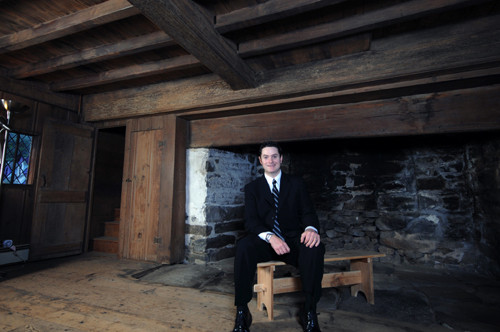
Dan Santos, southeastern New England site manager for Historic New England, is based at the Arnold House in Lincoln. He fills a full-time position that the Boston-based organization created in October to better serve Rhode Island.
In just the last three months, the number of Rhode Island members increased from 461 to 535. Santos is working closely with other groups focused on history and preservation in the state, such as the Great Road Historic District and the Historic Hearthside Homestead, both in Lincoln, as well as the Museum of Work & Culture in Woonsocket and the South County Museum in Narragansett.
Historic New England owns and manages four Rhode Island sites: the Arnold House, the Clemence Irons House in Johnston, Casey Farm in Saunderstown and Watson Farm in Jamestown, all dating from the 17th or 18th centuries.
Santos recently spoke with Providence Business News about his new post and the group’s plans in Rhode Island.
PBN: How long have you been with Historic New England?
SANTOS: I started with Historic New England Oct. 29 of last year, but I did work for Historic New England before, from 2003 to 2006 in another capacity, as the lead museum teacher for the Boston area, so it’s an organization that I am very familiar with.
I worked for the R.I. Historical Society as education and visitors’ services manager from 2006 to 2010. I was based at the John Brown House Museum in Providence.
Beyond Cash Donations: How New Forms of Giving Are Transforming Not-for-Profit Accounting
Evolving Funding Landscape for Not-for-Profits Not-for-profit organizations are being asked to do more with less,…
Learn More
PBN: Can you tell us a little bit about yourself and how you ended up working in the field of historic preservation?
SANTOS: My interest in history started when I was growing up on a farm in Rehoboth, Mass., finding arrowheads and hearing stories about King Philip’s War and thinking about the people who trod across the land before me. I’ve just always been interested in history. I’m that rare person that if you asked at the age of 10 what I wanted to do when I grew up, I would have told you, to work in a museum.
PBN: Are you are the first Rhode Island site manager for Historic New England?
Historic New England definitely wanted to engage the public more in Rhode Island. We’ve been here since 1918, when the Arnold House was given to Historic New England, so an organization that is 101 years old this year has been in Rhode Island for 93 of those years.
PBN: Tell us about Arnold House.
SANTOS: The house was built in 1693. We did a study of the tree rings [in the wood used to build the house] to determine when those trees were felled, and the house would have been built very shortly thereafter. It’s a rare surviving type of architecture, which is called a “stone-ender,” so the entire one end of the building is made of stone.
It really is a story of immigration, where the builders came from western parts of England and Scotland to this part of Rhode Island and this was the way they had learned to construct houses. They found a lot of stone around them in Rhode Island, for sure, and the Arnold family had deeded rights to the lime that was here in Lincoln. …
If you visit the Arnold House today, you can see on the outside of the stone end the lime that would have protected the stone and the mortar.
PBN: Was the Arnold House built as a residence?
SANTOS: It was, Eleazer and Eleanor Arnold lived here with at least nine of their 10 children. … The Arnold family lived here, several generations of them, until 1918 [when the house went to Historic New England].
I’d say in the 1920s, there was stabilization that was needed [to preserve] the structure and then, in the 1950s, more work was needed and it was decided at that time to restore the house back to its 1693 condition, as much as our organization could, based on scholarship and evidence we found within the walls of the building. So now when visitors come to the Arnold House, they can experience 1693 as much as possible.
The house did become a tavern starting in 1710, when a yearly license was applied for to operate a public house or tavern, and it was a tavern until 1725.
PBN: How does your position help Historic New England in Rhode Island?
SANTOS: We wanted to have a face in Rhode Island that would represent the organization, but someone who is accessible to the public. We’ve expanded the hours of the Arnold House, where I am based, which used to be open only for a few times each year. Now, starting recently in June, we’re open every weekend, Saturdays and Sundays (11 a.m. to 5 p.m.) year-round for tours.
Attendance has been great so far.
PBN: What do you see as Historic New England’s role in Rhode Island?
SANTOS: Historic New England’s role in Rhode Island is to preserve and share the stories of Rhode Islanders, as we do for all of New England. We do this through educational programs. … We have a program called “Colonial Times,” where students visit the Arnold House and learn about everything from illumination in the 17th century to writing with quill pens. …
Preservation is also an important part of what we do. On Oct. 1, we’re working with Roger Williams University on the “Looking Forward” symposium, which challenges a new generation of preservationists to articulate a vision for what is to be preserved in New England in the next 100 years.
We have a stewardship program where if you have an old home and you would like to protect anything from the paint color to a particular architectural feature … you can work with Historic New England to protect those features. •