A friend of mine recently retired, took his pension and moved from Rhode Island to a small town in a red state where marijuana laws are not enforced very rigorously. Recreational pot is very important to him. Does this mean Rhode Island should legalize drugs for personal use? Become a red state?
How do we know that my friend isn’t more representative than Alan Hassenfeld’s acquaintances: rich people who supposedly left Rhode Island because of our relatively high tax burden? Which scenario should inform state policy? The answer: neither.
Hassenfeld commissioned a study that claimed to “prove” that the Rhode Island estate tax causes out-migration, and as a result, a loss of jobs and tax revenue. Although the assertion appears plausible, the data are not there.
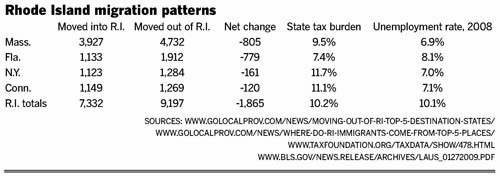
In 2008, the most recent year for which official statistics about migration among the states are available, four states accounted for a net loss of almost 2,000 former Rhode Islanders: Massachusetts, Florida, New York and Connecticut. Besides being the leading destinations for people leaving our state, all four states were also highest as sources of migration into Rhode Island. Migration occurs in all directions; the Hassenfeld study only counted people who left.
Even if we limit our sights to those who left, tax burden is almost irrelevant because differences across the states are not that great. Rhode Island’s 2008 tax burden (10.2 percent) was less than 1 percent higher than the U.S. median of 9.4 percent. The 33 most tax-costly states all fall within a 2 percent range of tax burdens: 9.8 to 11.8 percent. Rhode Island (No. 10 in the United States) is on the low side of the midrange of these 33 states.
Given the array of factors that contribute to the decision to leave one state and move to another, a 1 or 2 percent decrease in tax burden is likely to pale in comparison to considerations like quality of life, nearness of family, jobs, schools, climate, access to health care and other necessities, total cost of living, and so on. Based on all state and local taxes, two of the four states to which Rhode Island people relocated the most in 2008 (Massachusetts and Florida) had lower tax burdens than Rhode Island, and two (Connecticut and New York) had higher taxes.
According to a study of human migration within New England and between our region and other parts of the country in 2003-04, conducted by the New England Policy Center, all New England states lost population, particularly to Florida and the Southeast, due to a variety of national and regional issues which did not include state tax burdens. (Go to this Federal Reserve Bank of Boston website to see the report – www.bos.frb.org/economic/
neppc/dp/2006/neppcdp0601.pdf.)
New Hampshire (with the fifth-lowest tax burden in the country and lowest in New England), is an instructive example. Eight New Hampshire counties share borders with 11 Vermont, Massachusetts and Maine counties, all with higher tax burdens. When contiguous counties across state lines are compared, no clear migration patterns are evident. Slightly more New Hampshire counties gained population, but they included both counties that do not border other states. If people simply chased lower taxes, there would have been more consistent migration into New Hampshire from neighboring counties in Massachusetts, Vermont and Maine.
But Florida is different. With a very low tax burden (No. 47), almost 3 percent less than Rhode Island’s, and a similar unemployment rate in comparison to New York and Connecticut, Florida experienced almost 50 percent more in-migration from Rhode Island than those states. Why?
Another friend of mine retired to Florida. He hates taxes, but brags that he’s playing golf while we shovel, not that his tax burden has decreased. Maybe his golf partners are Alan Hassenfeld’s friends.
Parenthetically, for these four states there is no correlation between tax burden and employment rates, challenging another anti-tax myth.
In sum, many factors contribute to the decision where to live. We all know individuals who make decisions that appear to support or refute a favorite theory, but policy decisions which affect all of us should not be made on the basis of episodic data or hunches.
As much as the evidence is varied, it also clearly refutes tax burden as a major determinant of where people decide to live. •
Daniel Weisman is a professor of social work at Rhode Island College.
Seifert Systems Invests in Energy Efficiency to Strengthen Operations
For manufacturers, energy is more than just another operating expense. It plays a critical role…
Learn More