Before this year, not too many people worried a great deal about the flu. It was just one of those annoyances that came and went with the cold weather.
This season, however, fear of the flu is omnipresent, the result largely of the H1N1 strain and the resultant publicity about it, leading employers in Rhode Island to ramp up efforts to protect their workers and avoid the expense and inconvenience that can come with high rates of absenteeism.
“People are absolutely apoplectic” about both the seasonal and H1N1 types of flu, said Laurie White, president of the Greater Providence Chamber of Commerce. White said the Chamber has received numerous calls in recent weeks from local businesses looking for guidance and resources to fight flu in the workplace.
“Every business I go to has hand-gel [sanitizer] all over the place,” White said. “This is an unprecedented flu season, and it is great to see the corporate community appreciating the advantages of adult immunization.”
David F. Brochu, president and CEO of Strategic Point Investment Advisors in Providence, cited the shift in popular attitude as one advantage of the panic. “People don’t take the flu seriously enough,” he said. “People always have thought it was not that big a deal, but all of the publicity this year has changed the thought process.”
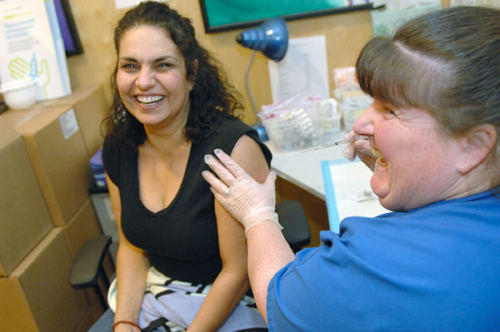
Brochu had representatives of The Wellness Company in Providence come in to immunize his 18 employees against the seasonal flu and will do the same when the H1N1 vaccine becomes available for wide use, which local health officials say probably won’t be until late January or February.
He also has given his workers unlimited paid sick time to make certain they do not come to work with the disease. “I tell people, if you come to work sick, I will send you home, and if you come in sick twice, I will fire you,” Brochu said.
He takes such a hard line against the flu because “we interact with the public a great deal, and we do not want our employees to get sick, for their own sake and for the sake of the business,” he said. “And we do not want to be the place that is spreading [the flu] to all of our clients.” Prominently placed on the mahogany desk in the entrance lobby of Strategic Point is a large squirt-top bottle of hand sanitizer, available for visitors and workers.
The state health department reported the percentage of physician visits statewide for influenza-like illness reached a peak the first week of November at 12.97 percent, but by Nov. 14, it had dropped to approximately 10 percent and has been dropping ever since.
The percentage of emergency room visits statewide for “fever/flu” symptoms follows much the same pattern, reaching a peak of 21 percent the first week of November and dropping to about 16 percent since then. This rate is still far higher than in 2007 and 2008, however, when trips to the emergency room for flu-like symptoms barely reached 10 percent of the total and generally stayed steady at about 4 percent, according to information from the health department.
Regarding the H1N1 strain in Rhode Island, the health department reported that 279 people had been hospitalized as of Nov. 18 and, as of Nov. 24, eight people had died from it. The most recent was a Cumberland man between 50 and 60 years old with no underlying health conditions. He has not been identified.
Annemarie Beardsworth, spokesperson for the health department, applauded Brochu’s policy of providing unlimited sick time. “Not only is that a good idea from a public health standpoint, it is a common-sense, good-business practice,” she said. “If your employer gives you that kind of flexibility, aren’t you going to be more loyal to that employer?”
Provant Health Solutions LLC, in East Greenwich, a health and wellness company serving 1,100 business clients in the United States, Canada and the Caribbean, has been “inundated” with calls, said Lisa Edenbaum, RN and vice president of business development.
Provant is one of the few vendors in the nation that still has some seasonal flu vaccine available, Edenbaum said, and would gladly accommodate any business that needs it. Asked about the cost factor when a business provides vaccinations, Edenbaum said some do charge employees $25 per shot, but others can go through employees’ health insurers and pay nothing. “It didn’t cost us anything,” said Laura Bard, marketing manager for Strategic Point, because health insurers covered the cost.
Donna Dube, RN and director of Lifespan employee health services at Rhode Island Hospital, reported that Lifespan vaccinated 73 percent of its work force against the seasonal flu – more than 8,500 workers – at no cost to employees. “We believe the flu vaccine is an employee benefit,” she said, “and this allows the hospital to give something back.”
Dube reported that 650 Lifespan employees in emergency rooms and intensive care units received the H1N1 vaccine in the form of flu mist, a practice she said all the state’s hospitals are following to protect urgent-care workers.
The H1N1 vaccine, available in Rhode Island in limited quantities, is going first to high-risk populations, such as pregnant women and children, according to Beardsworth. The federal government controls release of the H1N1 vaccine and allocates a specific amount to states on a weekly basis, she explained. Rhode Island is scheduled to receive 600,000 doses over the course of the flu season, which lasts through March.
At Strategic Point, Brochu actually has offered flu vaccinations to his employees for the last 10 years and he’s learned that this tactic is far better than “having a cascading cycle of illness throughout the office,” affecting one worker after another.
What is different this year is his decision to allow unlimited, paid sick time, instead of the usual five days per year. “Most employees do not abuse sick time,” Brochu maintained, and he has decided to keep the policy in place for the foreseeable future. “I don’t think I’m going to change it, it’s worked out so well,” he said. •