For decades, computers were prized resources that only the government and top universities could afford. Today, they are ubiquitous. But as computing power has grown, so have our ambitions, which have spawned a new breed of supercomputers.
Now Brown University has obtained such a machine, an IBM “high-performance computing system” with 1,440 processors, a cluster that can do more than 14 trillion calculations within a second, a peak-performance speed of more than 14 teraflops, and 4.5 terabytes of memory.
Altogether, the HPC system provides about 20 times the computing capacity that was previously available at Brown – and it’s going to be available not just to researchers on that campus, but to the University of Rhode Island, the Marine Biological Laboratory in Woods Hole, Mass., and by next year, to other academic institutions, hospitals and other nonprofits across the state.
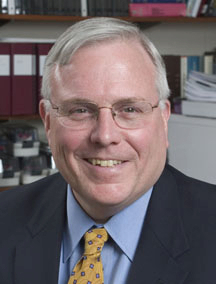
Clyde Briant, vice president for research at Brown, recently discussed the system with Providence Business News.
PBN: You got this machine through a partnership with IBM. How did it come about, and is it just Brown and IBM, or a broader group?
BRIANT: The [memorandum of understanding] was between Brown and IBM, but part of that was to reach out to other groups in the state, URI for example, and there are many others that we’ve been working with.
Beyond Cash Donations: How New Forms of Giving Are Transforming Not-for-Profit Accounting
Evolving Funding Landscape for Not-for-Profits Not-for-profit organizations are being asked to do more with less,…
Learn More
PBN: Who designed this system?
BRIANT: Brown and IBM began to talk about what was needed, but they interviewed groups from URI, groups from MBL, all the potential users, and put together a system … that would be optimal for them. My understanding is that it’s not a unique system – it wasn’t built from scratch just for this purpose, but rather it was a package that was put together to optimize it so as many users as possible could get on to the system and use it.
BRIANT: There are faster computers out there, and other universities have equivalent systems, but what is going to be special about this is, first of all, it is unique for Rhode Island; it’s going to be the fastest computer available in the state. And it was built with the idea that it would be used by more than just Brown, so the idea of very widespread use immediately begins to let us not get into research silos.
PBN: What are some specific projects at Brown that this system will be used for?
BRIANT: One, for example, is in materials science. There’s a lot of interest here in simulating the properties of materials. … Materials are complicated things – the materials you make automobiles out of, or jets – and to be able to simulate that on a computer requires a tremendous amount of input.
Another area that’s very important is visualization. We have a program here at Brown that Beth Brainerd in ecology and evolutionary biology runs that studies the motion of animals – walking, running, chewing – and by having a lot of visualization technology can put that back together in real time and study how the bones and muscles work together in those motions.
Things that I think are in the future … we know that the whole area of population biology is going to be big, as we collect more data both in public health and in social sciences and analyze that over time, such as in the National Children’s Study. … Certainly the whole area of the environment, climate change, that’s going to be big for us, environmental informatics.
PBN: Do you know of major projects that other institutions plan to use this for?
BRIANT: A group from URI is very interested in marine genomics … and we also expect that URI, through the Graduate School of Oceanography, will be very interested in a variety of ocean-dynamics types of problems.
BRIANT: Basically, there will be a mechanism for getting an ID on the computer. There will be a business model for chargeback of the time and the storage and so on. But basically, it will be through an application through the Center for Computation and Visualization at Brown.
[And] you wouldn’t have to come here at all. With good cyber-infrastructure throughout the state, you could work from anywhere and be able to use this.
PBN: What are the implications for Brown of having such an important and potentially widely used resource on its campus?
BRIANT: One of the great things will be having a centralized facility for computing, which will help everyone in the kinds of research they do. Having your own little computer that no one else uses can tend to lead to … groups working alone. I think this will be a very good mechanism to break down those silos and have researchers from across the university talking to one another and finding out about things.
PBN: Do you see this system making an impact on business and economic development?
BRIANT: Absolutely. One of the long-term goals is a statewide data center … really a home for high-performance computing, and the goal is that it would not just be Brown, URI, the hospitals, but actually also a way for small businesses that probably couldn’t afford the kinds of computing needs that they have to tap into, something like this. It would be a ready-made state service that one could tap into and use.
We’re planning to have for the rest of this academic year a series of symposia that will have the theme of what is the role of high-performance computing in different disciplines – population health, the environment, education. •