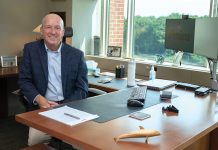
Warwick-based Casali & D’Amico Engineering leaped into survival mode by cutting staff from 20 to eight. President Joe Casali made up for some of the cuts by taking on a personal workload that keeps him on company business days, nights and weekends.
Middletown-based SGE/Northeast Engineers & Consultants slashed staff from 100 to 30 over the past two years and cast itself headlong into the wind-energy market.
The fastest-growing and largest construction-related companies in Rhode Island are doing whatever their corporate history, staff training and vision propels them to do to survive in these unpredictable times.
Sometimes they take opposite paths.
Three-year old Commercial Construction Group, or CCG, increased its staff from five to seven in July. The Cranston-based company expanded its territory and won a hotel and parking-garage project in western Massachusetts and an office building and interior build-out in Washington, D.C., as well as an interior project in Providence.
Deeply rooted Walsh Brothers, founded in 1901 and now with 230 employees, is sticking to its specialties in the higher education and health care segments, with an expansive portfolio of projects throughout New England.
Walsh is wrapping up a signature project for Women & Infants Hospital of Rhode Island – a new neonatal intensive care facility.
“We’re really about staying with what you know and doing it better, by increasing service and value,” says Walsh Brothers Senior Vice President for Strategic Development Denise Marien. “Certainly we’re here for the long haul. In many instances, our clients are multidecade and multigenerational.”
There’s no singular path to survival in these difficult economic times. But construction-related businesses in Rhode Island are pointing to stamina and flexibility as promising ways to cross the rocky terrain.
Some construction executives even say there’s hope on the horizon – and it may be as close as the latter part of 2009.
But until then, it’s a marathon, with mudslides.
Casali & D’Amico Engineering ranks 90th on Providence Business News’ 2009 list of Top Private Companies, with revenue of $1.6 million last year.
But last October, “the world stopped spinning. Money stopped coming in,” Joe Casali said. “Proposals didn’t get signed. Some people who usually paid invoices in 30 days paid in 60 or 90 days.
“To be frank, we are not doing so hot,” Casali said. “I rolled up my sleeves and I’m a working principal. I increased my hours like crazy.”
Casali is the only licensed professional engineer in his company, so he’s had to do things like leave the family vacation on Martha’s Vineyard to testify at the Johnston Planning Board.
Casali & D’Amico used to do 75 percent private projects and 25percent public. Now it’s the opposite.
“Municipalities are keeping us busy,” Casali said. Projects include the new Johnston Fire Station No. 4, the Johnston library and an addition to Exeter-West Greenwich High School.
“At CCG expansion may sound bigger than it is, when you start from scratch,” President Brian Byrnes said.
“I started about a year before the credit crunch. I had a couple of big jobs,” Byrnes said. “Then jobs got put on hold and it’s been a scramble since then.”
He is finding that jobs come more often now from clients with deep pockets, when the owner or developer can put in a substantial amount of money or form joint ventures or partnerships.
“I’m focusing on Rhode Island, southern Massachusetts and the mid-Atlantic market, which is more active,” Byrnes said. “If I was not geographically diversified, I’d be starving.”
CCG, which ranks 57th on PBN’s list with $16.8 million in 2008 revenue, added two field operations supervisors to handle the broader territory.
Following the money helps, Byrnes said. But there are limits.
Going after out-of-state jobs in a highly competitive market isn’t always feasible for small companies. It can be expensive and time-consuming without connections, said Byrnes, who was in the construction business for 27 years before founding CCG.
“You have to have some kind of avenue. Maybe you’ve worked with an architect on the job,” Byrnes said. “It doesn’t make sense to go chasing jobs out of the blue. Unless you have an enormous portfolio, you’re not going to get the job.”
Byrnes has an overall plan: “Do everything I can possibly think of.”
One company thinking of new ways to do business is Advanced Building Concepts of Middletown, No. 60 on PBN’s list with $11.2 million in 2008 revenue.
A former project manager shifted roles and is now targeting business development – a big change for the 30-year-old firm that never before had to market itself.
“We never did banging on doors, no cold calling,” Advanced Building Concepts President John Brooks said. “Our clients found us.”
Those clients are mostly in Newport County, including several projects for Newport Hospital.
“I think what helped us is being diversified in types of projects,” Brooks said. “If it we had just residential, we would have been hit harder.”
Even so, the company took a pretty hard hit.
“Things were going well until first quarter 2009. That was probably the worst,” said Brooks, who had to lay off 15 of 40 employees.
Earlier this year, available public jobs had lots of competition, he said.
“The private jobs we anticipated got either postponed or throughout the first half of 2009,” Brooks says.
Advanced Building Concepts hired an assistant estimator to deal with the changing environment.
“We’re bidding on more projects, so we have to estimate more,” Brooks said. “But we’re not getting as many projects.
“The second half of 2009 looks quite a bit better. There are projects on the horizon,” Brooks said. “Everything we’re looking at now is private.”
Dimeo Construction is moving forward on its momentum of 80 years in business, with a senior management team that’s been together for 25 years and offices in Providence, Boston and New Haven. The company came in at No. 13 on PBN’s list with $360 million in 2008 revenue.
Dimeo avoided major layoffs and is working on projects including the 327,000-square-foot Blue Cross and Blue Shield of Rhode Island headquarters in downtown Providence and the 150,000-square-foot CVS Caremark Corp. call center, data center and parking garage in Woonsocket.
Dimeo is also prepared for growing market segments, with more than 100 staffers trained in LEED and sustainability.
SGE/Northeast Engineering and Consultants saw it had to refigure its direction.
“One of the things that slowed us down is that private sector banks just stopped lending,” SGE CEO Blake Henderson said. “That brought so much potential work to a standstill. In one month, December of last year, we had $10 million of pending contracts canceled.”
The company comes in at No. 54 on PBN’s list, with $17 million in revenue last year.
“Right now we have a dozen contracts with 20 [more] pending, waiting for approval on either wind studies or wind design-build, and some solar,” Henderson said. SGE acquired Rhode Island Wind and Solar Power in March.
“The moral of the story is that in a very difficult and changing environment, you have to change to keep up with it,” Henderson says.
The company’s offices in Dubai, Boston and Middletown, operating with less than one-third of the previous staff, may be heading for a turnaround.
“It’s been a steady decline,” Henderson says. “But by reinventing ourselves, we actually started rehiring in July. By the end of 2010, we may have more than 50 employees.”
Walsh Brothers is also looking optimistically ahead. The company stands at No. 10 on PBN’s list, with $550 million in 2008 revenue.
“We completely understand the institutional market and understand that bit of hesitancy in the short term,” Denise Marien said.
“A couple of our developer clients have called for budget updates on projects that they started to design, then stopped – absolutely stopped,” Marien said. “Now we have to update the cost and maybe give the designer approval.”
That update could be good news, Marien said.
“Costs are coming in lower. Projects that start construction now could see some significant savings because there’s a lot of inventory of materials,” Marien said. “We feel there’s going to be a nice bounce-back.” •