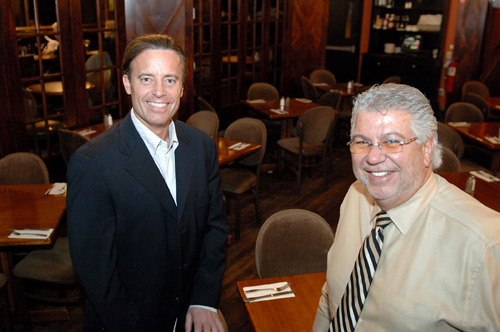
As Rhode Island was slipping into recession a year and a half ago, Providence restaurateur Gianfranco Marrocco took a close look at customer trends at his Federal Hill establishments and saw the economic writing on the wall.
But instead of wringing his hands, Marrocco, who owns Caffé Dolce Vita and Mediterraneo Caffé, swung into action. He introduced prix fixe menus, reduced the minimum number of guests required to book a private function, and replaced low-selling entrées with traditional pasta dishes.
The result? In spite of a 10 percent drop in customer traffic, Marrocco managed to eke out a slight increase in his revenue last year. “Even my accountant couldn’t believe it,” he laughed, adding, “It’s because we’ve been very aggressive” in dealing with a slowing economy.
Although it is difficult to get a clear picture of the health of Rhode Island’s $1.7 billion restaurant industry, observers say the trend is far from uniformly negative.
“I’ve got restaurants that are up and I’ve got restaurants that are flat, and then I’ve got some that are down,” said Dale Venturini, president and CEO of the Rhode Island Hospitality & Tourism Association.
Across New England, per capita spending on restaurant meals and snacks fell by 5 percent in 2008 compared with the prior year, according to The NPD Group, a research firm.
Yet in January, the most recent month for which figures are available, Rhode Island tax revenue from meal and beverage sales was up 5 percent compared with a year earlier – though that also includes other sources such as prepared food sales at supermarkets, and revenue was down by 1.4 percent in Providence.
In addition, Venturini said many restaurants that have managed to increase their sales have not seen a boost in their bottom line due to the higher cost of food and, until recently, energy supplies.
The National Restaurant Association forecasts that total restaurant sales in Rhode Island will grow by just 1.6 percent in 2009, the second-lowest rate in the country after Ohio, and below the national average of 2.4 percent. Those figures are not adjusted for inflation.
Local industry observers emphasize that the situation faced by independent restaurants, the backbone of the industry here, is different from that of national chains such as Applebee’s or Outback Steakhouse.
Morgan Stanley estimates that the recession could force those and other casual-dining companies to close 1,200 of their 18,000 locations nationwide. Starbucks recently announced plans to close about 200 “underperforming” U.S. stores, including one in Warwick.
It is crucial to understand and appeal to the more value-conscious diners who are still eating out, said Steve Marra, co-owner of Pinelli Marra Restaurant Group, which runs eight restaurants in the state including Twist, in Providence and Warwick, and The Grille on Main in East Greenwich. Marra’s establishments have held the line on meal prices and added $9.95 specials during the week.
“People, obviously, are social creatures – they’re still going to go out,” he said.
Ken Cusson, director of the Newport Harbor Corp.’s restaurant division, said he has taken similar steps, and also found overhead savings by, for example, reducing energy consumption.
Cusson said a downturn makes it particularly important for businesses to have solid brand equity. “The restaurants with the better reputations [who are] executing well consistently are bringing their guests back into their restaurants,” he said.
“Being able to predict what’s going to happen – that’s pretty difficult,” Cusson said. “But understanding, hey, you’re not going to see as much profit this year but still build your business and take care of the guest – in the hospitality industry, if you take that approach you’ll do OK.” •