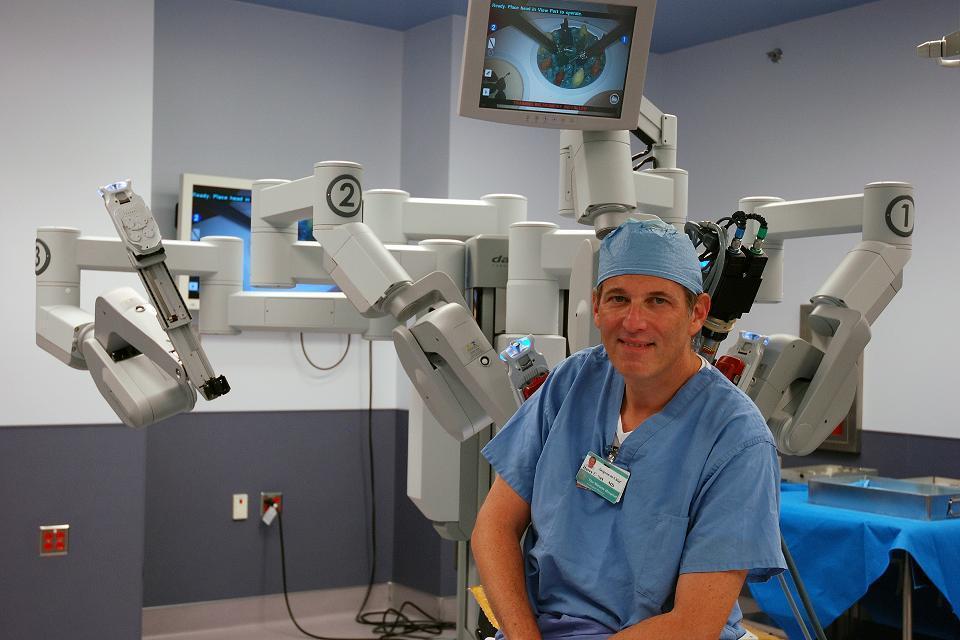
A surgical robot introduced last November at The Miriam Hospital has been embraced far more quickly than anyone predicted, with more than 120 surgeries completed so far. And now the hospital wants to win approval to use the machine in a wider range of procedures.
The R.I. Department of Health last year approved use of the Da Vinci Surgical System robot – nicknamed “Leo” – for only three types of surgeries: prostatectomies (the removal of part or all of the prostate); mitral valve repair; and a type of esophagus surgery.
Beyond Cash Donations: How New Forms of Giving Are Transforming Not-for-Profit Accounting
Evolving Funding Landscape for Not-for-Profits Not-for-profit organizations are being asked to do more with less,…
Learn More
Miriam’s stated “primary objective” in seeking approval for the robot, which the hospital said cost about $1.7 million, was to provide a minimally invasive option for prostate cancer patients. And that is all it has been used for so far, hospital officials said.
But while in fiscal 2004 (the last year for which figures are available), Miriam surgeons did a total of 51 prostatectomies on patients eligible for a minimally invasive procedure – and in their first year with Leo, they had predicted they would do 34 – as of last Wednesday, they had done 122.
“And we’re only in our 10th month, so there was clearly a lot of pent-up demand,” said Dr. Harry C. Sax, surgeon in chief at Miriam and a professor of surgery at Brown University’s Warren Alpert Medical School.
It was Sax, who came to Miriam from the University of Rochester two years ago, who spearheaded the effort to bring robotic surgery to the hospital. The doctors in Rochester had been using a robot since 2001 with great success, he said, and there was a growing body of evidence that patients could greatly benefit from the technology.
Robotic surgery is part of a larger trend in medicine toward minimally invasive surgery: smaller incisions, more precise and delicate operations, all to reduce the damage to surrounding tissue, reduce bleeding, and get patients healed more quickly.
Miriam has made minimally invasive surgery a priority in recent years, and in June, the hospital completed a major construction project that included 10 new, extra-large operating rooms designed to accommodate the often-bulky equipment needed for such procedures.
One of those new ORs is now home to Leo, a towering, four-armed machine that is controlled through another big machine that looks like some kind of virtual-reality gadget, with pedals, finger controls and two big lenses to peer through. It’s the only surgical robot in the state.
Before Leo came into the picture, the most delicate procedures being done at Miriam were laparoscopic surgeries, which also involve tiny incisions – 5 to 10 millimeters, or about a quarter- to a half-inch, long. Through those incisions, doctors would insert a telescopic rod with a camera and a light at the tip. They would inflate the abdomen with carbon dioxide to give themselves some space to work, and they would use tiny tools attached to another rod, and controlled with strings inside the rods, to explore, cut, remove tissue and make sutures.
But laparoscopic surgery tools have several drawbacks, Sax said: The cameras have a single eye, so surgeons can only see in two dimensions, without a sense of depth. And because of the mechanics of the tools, to go left, for example, you have to pull to the right. It’s not intuitive.
Leo’s camera has two eyes and two light sources, so the surgeons can see in 3-D. And the finger controls are completely intuitive – you move up, the tool goes up; you turn clockwise, the tool goes clockwise. It’s as if the surgeon were holding the tips of the tools with his fingers, only the machine is calibrated to smooth out any small tremors, and it can actually be set so the surgeon can move his fingers as if to make 5-millimeter sutures, but actually make them 1 millimeter each.
“The difference between laparoscopic surgery and this,” Sax said, “is like eating with chopsticks and one eye blindfolded vs. eating with a fork and being able to see your whole food.”
Of course, surgeons can’t just jump into the Da Vinci machine’s seat and operate, even if they have laparoscopic surgery experience. Working with state health officials, Miriam developed a training program – with simulations – for surgeons who want to use the robot, Sax said. In addition, for the first several surgeries, an experienced proctor will work with them.
Initially, using the robot will take more time, but with experience, it gets easier – so prostatectomies, for example, now take roughly as long as non-robotic procedures, about two and a half hours.
“By the time you’re up to eight or 10 of them,” Sax said, “you’ve gotten very efficient.”
For patients, the outcomes with the robot have been very good, Sax said. Not only do they face a lower risk of losing sexual function and continence, he noted, but their recovery is much faster: “They go back home the next day, and many of them are back to their normal activities within two weeks,” as opposed to several weeks.
And from a business perspective, there’s no question that the investment is paying off for Miriam. In 2004, the hospital treated 12 percent of eligible prostate surgery cases in the market; in its application to the state, it predicted that by the third year, with 100 surgeries, it would be conducting 33 percent – and it already has exceeded that number.
It’s hard to tell where those patients are coming from, said Sandra L. Coletta, chief operating officer for Miriam, but the hospital had predicted that it would draw about half the patients who used to go to Boston, Hartford or elsewhere for robotic surgeries, and some who, fearing the complications of traditional prostatectomies, would have forgone surgery entirely.
Medicare and other payers don’t reimburse Miriam more for robotic surgeries than for the traditional kind, Coletta said, but because of the shorter stays and fewer complications, the hospital’s total cost per patient ends up being lower.
The challenge now, as Sax and Coletta see it, is to make the most of the robot’s potential. It took Miriam more than a year to get its initial approval for the machine, even though about 400 were in use nationwide, in all but a handful of states.
This week, Coletta said, the hospital plans to apply to use it in other procedures; she wouldn’t specify which ones.
Approval is not guaranteed. The state’s certificate-of-need process inherently involves a measure of skepticism about new technology, both to avert lavish spending on equipment that boosts the cost of health care, and to protect patients.
In an interview, Dr. David R. Gifford, the state health director, said minimally invasive surgery can be very beneficial, but only if it’s done by knowledgeable and skilled surgeons with knowledgeable, skilled teams.
And while having the latest technology at local hospitals really can benefit patients, Gifford said, it’s important not to just presume that the newest, priciest gadget will work best for all.
“We tend to assume that all technology is good, and that’s not always true,” he said. “There has been a lot of new technology in surgery that everybody has run out and started to use right away, only to find out that it’s not as beneficial. … We want to carefully make sure that if we’re going to introduce new technology, it’s not going to harm more people than it helps.” •