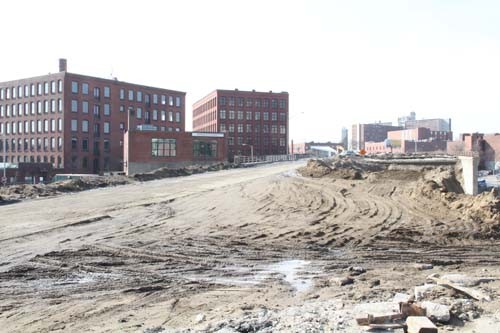
Heavy equipment may be tearing down the old Interstate 195, but the erstwhile roadway promises to live on for years to come. That’s because much of the asphalt, concrete and dirt being trucked away is being recycled and turned into – yes – new roadway.
And despite the harsh winter weather, the removal of the old highway is actually ahead of schedule, according to the state. Contractors armed with heavy equipment simply cleared away the snow after heavy storms, R.I. Department of Transportation Deputy Chief Engineer Frank Corrao III said.
Contractor Cardi Corp. has torn up about three-quarters of the old highway and removed about half the dirt forming the embankments that held it up. The state and Cardi say the move has saved taxpayers money and conserved natural resources such as oil and stone.
“It makes sense all around,” said Stephen Cardi Sr., the treasurer of Warwick-based Cardi Corp.
The concrete from the road and retaining walls heads to a subcontractor in Johnston who crushes it to form gravel. That gravel often ends up as the base of roadways or covers embankments, Cardi said. The same subcontractor also recycles wood and some ends up once again as sheathing under overpasses.
The asphalt is trucked to Cardi’s plant, melted down and combined with new material to make asphalt. Like the concrete, it becomes part of the state’s roadway network.
“It’s just as good as brand new,” Cardi said.
Perhaps somewhat ironically, Cardi already used some of the old Interstate 195 for the new highway. Some of the gravel covering embankments comes from crushed retaining walls Cardi knocked down early on during the relocation project.
More recently, Cardi has moved to demolishing the stretch of the former highway that ran between Wickenden Street and Interstate 95. The $6.8 million contract represents the bulk of the demolition of the old I-195 that stretched about seven-tenths of a mile, spanned the Providence River and cut through the heart of the capital city.
The latest phase – which marks the last of the major demolition – comes with no shortage of material. Corrao said the department expects to move hundreds of dump trucks worth of dirt.
Workers will keep about 35,000 cubic yards on site for grading purposes. About 35,000 cubic yards will go to the American Tourister site in Warren for environmental remediation; 50,000 cubic yards to cap an old landfill in East Providence; 15,000 cubic yards to the Fields Point area in Providence for another environmental remediation project; and 110,000 cubic yards to the R.I. Resource Recovery Corporation.
The RIRRC plans to use about 60,000 cubic yards to fill in depressed areas at the state’s Central Landfill in Johnston. The rest, about 50,000 cubic yards, will go to filling in and capping the defunct Cece-Macera Landfill nearby.
Brian Card, director of operations for the Resource Recovery Corporation, said the free dirt delivered directly to the Cece-Macera Landfill eliminates the costly need for the corporation to truck dirt from the main landfill. And using the rest of the dirt at the main landfill to fill depressions keeps it from ending up as cover for buried waste at the landfill.
“For us, it worked out well,” Card said.
The city of Providence also caught a break with a plan by DOT to leave behind the piers of the old bridge carrying I-195 over the Providence River.
The piers will remain in place to carry a pedestrian bridge planned by Providence. Saving the piers, state and city officials have said, will reduce the overall cost of the pedestrian bridge.
The DOT pledged to keep most of the construction trucks off local roads and on the old highway to appease business owners concerned about the vehicles clogging up roads. Out of concern for sleeping residents, the DOT has prohibited work at night. And demolition of many of the bridges will wait until after the end of the academic year at the nearby Johnston & Wales University.
“There was a lot that had to happen in order for this contract to be successful,” Corrao said.
The measured pace is just fine with Gov. Lincoln D. Chafee. Spokesman Michael Trainor said the governor – who took office in January – is still assembling a strategy to develop the land that will come available once DOT completes demolition work.
“In the view of the Chafee administration, that timing, whether it’s June or August, is not critical at this juncture,” Trainor said.
Ultimately, the demolition will open up about 39 acres of land, of which 19 will be set aside for parks and streets. Another 20 acres are open to development and have been eyed by Johnston & Wales University and Brown University. The city and state also say they are working on various plans to attract private development.
To pave the way for development, DOT says it will grade the sites, reconnect many of the city streets and install utility lines. The DOT plans to seek bids for the local street work at the end of this year or the beginning of 2012.
And who knows? Depending on who wins the contract, those city streets could well feature materials from the highway once in its place.
“We try to recycle every ounce we can,” Cardi said. •
Correction: An earlier version of this story incorrectly said concrete rubble goes to a plant in Scituate. It actually heads to a plant in Johnston close to the town line.
Beyond Cash Donations: How New Forms of Giving Are Transforming Not-for-Profit Accounting
Evolving Funding Landscape for Not-for-Profits Not-for-profit organizations are being asked to do more with less,…
Learn More