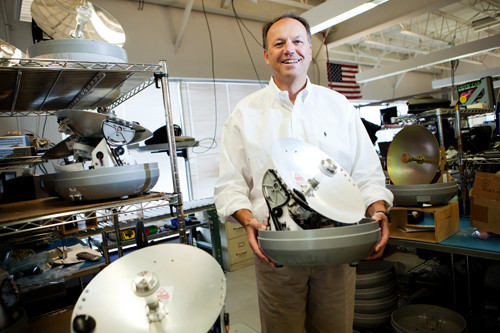
The economy may be sluggish everywhere else, but for the electronics firm KVH Industries Inc., these are boom times.
The company is building a new 75,000-square-foot manufacturing plant just across the street from its Middletown headquarters. It has made some new hires over the past year, and now is looking for a dozen more.
The growth spurt is fueled in part by the success of its latest product, the TracPhone V3, the latest advancement in maritime satellite communications. First unveiled in February, the device fast became a must-have item for anyone who owns a boat. It’s smaller and faster than anything else available, and rates are one-tenth those of other at-sea communication systems. With the V3, a yachtsman or a fisherman sailing almost anywhere on the open ocean can call home, check his email, hold a video conference with business colleagues or watch a ballgame on TV.
For that advancement, Providence Business News has named KVH Industries’ work the top innovation in Rhode Island in 2011 in the information technology category.
“It’s the world’s fastest-growing VSAT solution,” said KVH President and CEO Martin Kits van Heyningen, referring to the communications technology used at sea. “Not long ago, a person using a cell-phone offshore could only connect when near land. With the network we have now, we cover the globe. We’re covering a hundred million square miles.”
According to the company website, the V3 utilizes a stabilized antenna and a modem mounted below deck. The dome-shaped device measures 14.5 inches in diameter and weighs just 25 pounds, the perfect size for storing aboard a cramped ship. The new antenna is equipped with groundbreaking dielectric feed-rod technology for crisp reception even in bad weather, and is designed to withstand the rigorous conditions encountered aboard both commercial and recreational vessels. The cost: about $16,000.
Low usage rates are another big selling point. You can talk on the phone for 49 cents per minute, or download data for 99 cents per megabyte. Some broadband subscribers were previously paying rates of $10 or more. Coverage is almost worldwide, with the exception of a few dead zones around Antarctica and South America.
The V3 is an advancement on a previous KVH TracPhone, a bigger, bulkier device that lacked the new model’s reach. Other earlier satellite communications solutions were slower and more expensive to use, or were unreliable and required expensive hardware for installation. Little effort was required to identify the market need for the latest innovation. These days, many people feel they must be in constant contact with their home or office. And at sea, any communication improvements are welcomed as safety advancements.
The V3 has already been put to use on U.S. Coast Guard vessels, which some boating enthusiasts see as a seal of approval. It’s also the first maritime antenna of its size to be approved by the Federal Communications Commission.
The trade press has offered praise as well. “KVH has been a long-term industry leader in antenna stabilization and satellite communication,” reads a review in Sail Magazine. “Its latest V3 satellite phone delivers crisp voice calls, competitive data rates and faster connections.”
Kits van Heyningen attributes the product’s success to hard work and investment by the KVH team. “Our competitors took the standard land-based solution and tried to adapt that for ships,” he said. “We started with a clean sheet of paper and worked from the ground up. The real breakthrough is that we’re providing an end-to-end solution. That’s the antenna, the modem, and 14 ground stations around the globe. It took about four years to build the entire network.”
The company also produces digital compasses, fiber optic gyroscopes, high-performance sensors, integrated inertial systems and mobile satellite communication devices. KVH products are used in commercial applications, such as industrial robotics and unmanned vehicles, and by the U.S. military in remote weapon systems, torpedoes, gun turrets and communication antennas. The company’s navigation systems have been used in combat vehicles in Iraq, Afghanistan, the Balkans and elsewhere.
According to Kits van Heyningen, the company is now preparing to fill a dozen positions. “We’re looking for network engineers, marketing people, copy writers and tech writers,” he said. “This isn’t exactly Silicon Valley, so it’s sometimes difficult to attract the right people. But so far we’ve put together a talented team.”
The expansion to other locales does not mean the company has plans to leave Rhode Island, according to the CEO. He notes that employees love living near the ocean. “We make marine products, and many of us are boaters ourselves,” he said. •