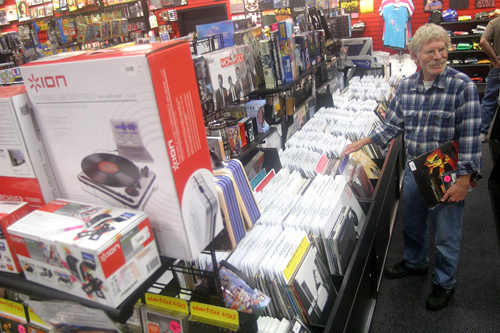
Once relegated to dusty basements and considered all but dead, vinyl records are making a comeback. Music stores are expanding their selections, record labels are reprinting old LPs and more bands are putting out new albums on vinyl.
“There’s a ton of excitement. It’s the buzz thing going on in the music business right now,” said Duncan Browne, chief operating officer of the 28-store Brighton, Mass.-based Newbury Comics chain. “It’s just a matter of how big it’s going to get.”
In an industry hit hard by declining CD sales and the rise in digital music downloads, vinyl record sales have been a blessing to struggling retail music stores. Vinyl record sales increased by 90 percent last year and are up another 55 percent nationwide through the first five months of this year, according to Nielsen SoundScan, which tracks the sale of music products throughout the United States.
When asked why vinyl has become popular again, Steve Kotler, owner of Round Again Record on Wickenden Street, had a simple explanation. “The real reason is that they’re cool,” he said. “For this moment they have an aura of hipness.”
Like Converse All-Stars, Ray-Ban sunglasses and other vintage products now in vogue, vinyl records have become hip again. Older listeners and audiophiles have kept vinyl on shelves for years, but the recent surge in popularity has come primarily from new, younger customers.
Even with these new buyers, vinyl records make up only a small part of the music purchases, accounting for less than 1 percent of total album sales last year, according to Nielsen SoundScan. The bestselling vinyl record of 2008, Radiohead’s “In Rainbows,” sold 25,000 copies last year. That number is respectable, but nowhere near the more than 2.7 million copies sold of the bestselling CD, Lil Wayne’s “Tha Carter III.”
Though unlikely to replace CDs or offset revenue losses, after years of bad news the increasing popularity of vinyl is a welcome change for local storeowners struggling to stay relevant in a digital age. Rob Yeremianm, owner of The Time Capsule, a used-record and comic book store in Cranston, said he’s seen a 30-40 percent increase in vinyl record sales over the last six months.
Audiophiles and DJ’s have praised the warmth and thickness of vinyl’s sound for years, and there has been recent technological advancement. New records often come in 180-gram versions, which produce better audio and are less prone to distortion than older 140-gram versions. State-of-the-art turntables also produce better sound and allow people to connect their record players to computers to convert albums into digital music files.
Browne, however, downplays the importance of sound quality as a factor in attracting these new customers. “How can we be selling so many $100 turntables if it’s the audio quality?” he asked. “It’s not like people are listening to these things on expensive stereo systems.”
Browne said the sales increase has more to do with the “cool factor.” Though big retailers, including Best Buy, have begun stocking vinyl and large record labels are producing new albums by big-name bands, Browne says he sees little future in the format because the perception of vinyl as hip will likely be fleeting.
For now, businesses like Luke’s Record Exchange in Pawtucket, which briefly closed last May due to declining sales before reopening in response to the demand for vinyl, are thriving. Owner Luke Renchan said he’s seen a “huge turnout” lately.
Despite the growing popularity of vinyl records, storeowners said music lovers should not expect a resurgence in other forgotten music formats.
“No one’s going to collect cassettes,” predicted Kotler, the owner of Round Again Records. •