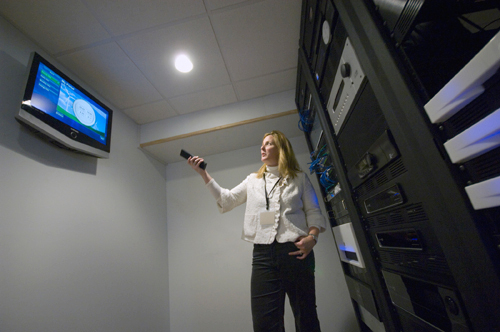
When Kimberly Lancaster Hageman pitches her house to a prospective buyer she tells them about the panoramic views of Narragansett Bay and the easy access to local beaches. She also spends time highlighting the utility bills for this four-bedroom, four-bath house: No cost for natural gas and oil last winter thanks to a geothermal system and just $55 a month for water thanks to efficient plumbing.
Hageman built her home to meet some of the toughest energy-efficiency standards in the country, banking on the expectation that buyers would go shopping for green homes. Time will tell if Hageman played her cards right, but indicators point to more Rhode Island homes incorporating energy-efficiency standards to set them apart from the competition.
The number of Rhode Island homes applying for the U.S. Green Building Council’s Leadership in Energy and Environmental Design (LEED) certification has increased from just one in 2007 to 60 thus far in 2010, including a 58-unit development in North Kingstown. Hageman received gold certification – the council’s second-highest rating – last year.
Connie McGreavy, interim executive director of the council’s Rhode Island chapter, said those numbers tell only half the story. Homeowners building to LEED standards – considered the de facto standard in the industry – are not required to seek certification. And unlike businesses that pursue LEED certification partly for bragging rights, homeowners do not need an official letter to satisfy their green envy. That means the number of homes meeting LEED standards could be far, far larger.
“Awareness has definitely notched itself up,” McGreavy said, who pointed to a society increasingly concerned about the environment and fretting over rising utility costs.
She estimates the number of calls from homeowners seeking ways to make their homes green has shot up at least 50 percent this year over last. Contractors are also calling more often looking for guidance on becoming LEED-certified builders.
Even U.S. Sen. Sheldon Whitehouse, D-Rhode Island, has jumped into the action. He is sponsoring the Energy Efficiency in Housing Act in Congress that would direct the U.S. Department of Housing and Urban Development to establish mortgage incentives for homebuyers – such as waived fees, higher permitted loan principal and lower interest rates – to finance purchases of energy-efficient homes and home improvements. The bill would also create a $5 billion loan fund to help states and municipalities develop green-building programs and allocate $50 million for a 50,000-unit, low-income, energy-efficiency pilot program with cost savings shared between the tenants and the landlord.
Earlier this year Caldwell, vice president of Caldwell & Johnson, renovated a home in North Kingstown that meets four energy-efficiency standards: LEED, the U.S. Department of Energy Builders Challenge program, Energy Star and the National Association of Home Builders National Green Building Standard.
Caldwell said the decision to incorporate the green elements and spend $4,000 acquiring the certifications came from a desire to strengthen his balance sheet as much as protect the environment.
“This is not a charity here. This is how I make my paycheck,” Caldwell said.
The initial investment in building energy-efficient homes can be pricey – stretching into the tens of thousands of dollars for features like solar panels. But Caldwell said the payoff in terms of cost savings on utilities is big over the long term and attractive to buyers.
Within weeks of putting the North Kingstown house on the market he received eight offers at or above his asking price. He eventually sold the home for $255,000 to a school teacher for an undisclosed profit.
“I would do that every day of the week,” he said.
Caldwell is now planning the construction of a 1,152-square-foot, concrete house in North Kingstown he says will be one of the most energy-efficient homes in the state. It’s part of his larger strategy to build expertise in green construction so he’s ready to roll when the housing market rebounds.
Hageman, the homeowner, said she will seek a new home with energy-efficient features after she sells her existing house in Narragansett. The relatively low utility bills and the smart computer networks that monitor her home’s energy use are no longer luxury extras but features the family depends on.
“How do we go backwards? We can’t,” Hageman said.
But paying for the energy-efficient windows, the spray-on insulation and the geothermal system may limit – for now – the ability for middle class America to follow Hageman to the green houses of tomorrow.
Caldwell said buyers need to persuade banks to issue loans covering the premium cost of the systems. That can be a hard sell in these days of tight credit markets. Things could change though.
Whitehouse’s bill would require home appraisers to take into account long-term utility cost savings from renewable energy systems and energy-efficiency improvements. The rule would apply only to sales touched by federally regulated transactions, although such regulations affect most transactions.
But the banking industry may not require the push. McGreavy noted that the Deutsche Bank Americas Foundation, a philanthropic arm of the German bank, is compiling a database of hundreds of green, retrofitted homes in New York City and will measure their energy use. The idea, the bank says, is to see the results of energy efficiency in terms of dollars. If the results are positive, banks may be more willing to increase lending for green homes, McGreavy said.
Hageman hopes so. Her 5,400-square-foot house – less than a year old – is on the market for $2.58 million – green features and all. •