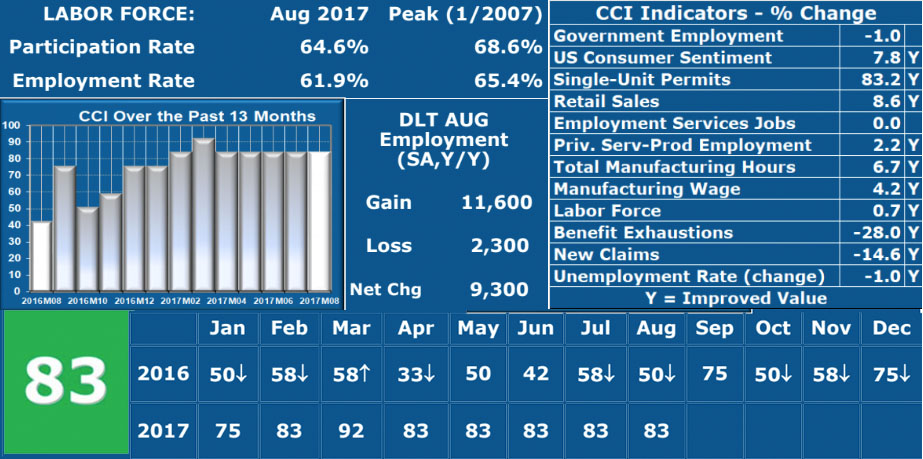
SOUTH KINGSTOWN – Rhode Island’s economy continued to outperform year over year, according to University of Rhode Island economist Leonard Lardaro in the latest Current Conditions Index measuring the state’s performance, released on Monday.
The report found the state economy measured an 83 for the fifth consecutive month. A CCI reading greater than 50 suggests economic growth and a value less than 50 indicates contraction.
Your Business Has Gone Global. Has Your Insurance?
A decade ago, “doing business internationally” was mostly a large-company concern. Today, a manufacturer in…
Learn More
In August, PBN reported the state’s unemployment rate was 4.3 percent, holding steady from July.
The August CCI report reflects a 33-point increase from August 2016. Lardaro maintained that the CCI’s positive streak hasn’t occurred in a “very, very long time.”
Nine of the 12 CCI indicators saw improvement in August 2017, according to the report.
Payroll employment rose year over year by almost 2 percent in August. Lardaro remains skeptical of the state’s labor force’s recent improvement trend, which he said he emphasizes as a “train wreck.”
Lardaro remains concerned about the Employment Service Jobs category failing to improve, which he said is an indicator of future employment.
New claims, what Lardaro calls the timeliest measure of layoffs, declined 14.6 percent, registering its eighth improvement in the last 10 months.
Single-Unit Permits, which reflects new home construction, rose an “amazing” 83.2 percent in August year over year due to an “easy comp” in August 2016.
Total manufacturing hours rose by 6.7 percent year over year, a measure for manufacturing output in the state.
U.S. consumer sentiment rose 7.8 percent in August, its 10th consecutive increase.
Government employment fell 1 percent from a year ago. Private service-producing employment growth increased by 2.2 percent year over year.
Retail sales rose a “robust” 8.6 percent year over year after falling in July.
Benefit exhaustions, which reflects longer-term unemployment, declined 28 percent year over year as part of a long-term downward trend.
Chris Bergenheim is the PBN web editor.