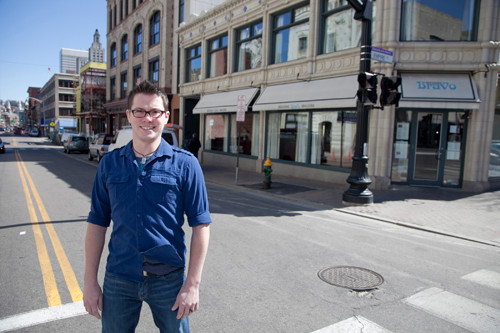
Charles Lafond describes himself as an avid supporter of public transportation. But the manager of Bravo Brasserie in Providence is skeptical about a proposed plan to return streetcars to city streets for the first time in almost six decades.
He worries that constructing the project would interrupt business at the Empire Street restaurant, which is on a corner along the proposed route. He wonders how the state will pay for the streetcars and if it will come in the way of new taxes. And he questions where planners would fit the tracks in the seemingly narrow and congested city streets.
“I just don’t think it’s a practical answer for what’s happening in downtown,” Lafond said, favoring instead the expansion and refinement of existing bus and trolley service.
Officials from the R.I. Public Transit Authority recently proposed a tentative route for a roughly 2-mile-long line. Nicknamed “Meds to Eds” by former Providence Mayor David N. Cicilline, the route would carry passengers from the College Hill neighborhood to the Jewelry District and its emerging life sciences core.
As proposed, the line would start close to the intersection of Angell and Thayer streets, use the existing College Hill transit tunnel, cross the Providence River, head west down Washington Street, then south along Chestnut, Richmond and Eddy streets before ending in front of Rhode Island Hospital. The reverse trip would follow the same route except for a small deviation to Richmond and Ship streets.
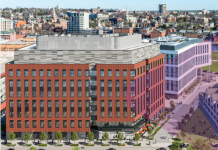
Such a route would bring riders over the Providence River, by bus-hub Kennedy Plaza, alongside the edge of Johnson & Wales University’s Downcity campus and by the future home of Brown University’s new medical school.
“There’s just such a great concentration of activities” along the recommended route, said Amy Pettine, a special-projects manager at RIPTA.
Planners envision university students hopping on the streetcars on their way to classes or other academic activities. Employees at buildings along the route – especially at the hospitals – will reach lunch spots and meetings using the streetcars rather than fight traffic with their cars, Pettine predicted. And curious tourists may be more willing to board a streetcar, with its defined physical route and nostalgic appearance, than a bus.
“When you invest in rail you can be pretty sure we’re not taking that service away anytime soon,” Pettine said.
Planners still need to refine the specifics of the route. How would passengers connect to the Providence train station? Should the line extend past the hospitals to Prairie Avenue to allow RIPTA to move a bus route farther west? And should officials tweak the route to put the trains closer to the Coro Center – a busy medical office building?
There’s also a question whether streetcars – rather than a rapid bus line or traditional buses – would really be the best fit for the route. Those decisions are expected to be made this summer. Besides the RIPTA board, the city would also have to give its approval before streetcars make their return.
And the state still must figure out how to pay for the project estimated to cost $75 million. The service would cost another $2 million to $4 million a year to operate, money cash-strapped RIPTA does not expect that fares alone will cover. Pettine said RIPTA hopes the Federal Transit Administration will cover half the cost of building the project. The rest, she expects, would come from a mix of state, city and private sources.
Ideas floated include creating a special assessment zone around the route and charging property owners what would essentially amount to a streetcar tax. Another plan assumes the streetcar system leads to higher property values and, by extension, higher tax bills. But instead of sending the new portion of taxes to the city, the revenue would go to a fund to pay for and maintain the streetcar system.
Under another concept, streetcars would reduce the need for university-operated shuttles. The schools would then take the money saved and put it toward the streetcar system.
Mike McCormick, assistant vice president for planning design and construction at Brown, called the potential to link College Hill to the schools and increasing research activities in the Jewelry District “excellent.”
Brown already runs its own shuttle along the same route proposed by RIPTA. McCormick said that ideally a streetcar – or similar alternative – would replace that route. Then Brown could shift some of the money it saves to supporting that system.
The streetcar plan must also muster support during a formal hearing process and meet environmental permitting requirements. That, and the lack of an identified funding stream, means the project is at least five years away from completion, Pettine said.
And that is if it occurs at all. Not everyone is convinced streetcars will deliver an economic boon.
Brown University assistant professor of economics Nathaniel Baum-Snow questioned the demand for a streetcar line traveling a distance that many people could probably walk faster, when one considers the time spent waiting for the next streetcar.
“I would certainly enjoy riding a streetcar in Providence,” said Baum-Snow, who lives in the city. “But the evidence from other light-rail lines in other cities is that unless you build a sort of large, fast, interconnected system you’re not going to attract a lot of riders.”
“I think if they’re going to build this they’re going to [do so] with this being very much the beginning rather than the end itself,” Baum-Snow said.
The streetcar proposal grew out of a larger plan called Transit 2020 that suggested planners take a careful look at a number of changes, including branding bus routes, creating new bus hubs on the outskirts of the city and leveraging technology to improve service.
Pettine said the relative shortness of the streetcar line was done intentionally to keep its cost palatable. Someday, she said, it could also become just the first leg of a larger system.
If streetcars do become a reality, it would not be the first time they rolled on the capital city’s streets. During the first half of the 20th century, streetcar lines dotted the landscape. At their peak in 1941, they recorded about 200 million trips that year, said Mark Therrien, RIPTA’s assistant general manager.
But the rise of the automobile contributed to the downfall of streetcars in Providence and other American cities. The last streetcar line in Providence – along Blackstone Boulevard – shut down in 1952. •