BankFive Corp. CEO Thomas Lyons acknowledges it wasn’t exactly a moneymaker.
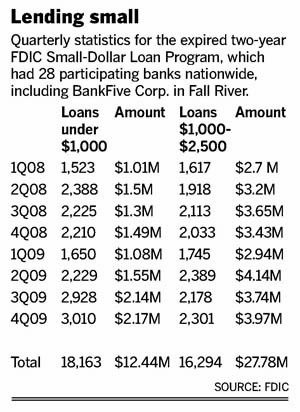
For two years, the Fall River bank was one of only 28 institutions nationwide participating in a Federal Deposit Insurance Corporation pilot program to offer small-dollar loans to borrowers in desperate need as an alternative to expensive payday lenders.
Established banks typically don’t bother with small-dollar lending because many feel it is not worth the effort.
But profitable or not, BankFive has decided to make loans less than $1,000 a permanent product.
“We didn’t do it for the profit,” Lyons said last week. “It’s that we’re a community institution.”
In the two years of the FDIC program, which ended in the fourth quarter of 2009, BankFive issued just 13 loans averaging about $1,000, according to Lyons. One borrower defaulted and the remaining 12 continue to make payments.
Despite the lack of activity, Lyons said he sees small-dollar lending as a way to reach the “unbanked” and “underbanked” in BankFive’s market – Massachusetts’ South Coast region between Swansea and Fairhaven – particularly first-generation immigrants who aren’t familiar with the U.S. banking system.
Now renamed the Affordable Smart Dollar Loan, the program offers borrowers amounts of up to $1,000 with no origination fees and no prepayment penalties at a fixed annual percentage rate (APR) of 5 percent.
Lyons said the small-dollar loans haven’t added much, if anything, to the bottom line of the bank, which has about $708 million in assets.
But that wasn’t the point.
FDIC started the program two years ago as way to find the best ways for financial institutions to offer affordable, small-dollar loans.
For many people, a payday lender is the only place to turn in an emergency when cash is needed. But loans from storefront nonbanks can come with short payback periods and exorbitant fees.
In Rhode Island, a licensed check-cashing business can charge fees as high as $15 for every $100 loaned in a two-week payday loan.
Banks participating with the FDIC program agreed to offer loans less than $1,000, with APRs capped at 36 percent and no prepayment penalties, among other things.
For its part, the FDIC declared the program a success. In the two years, the 28 banks issued 34,400 small-dollar loans with a principal balance of $40.2 million. The agency did not specify the program’s overall default rate, but said it was in line with rates for similar types of unsecured loans.
At BankFive, Lyons said his bank’s 7.6 percent default rate – one out of 13 loans – is much lower than the 10 to 20 percent that he’s heard other banks were dealing with.
Nevertheless, the FDIC said the results were encouraging.
“A key lesson learned was that most pilot bankers use small-dollar loan products as a cornerstone for building or retaining a long-term banking relationship,” FDIC said in its final report. “Almost all of the pilot bankers indicated that small-dollar lending is a useful business strategy and that they will continue their small-dollar loan programs.”
FDIC Chairwoman Sheila C. Bair said the agency would continue to work in “expanding the supply of small-dollar loans.”
Right now, BankFive isn’t heavily promoting its small-dollar loan program, although there is information about it on the bank website. Applications are available at every bank branch.
The bank had lowered the required credit scores for potential small-dollar borrowers, but some applicants have been turned away because of severe credit or financial problems.
Lyons is hopeful that the program would continue to help some “micro borrowers” who have trouble even getting a credit card.
“It’s not turning the earth upside down with job creation,” Lyons said. “But at least we’ve given the FDIC the tools to develop a program.” •