When the state proposed its own economic stimulus package back in December, the hope among Rhode Island officials was that the $165 million program for new loans would give small- and mid-sized business owners relief from the credit crunch.
But then, the legislature took no action on the package for more than six months – an eternity if you are a small-business owner struggling to make ends meet.
Luckily, the eight banks in or near Rhode Island that pledged $5 million to $25 million each in new small-business loans did not wait for the General Assembly to act. They went ahead and issued loans, without the assured financial backing of a 90 percent state guarantee that required legislative approval.
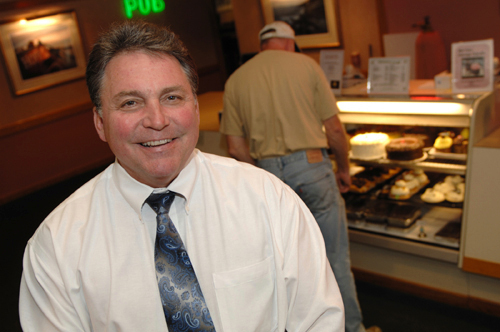
H. Robert Bacon, owner and operator of the Gregg’s Restaurant chain in Rhode Island, is among the business owners who are glad they did.
Bacon, who has run the company since 1982, had an agreement to buy the chain of four restaurants from former owner Ted Fuller when the latter decided to retire this year. Bacon went to Washington Trust Co. for financing because “they are familiar with Gregg’s and with me,” he said. The sale closed in January, after Bacon and his wife, Bobbie, a co-owner, received what he said was a loan of “several million dollars” to make the purchase.
If Washington Trust had not provided a loan when it did, “I don’t think the deal would have gone through,” Bacon said. “I didn’t have that kind of money in my pocket.”
Based in Warwick, Gregg’s employs 520 full- and part-time workers. Although there is no state guarantee attached to his loan, part of Bacon’s funding does come with a 90 percent federal guarantee, in the form of U.S. Small Business Administration (SBA) backing, he said.
It’s a good thing Washington Trust and the other banks did not wait for state approval.
Although scaled back in recent weeks, the state economic stimulus package proposed by Gov. Donald L. Carcieri and the state Economic Development Corporation (EDC) was not part of the 2010 fiscal year budget approved by the House last week, meaning the proposal is likely dead this year.
House Finance Chairman Steven Costantino, D-Providence, said the package was dropped before his committee voted in favor of the budget proposal June 17 due to financial considerations. “It was a matter of money,” he said. “We just didn’t have the money.” He referred to the potential liability the state would incur if it guaranteed the small- business loans and then borrowers defaulted.
Under the initial plan, the state would have made sure that up to 90 percent of the small-business loans were guaranteed by adding its own guarantees to those the SBA already offered (at 40 and 75 percent) and by guaranteeing direct bank loans up to the full 90 percent. The idea was that 90 percent government guarantees would encourage lenders to make loans.
However, in February, the federal government came out with its own stimulus package, which raises the SBA guarantee on most loans to 90 percent and waives or reduces the federal application fees. Both provisions are slated to expire in 2010.
As a result, officials decided to trim back the state’s potential liability to $15 million, with 90 percent guarantees only for those loans not backed by the SBA. The federal provision for fee waivers/reductions also made the similar state proposal unnecessary, according to Hashway.
But in the end the effort was for naught and supporters are now left to try again next year.
Without a state guarantee, most of the financial institutions that six months ago pledged $165 million over a two-year period already have loaned out at least $104.1 million of that amount in the form of SBA-backed or direct loans, according to representatives of the eight banks and credit unions contacted recently by Providence Business News.
Washington Trust and Bank Rhode Island have loaned more than their pledged amounts of $20 million and $25 million, respectively, representatives said, with final figures not available until the end of the second quarter. William A. White, president and CEO of Coastway Credit Union, said there is “no doubt” the credit union also will go beyond its $25 million pledge. “The money has never stopped flowing at Coastway,” he said.
With more than $15 million worth of loans “booked or in the pipeline,” Thomas W. Kelly, president and CEO of Bank Newport, pointed out his bank is well “ahead of schedule” on its two-year $25 million pledge. A state guarantee, however, would be “nice,” Kelly said, and provide the tipping point in favor of three or four pending loan applications. With the guarantee, “we could give relief to customers we might not normally lend to,” he said.
The SBA in Rhode Island is not waiting for the state to act either. Mark S. Hayward, director of the Providence-based office, said his agency guaranteed 19 small-business loans made by various lenders in just the first 16 days of June, representing $2.2 million, 26 new jobs and the retention of 140 jobs. This compares to 15 loans worth $4 million backed by the SBA during the same time period one year ago, but Hayward warned against strict comparisons because he said a number of the 2008 loans were for large amounts.
Hayward, who championed the state stimulus package six months ago, now says his agency has the authority to act without the state. “Under the SBA’s authority, we are continuing to do loans with participating lenders,” he said. “Our agency has sufficient guarantee authority to do what is needed for small business.”
Hayward earlier this year urged enactment of the state package so Rhode Island would have the tax credit and loan guarantees in place when federal provisions expire next year. He indicated last week that the state tax credit may be proposed again next year.
Of the eight participating banks and credit unions, only one – Randolph Savings Bank in Randolph, Mass. – did not provide specific figures on how much of the pledged funds has been loaned to date. Randolph pledged $15 million.
A representative of Randolph, however, said the bank continued to make loans to credit-worthy businesses in Rhode Island. “As of this date, we have not turned down a loan due to the lack of a guarantee,” said Michael Spinelli, senior loan officer and senior vice president of Randolph. •