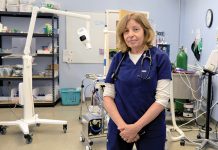
After years of treating children with attention problems and autism, clinical psychologist Laurence Hirshberg could see there were limitations to how much help he could be.
Hirshberg says he could teach his clients skills to control emotional outbursts, for instance. “But then they were having to manage those emotions all the time,” he says.
Medications could be used to treat neurological conditions, but sometimes those were ineffective, too.
“Conventional treatments were only taking them so far,” Hirshberg says.
So he turned to an innovative therapy called neurofeedback, and eventually a new practice was born.
Since 2001, Hirshberg has been running the Neurodevelopment Center, which provides traditional and innovative treatments for a variety of neurological conditions in both children and adults.
The innovative treatment comes in the form of computers and a machine – called an electroencephalograph, or an EEG – that measures the brain’s electrical activity. They’re used to train the brain to sharpen attention, relieve anxiety and improve mood without medication.
While the technology is complex, Hirshberg says, the treatments are simple for clients.
Often, the 30-minute sessions entail playing video games or watching movies while a computer monitors brain activity. If the readings indicate the client is losing focus, growing anxious or becoming emotional, the computer automatically turns down the volume or shrinks the viewing screen until the brain function returns to acceptable levels. Many times, doing so is a subconscious effort. Eventually, the proper behaviors become second nature.
At the outset, clients get a detailed EEG assessment that provides Neurodevelopment Center psychologists with a brain map used to target the feedback training.
Hirshberg insists the sessions can be effective in treating attention deficit hyperactivity, obsessive compulsiveness, anxiety, autism and even post-traumatic stress.
In fact, the Neurodevelopment Center has been treating veterans who served in Iraq and Afghanistan and have struggled in their return to civilian life.
“Two vets we started to work with have shown huge improvements,” Hirshberg says.
While the majority of his clients are children suffering from neurological conditions – some as young as 4 – Hirshberg says his clients have been as old as 70.
And not all health insurance plans cover the office visits, which are as much as $80 per session.
But, he says, recent research and studies have been supportive. And new clients or their parents are given a 90-minute explanation of how neurofeedback works.
“Of course, they’re going to be skeptical, but after the orientation, most say it makes sense,” Hirshberg says.
He does acknowledge that the treatment doesn’t work for everybody, at least not immediately. If there are no changes in behavior after 20 sessions, Hirshberg says the center stops charging for future treatment.
It has taken time for Hirshberg to build the neurofeedback practice.
He started out in 2001, treating a small number of clients from his traditional practice who weren’t progressing.
Over the years, the center has grown from a small office with a tiny staff to a 6,000-square-foot location with five psychologists, four technicians and some support staff.
At its peak, the center was conducting 120 neurofeedback sessions a week – about 60 clients – plus another 20 to 30 clients receiving training at home.
Then the economy fell apart, and “our phones stopped ringing,” Hirshberg says.
Watching their wallets, potential clients worried about paying for a treatment with which they were unfamiliar.
The number of office visits has since bounced back, “but we’re not back to where we were at the peak,” Hirshberg acknowledges.
Hirshberg also has branched out, opening a mental-fitness center in the same office called Stay Sharp, hoping to capitalize on research that indicates brain training can hold off age-related mental decline.
He foresees a day when companies will offer mental-fitness centers, along with physical-fitness centers. But, so far, Stay Sharp hasn’t attracted much business.
“That’s been a much harder proposition to interest people in,” Hirshberg said. “But I think there is a good product here.” •
COMPANY PROFILE
Neurodevelopment Center Inc.
OWNER: Laurence M. Hirshberg, director
TYPE OF BUSINESS: Neurofeedback treatment facility
LOCATION: 260 West Exchange St., Suite 210, Providence
EMPLOYEES: 13
YEAR ESTABLISHED: 2001
ANNUAL SALES: WND
Beyond Cash Donations: How New Forms of Giving Are Transforming Not-for-Profit Accounting
Evolving Funding Landscape for Not-for-Profits Not-for-profit organizations are being asked to do more with less,…
Learn More