Catherine Pena was working two jobswith three little boys at home trying to make ends meet when a friend suggested working in the trades. Today, Pena is the business representative/organizer for the Carpenters Union Local 330 and current chair of the Rhode Island Building and Construction Trades Council’s Women’s Council.
Amy Parrilla and Jenifer Gomez just graduated from Roger Williams University with degrees in construction management through the Shawmut Scholars Program. Gomez credits her interest in the trades to her father owning a hardware store when she was a child growing up in Guatemala. Parrilla was involved in the carpentry program at her high school in Medford, Mass.
Vennicia Kingston wanted to turn her life around after being incarcerated. A friend told her about Building Futures, which offers a construction pre-apprenticeship program. She didn’t know much about construction, but her options were few, having just been fired from a grocery store. She decided to try it and was accepted.
“Building Futures was life-changing for me,” said Kingston, who now owns her own company, Eagle Eye Post Construction Service LLC in Johnston.
She has 14 employees and recently landed her first $1 million contract. She says getting into the construction field was the best decision she ever made.
In Rhode Island, women remain a clear minority in the traditionally male-dominated construction industry, but there are efforts to grow their numbers in a field advocates say is lucrative and offers a variety of opportunities. In addition, according to data from the R.I. Department of Labor and Training, 2,359 projected annual job openings in the industry due to exits, transfers and growth.
Pena, Parrilla, Gomez and Kingston are examples of what is possible for women willing to consider the building trades for their career path.
At Providence-based Building Futures, CEO and President Andrew Cortés says encouraging more women to join the industry has been a focus of his organization since its inception in 2007. The nonprofit works closely with the Rhode Island Building and Construction Trades Council’s Women’s Council to attract women to the industry.
“It’s remarkably low,” Cortés said about the number of women in construction in Rhode Island, “which makes absolutely no sense given the economic opportunity the building trades offer.”
“People in general have very little exposure to what a career in the construction trades looks like,” Cortés said. “For far too many years it was a college or nothing pathway and we need to change those dynamics.”
[caption id="attachment_507206" align="aligncenter" width="1024"]

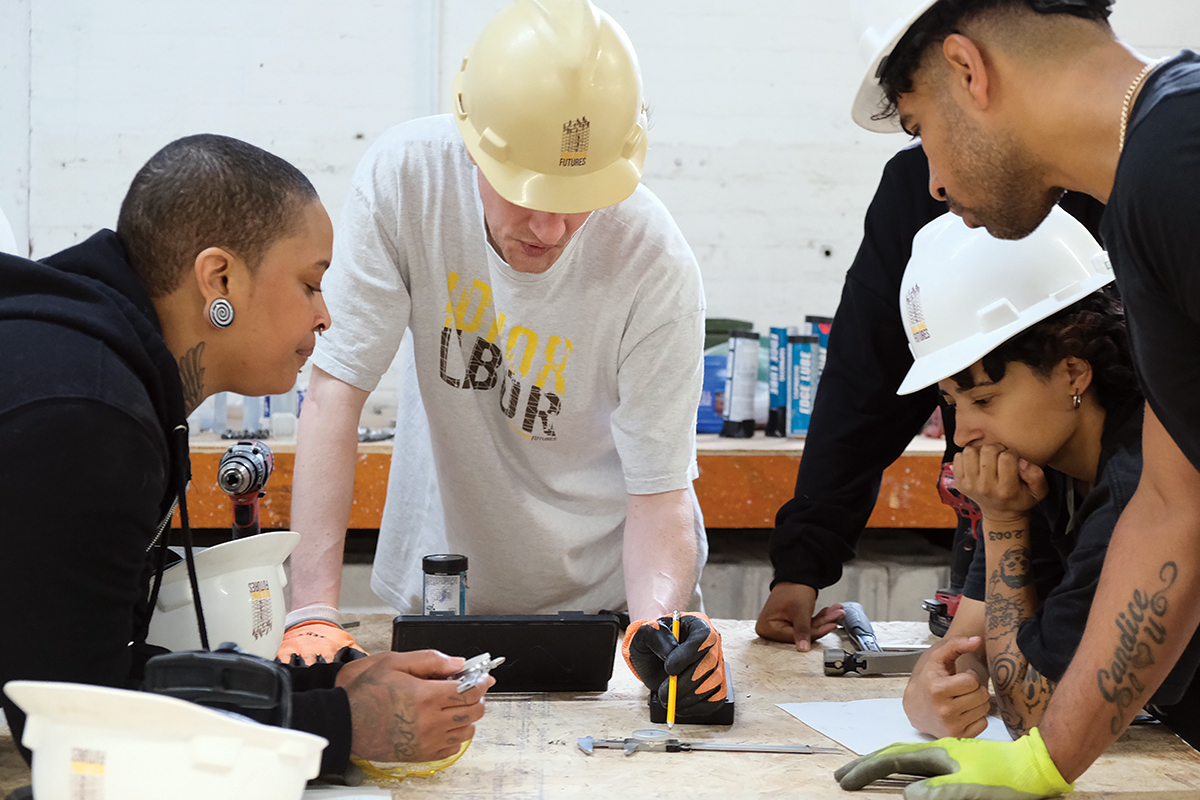
CUTTING EDGE: Quiana Ferguson, a student in the Building Futures pre-apprenticeship class held earlier this year from May 5 to June 6, works on a project.
COURTESY BUILDING FUTURES[/caption]
In Rhode Island, women earn about $0.84 for every dollar earned by men, but in construction the pay equity gap closes to about $0.96 to the dollar. And, in the unionized construction industry, the pay equity gap with men closes completely, he said.
“For a single mother looking to support her children and who likes working with her hands, this is an incredible career path,” Cortés said.
While Cortés acknowledged there can be bias against women doing traditionally male jobs, he said in the construction trades, everyone is judged on their ability to perform. Succeeding in the industry helps change that bias, he said.
There is a significant shortage of workers in general in the building trades, Cortés said, adding that the 55-year-old-plus demographic has the largest percentage of workers at 27.5%. That age group has grown over the past decade, while all other age groups have shrunk, according to the Building Futures Impact Report in 2024.
“It’s the perfect time for young women to enter the industry,” Cortés said. “The industry is doing well in Rhode Island. The outlook is good for the next few years.”
The numbers of women working in the construction industry are slowly growing.
According to data from the DLT, the percentage of female employment in the construction sector increased to 17.6% in 2023 compared with 16.1% in 2019. The percentage of female employment in field construction occupations increased slightly to 3% in 2023 compared with 2.2% in 2018.
Pena said she followed in the footsteps of a friend who was working as an insulator, who told her she could make better money by working in the trades. Pena started working as a carpenter in 1997. Her first job was working on bridges.
“The first day they told me I had to use power tools and cut materials and I thought, ‘Wait, what did I get myself into?’ ” Pena recalled. “I thought I would be holding a flag, directing traffic. That was my thought of a woman in construction. It ended up being something totally different that I didn’t expect. The first six months was very rough and I actually got into an accident, a really bad accident on the job [a tire hit her on the highway], but my focus was to make it work because I still had little boys at home and knew it could be a great career. … I took time out, came back and flourished. I was in leadership roles my third year in.”
Pena said the culture was difficult – she was a young, petite, Hispanic woman working with mostly men and had to deal with sexism and discrimination. She said her worth was not recognized until colleagues saw what she was capable of doing. Pena said she also felt as though she had to work 10 times harder.
Still, she did not give up. After a five-year break from construction, she began working for Shawmut Design and Construction through a subcontractor, which she said was a wonderful experience. Shawmut respects women and promotes diversity, she said. She worked on the University of Massachusetts Medical Center project in Worcester, Mass., as a project foreman.
Of the 1,200 members in her union, only about 30 are women, she said, noting that the number has grown since the 1990s when she estimated there were “only a handful.” Pena also runs Sisters in the Brotherhood support group for women in the trades, tackling topics such as financial literacy and improving skills.
Parrilla, of Malden, Mass., and Gomez, of Providence, were part of the inaugural cohort of RWU’s Shawmut Scholars program, which started in 2021. It provides access to education and career development through four-year scholarships, paid internships, professional development and mentorship to students majoring in construction management or engineering. Three Shawmut Scholars graduated this year.
Both Parrilla and Gomez plan to work at Shawmut after graduation. Parrilla, who also minored in business, will work in the Boston office and Gomez in the Providence office. Both are grateful for the hands-on experience and mentorship that the program offers, and Parrilla hopes to one day have her own company with her family.
Gomez, who also majored in Spanish with a minor in business, said she is the first person in her family to graduate from college. Gomez was 14 when she came to the United States, attending school at Cranston High School East. Shawmut has helped her manage the challenge of being a woman of color in a male-dominated field, she said.
“Their journeys are exactly why we built this program, and we’re excited to expand it next year by welcoming four scholars as part of our ongoing investment in emerging talent,” said Marianne Monte, chief people and administration officer at Shawmut.
Monte said women now comprise 32% of Shawmut’s workforce, which is three times the industry average. That growth reflects the company’s sustained focus on attracting, retaining and developing talent across all levels, she said, adding they regularly review pay and promotions to ensure fairness and prioritize building supportive teams and safe job sites.
“We know, and have heard directly from our clients, that teams with diverse backgrounds and perspectives deliver a better product in the end,” Monte said.
RWU has 254 students enrolled in the construction management program; 29 are female, according to the university. Forty-six graduated with the degree this spring, including six women.
Anita Bruno, founder and CEO of Rhode Island Women in the Trades, said more women are needed in the trades, and more support is needed to encourage them to pursue this pathway. She has 20 years experience as a union carpenter and founded the Providence-based nonprofit in 2019.
Barriers exist in recruitment, as well as retention, Bruno says, adding that the obstacles the women encounter force some to leave the industry. Complaints have included lack of training, harassment, discrimination, hostile work environments and being held to a higher standard than their male counterparts. Unions also can be unwelcoming to tradeswomen, she said.
“I got into workforce development because there’s not enough of us. … Once they come through our program they have a lifetime support system,” Bruno said. “We have a sisterhood now.”
About three times a year, her organization offers an eight-week pre-apprenticeship program to introduce women to construction. It is grant-funded, so it’s no cost to the participants. Thirty women have completed the program since it began in 2022.
They spread the word about the program by contacting schools and agencies, including the R.I. Department of Corrections. Polaris MEP assists with training. Participants learn “construction math,” resume writing and interviewing skills, financial literacy and Occupational Safety and Health Administration safety training. They learn how to drywall, frame a wall and install a window. The last cohort featured six women who renovated a church kitchen in the Silver Lake section of Providence.
Bruno said the trades can also be lucrative – women can make between $100,000 and $200,000 a year and receive benefits.
“The sky’s the limit for them,” she said.