One in five U.S. women, experts say, will develop an ovarian mass at some point in their lives. For the overwhelming majority, it will turn out to be just a cyst or a benign tumor. A tiny fraction of them – less than one in 10,000 – will be diagnosed with ovarian cancer.
For those who do have cancer, early detection and treatment is crucial. Ovarian cancer kills about 15,000 women each year, more than any other gynecologic cancer. For the rest, it’s important to know they are all right and to avoid needless surgery.
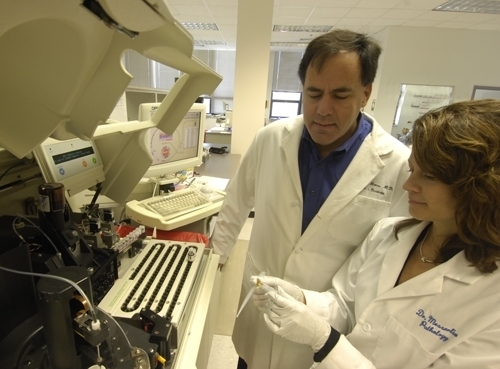
Last year, Dr. Richard Moore of Women & Infants Hospital unveiled research that could make a huge impact for both kinds of women: by testing for two proteins in patients’ blood, he showed, you can tell whether they have ovarian cancer with 95 percent accuracy.
It was the culmination of years of work by Moore and others, most of it supported by federal grants. But in developing the new test, Moore had an industry backer – Fujirebio Diagnostics, which had created a test for one of the biomarkers and now sells both tests internationally.
The project is part of a growing wave of industry-sponsored research in Rhode Island’s hospitals and academic biomedical labs. With limited government and foundation grants available, researchers are increasingly teaming up with businesses, both for the advancement of medicine and to give local patients access to cutting-edge diagnostics and therapies.
It is not a new phenomenon: Pharmaceutical companies and medical device makers always have worked with scientists and clinicians to develop and test their products.
But while industry-sponsored projects were historically a very small – and less prestigious – part of academic researchers’ work, several factors are changing that.
For starters, biomedical research in Rhode Island is growing rapidly, especially at Brown University and in the Lifespan health system. But Care New England, independent hospitals, the University of Rhode Island and local companies are getting into the act, too.
All those projects need funding, and not all of them can get National Institutes of Health grants. So to keep growing their research, institutions increasingly need private sector money.
Medicine is also advancing more rapidly than ever, creating a wealth of opportunities for research at all levels, from basic science to clinical trials to comparisons of different therapies or diagnostic tools. At the clinical trial level and beyond, researchers say, industry partners are increasingly involved even in projects with government funding.
The bottom line, said Dr. Paul A. DiSilvestro, who is principal investigator for Women & Infants’ Gynecologic Oncology Group and works closely with Moore, is that industry- and NIH-backed projects are increasingly similar, and the lines between them are blurring.
“They’re all well-designed, highly researched, excellent, background types of trials that look to accomplish similar things: At the end of the day, do you have a product or a test or a prevention strategy that will benefit the health of patients?” he said.
DiSilvestro’s group is very active in National Cancer Institute-sponsored projects, and the doctors – who are both clinicians and scientists, several of them Brown faculty members as well – have built their careers in government-sponsored, academic research.
But many NCI-sponsored trials, DiSilvestro said, now include industry co-sponsors. A company may participate to evaluate the effectiveness of a biomarker test or other screening tool it is developing, or of a new cancer treatment, and compare it with existing options.
And for clinical trials, industry seeks out researchers like DiSilvestro and his colleagues because as active clinicians, they have access to patients to enroll in trials.
DiSilvestro said the industry grants are unrestricted, and the researchers design, manage and report on the trials without company interference. The nature of their work is also such that they are not testing potential blockbuster drugs, but rather tumor markers and other products that can be valuable to their manufacturers but won’t generate huge profits.
“I don’t do drug research and research in trials where there’s a large interest and a large monetary gain,” he said.
Oncology isn’t the only field in which industry-sponsored research is flourishing at Women & Infants. Last fall, Brown-affiliated researchers at the hospital got $475,000 from Beckman, Coulter Inc. to study serum biomarkers that may predict preeclampsia, or high blood pressure in pregnancy, as part of a 10-site, two-year national trial.
Also last fall, Jacob Canick, director of the Division of Medical Screening and Special Testing at the hospital and a professor of pathology and laboratory medicine at Brown, received a $4.5 million grant from the molecular diagnostics company Sequenom to study an RNA-based test it has developed to detect Down syndrome and reduce the rate of false positive results.
For example, Padbury said, he’s doing a study, sponsored by an infant formula maker, on the effect of a proprietary carotenoid supplement (carotenoids are antioxidants such as beta-carotene and lycopene that are found in fruits and vegetables and are precursors to vitamin A) in the visual development of low-birth-weight infants.
Women & Infants would not be able to do such a study without a formula maker’s support, he said, “but that very type of study is what’s led to advancements and improvements in the formulas we use to treat extremely low-birth-weight infants.
Advances in chemotherapy for childhood malignancies, he added, also have come from clinical-trial research that was, to a great extent, sponsored by industry. And Women & Infants patients benefit directly, he stressed: For example, the hospital was involved in the first trial for a drug for premature babies with lung disease that was tested for eight years.
Industry-sponsored research is also growing at Lifespan, though it still accounts for just a fraction of project funding, about 8 percent, said Peter Snyder, who took over the newly created post of vice president for research last July.
Hiring Snyder was itself a statement about Lifespan’s view of industry partnerships. A neuroscientist, Snyder came from Pfizer Global Research and Development.
Snyder said Lifespan will keep working to grow its NIH-sponsored research – it even plans to seek a new Center of Biomedical Research Excellence (COBRE) grant in stem cell biology – but as he sees it, “having all or most of our funding come from a single source is not a good strategic position to be in.”
In addition, he noted, “very exciting” technologies and therapies are coming out of industry labs. “There’s no reason why Lifespan and our hospitals shouldn’t be partnering with industry and local companies to pursue novel therapies wherever they’re being developed,” he said, “as long as we can maintain our ethical principles and protect academic freedom.”
NIH funding also overwhelmingly supports early-stage, “path-finding” research, Snyder noted, so if Lifespan wants to be involved in the full range of biomedical research, it has to work with industry. And there’s plenty going on: In oncology alone, there are 33 active studies enrolling patients for new therapeutics or new delivery mechanisms, Snyder said. There are Alzheimer’s treatment trials, clinical trials to treat pediatric rotovirus infection – a common cause of diarrhea – and studies of HIV and AIDS treatments.
Snyder said he’s also working with Brown to better manage intellectual property and technology transfer, since lots of good ideas with commercial potential are coming out of their labs. “We’re working very actively with the inventors to make sure that they have the right teams around them to grow the technology, and that we’re able to manage conflicts of interest as they arise,” he said.
Along with Lifespan and Care New England, Brown – which declined an interview request for this story – is by far the most active local institution working with the biomedical industry. But URI, especially its College of Pharmacy, is also very involved.
Interim Dean Ronald P. Jordan said he sees academic institutions across the country looking more and more to industry, and with strong regulatory and internal protections in place, he’s confident that it’s a good thing. Plus for Rhode Island, he noted, leveraging the universities and hospitals to attract pharmaceutical research is great for economic development.
For individual researchers, industry sponsorships can be crucial. Fatemeh Akhlaghi, a URI pharmacy professor whose work focuses on the use of immunosuppressants in organ transplants, said industry is her main source of funding – both for small projects she initiates, and for major studies such as one she’s doing at Rhode Island Hospital with Dr. Reginald Gohh, a Brown professor and clinical director of transplant services, involving kidney transplant patients.
Akhlaghi said she’s always pursuing NIH funding and also reaching out to foundations and groups such as the Juvenile Diabetes Association, but money is very tight.
“So the alternative is industry-sponsored projects,” she said. “And it’s really valuable for drug companies to have access to [our] patients, and for clinicians to be on top of research going on in the industry. … It’s kind of like a win-win situation for us.” •