Entities in charge of teaching employees new skill sets must do more to reach out to and develop partnerships with employers in Rhode Island, to see what skills companies need their workers to have to succeed in the 21st century, according to a Drexel University educator and labor expert.
The recommendation by Paul E. Harrington, director of the Drexel University Center for Labor Markets and Policy in Philadelphia, Penn., drew strong support from business leaders, lawmakers and state officials during last week’s Senate summit on the state’s economy and job creation, though some said employers can do more too.
Rather than place the onus solely on the training agencies and organizations, “it is actually a two-way street,” said Donna C. Cupelo, regional president of Verizon Communications. “Businesses need to reach out, especially to our higher education institutions.”
In addition, according to Charles J. Fogarty, director of the R.I. Department of Labor and Training, some initiatives suggested at the summit already are in place or are being put into place in the form of such programs as Career Pathways and the Governor’s Workforce Board.
Cupelo and Fogarty spoke after the March 21 summit at the Knight Campus of Community College of Rhode Island, entitled “Jobs for Rhode Island” and convened by Senate President M. Teresa Paiva Weed. About 70 people attended, including approximately 30 state senators, organizers said.
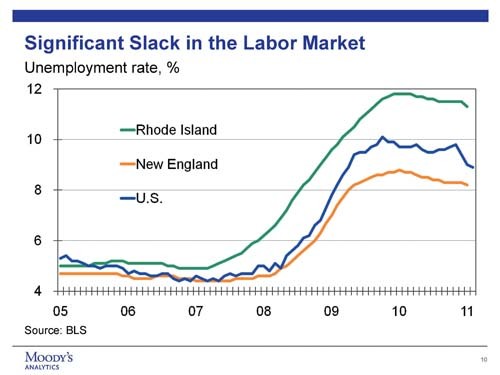
The summit featured local and national experts discussing the state’s unemployment rate (at 11.2 percent as of February) and what can be done to provide more jobs for more Rhode Islanders.
Cupelo was part of a two-member team representing the business community that spoke about shaping the work force to meet business needs, along with Robert DiMuccio, president and CEO of Amica Insurance Co., whose corporate headquarters are in Lincoln. Fogarty and several DLT staff members attended as spectators.
Harrington called for “very strong outreach” on the part of work force training agencies – including those overseen by the state and at local colleges and universities as well as privately run concerns – to forge stronger ties to businesses.
He cited internships and cooperative education programs as examples of workable solutions that can lead to long-term partnerships between education and business. He praised the William M. Davies Jr. Career & Technical High School in Lincoln for using advisory boards made up of local business representatives.
During the summit, Cupelo and DiMuccio each pointed out how technology today dominates just about every workplace. “Every employee is a technical employee to some degree,” DiMuccio told the gathering, and he called for “core levels of training” in technology from grammar school to college.
Cupelo said young people need to explore career options before they reach high school, citing the Boston Private Industry Council that pairs businesses with students at the middle school level as an example.
“As businesses, we can do more,” she said, to work with educators and expose youth to employment sectors “at a much earlier age than we do now.” Studies have shown, she said, that students who identify career options at a young age are more likely to graduate from college and be successful later in life.
Fogarty, a former lieutenant governor named this year by Gov. Lincoln D. Chafee to head DLT, cited several initiatives already under way that address problems mentioned at the Senate summit, such as the Governors Workforce Board.
Created about six years ago, the GWB is appointed by the governor and works closely with DLT to develop “demand-driven” work force training, Fogarty said, in such targeted sectors as health care, hospitality, defense, information technology, advanced manufacturing and the marine trades. Joseph J. MarcAurele, president of the Washington Trust Co., currently chairs the GWB.
Under consideration, Fogarty said, is creation of a GWB subcommittee that would comprise small-business representatives. At the least, he said, small-business owners will be among those first considered to fill future GWB vacancies.
Last year, Career Pathways was created to address the skills gap in the state’s work force, Fogarty said, and will be centered at CCRI. A task force is now putting together final details of the Career Pathways program, Fogarty said. •