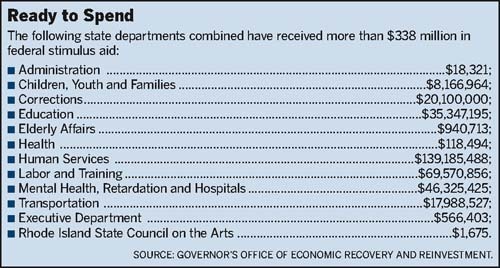
Federal stimulus money going directly to Rhode Island state government is expected to top $1 billion, and already state departments have plans to spend more than $338 million of that money.
Jamia McDonald, director of the Governor’s Office of Economic Recovery and Reinvestment, on Nov. 20 presented the latest data on how the state is spending the stimulus money, during a meeting with the R.I. Small Business Advocacy Council (SBAC).
According to figures supplied by McDonald, the state has received $338,330,066 as a result of the American Recovery and Reinvestment Act of 2009.
The estimated number of jobs created or retained due to the funding depends on which Web site you check. The Web site for McDonald’s office said that, as of Oct. 29, 1,490 jobs in Rhode Island have been created or retained. However, Amy Kempe, spokeswoman for Gov. Donald L. Carcieri, said that this figure includes only jobs created/retained as a direct result of funding that went to the state.
Others that received stimulus dollars directly, such as cities and towns or federal contractors, also created and retained jobs, which Kempe said should be included in the figures provided by the federal government on its Web site (www.recovery.gov), where 2,012 jobs created/retained are reported for Rhode Island as of Oct. 30. The state ranks 47th out of 52 entities (including the District of Columbia and Puerto Rico) on the number of jobs created thus far.
As of Sept. 30, McDonald said, the state was scheduled to receive $1.08 billion in federal stimulus funds out of a total $787 billion nationwide. The stimulus plan includes: $288 billion in tax cuts and benefits for working families and businesses; $224 billion for education, health care and entitlement programs; and $275 billion for federal contracts, grants and loans.
The federal government is slated to release the largest amount of funds, about $110 billion, in the current federal fiscal year, with lesser amounts disbursed each fiscal year thereafter until 2015.
The federal law contains specific
timelines for spending the money because Congress intended the funds to be spent quickly to maximize the economic impact, according to the state-recovery Web site for McDonald’s office, (www.recovery.ri.gov).
Here is how the state intends to spend the money, according to the “main funding streams for Rhode Island” outlined by McDonald: Medicaid would receive more than $450 million; education, $260 million; transportation, $176 million; energy, $55 million; food stamps, $52 million; water improvements, $46.5 million; work force development, $17 million and public safety, $11.5 million.
Lt. Gov. Elizabeth H. Roberts, who chairs the SBAC, said the meeting with McDonald was intended as a “first step” to open up the process so that small businesses know about the federal funding and can plan accordingly.
Roberts pointed to the state-recovery Web site as a first stop for businesses. The Web site allows visitors to search for funding opportunities among 10 federal agencies, but state opportunities are limited to a residential weatherization program with an already expired Nov. 3 deadline. Visitors are referred to other Web sites that help small businesses obtain state contracts.
Roberts suggested small businesses looking for more information contact the Rhode Island Small Business Development Center at Johnson & Wales University, directed by John Cronin, or the Rhode Island office of the U.S. Small Business Administration (SBA) , whose director is Mark S. Hayward. •