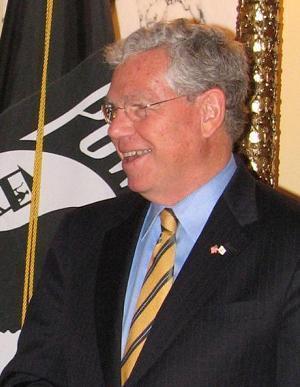
State government is knee-deep in the complex process of tracking and claiming its share of federal stimulus dollars, but Gov. Donald L. Carcieri says it is unclear when Rhode Island will feel the impact of what is expected to be as much as $1 billion in new funding for everything from roads and bridges to schools and windmills.
Jamie McDonald, director of the state office of economic recovery and reinvestment, backed up Carcieri’s assessment to the R.I. Economic Policy Council during its May 12 meeting. The policy council functions as an advisory board to EDC.
Although the state is working to take advantage of the federal funding “as fast as we can,” the governor said, no impact can be expected yet, particularly in the area of job creation, because the bulk of the $787 billion will be distributed over the next two fiscal years, 2010 and 2011. “This money is not having any significant impact now,” he said. In terms of job creation, he added, “the money is flowing very slowly” and “anyone who thinks it’s coming out in a big bucket fast is mistaken.” At 10.5 percent, the state has one of the nation’s highest unemployment rates.
Although no one knows for certain when Rhode Island will begin to feel the impact of the stimulus money, Carcieri suggested a roughly two-year timetable because, with funding expected to flow the heaviest in 2010 and 2011, “if our [state] revenue doesn’t climb in two years, it will be an issue,” he said.
A week before the American Recovery and Reinvestment Act of 2009 was signed into law on Feb. 17, the governor signed an executive order creating the state recovery office to take charge of the complicated process of applying for the federal funds, which will come to the state in a variety of ways. Some of the money will go directly to state government, some of it will go to cities and towns and some will be apportioned on the basis of competitive grants nationwide.
Most of the funding for alternative energy projects will be in the form of discretionary grants, according to the governor and Jamie McDonald, director of the state office of recovery and reinvestment. “We’re looking at how we can use that pot of money to leverage some of the things we have percolating now,” the governor said, mentioning offshore wind projects as one example. “We’re going to push the envelope a little bit on how we use those energy dollars,” he added.
Carcieri revealed that the governors in the Northeast are working together to develop alternate energy projects for the entire region, such as wind power.
In the same vein, the governor spoke of $5 billion that will become available in federal education grants, and he said a move is under way to have the New England states work together on an education strategy for the area as a whole. He said this would be a continuation of ongoing educational planning taking place among the New England states.
As for transportation, Michael Lewis, director of the R.I. Department of Transportation (DOT), on the department Web site (www.dot.ri.gov/), reported that $137 million is “on its way” to Rhode Island for transportation projects and he fully expects to have the funds obligated by the federal deadline, clearing the way for the state to receive even more if other states don’t spend their allotments in time.
Housed at the Statehouse, the office of recovery and reinvestment comprises teams drawn from various state agencies working to keep track of and obtain stimulus funds in such areas as health, education, energy, information technology and transportation. The federal government provided no mechanism to cover administrative overhead, so the state is absorbing this cost, Carcieri said.
At the end of the meeting, Carcieri provided the policy panel with a quick summary of the recommendations made by a special committee he created to review EDC and its operations.
Although the review panel has pegged the Economic Policy Council for eventual extinction, Carcieri said the group of community leaders will continue to meet until the EDC changes are in place. Legislation to revamp the department and “enlarge the board of directors” is pending before the General Assembly, he said. •