While Dan Beardsley admits he is “somewhat grateful” that Gov. Donald L. Carcieri is looking to restore some aid to cities and towns, the good feelings only last so long when the director of the Rhode Island League of Cities and Towns talks about the governor’s 2009 and 2010 state budget plans unveiled last week.
What concerns Beardsley is Carcieri’s use of federal stimulus money to help fund such things as state aid to education in both his 2009 supplemental plan and his $7.62 billion 2010 budget proposal.
When the infusion from the American Recovery and Reinvestment Act of 2009 (ARRA) dries up in a few years, the state will be left with a bigger hole, Beardsley warned last week.
“It’s disturbing to me,” he said. “There were no tough decisions [in the budget proposals], and decisions that were made are going to have major ramifications.”
With its use of hundreds of millions of ARRA dollars, Carcieri’s proposed tax-and-spending plan for fiscal 2010 – and his revised supplement budget for the current year, which ends June 30 – has raised new questions about how and where the federal stimulus money should be used.
The Carcieri administration itself isn’t totally sure.
Carcieri told Providence Business News last week that state officials are still seeking clarification from the federal government as to how they can use $37.2 million from the “state fiscal stabilization fund” of Rhode Island-dedicated ARRA money that the governor already has earmarked for education.
“They’re trying to devise the rules and regulations on the fly about how this money should flow,” the Republican governor said. “It’s really made it very complicated.” Carcieri added, however, that he is optimistic it will be allowed.
Lt. Gov. Elizabeth H. Roberts, a potential Democratic gubernatorial candidate, chimed in last week, issuing a statement critical of the governor’s proposals.
For his part, Carcieri said he feels like he’s administering the money as best he can. “We’ve scrubbed this budget up and down,” he said in an interview with PBN. “What we’ve tried to do is follow the spirit of what we think the stimulus is about.”
Rhode Island is due to receive about $470 million as an increase in Medicaid funding called the Federal Medical Assistance Percentage, or FMAP. The money will allow some state funds to be shifted to other uses, so Carcieri has called for $137.3 million to be plugged into the 2009 budget and another $184.2 million to be placed in the 2010 package.
The governor’s tax-and-spending recommendations are the initial steps in a budget process that is expected to be difficult as the GOP governor and the Democrat-controlled General Assembly deal with projected deficits of $347 million in 2009 and another $504 million in 2010.
It doesn’t help matters that the economy has sunk to levels that haven’t been seen in many years, which is dampening state revenue figures.
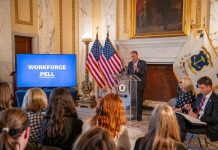
“We’ve felt it early, and we’ve felt it severely,” Carcieri said in a press conference unveiling his budget plans last week.
Rep. Steven M. Costantino, D-Providence, chairman of the House Finance Committee, could not be immediately reached for comment last week.
But House Minority Leader Robert A. Watson, R-East Greenwich, usually a Carcieri ally, lambasted the governor’s plans to hike the cigarette tax and revise the personal income tax, which Watson asserts would increase tax bills for many Rhode Islanders.
“I don’t think we need to rely on tax and fee increases to balance the budget,” Watson said. “I go back to what the governor had said before: It’s not a revenue problem; it’s a spending problem.”
In addition to its use of hundreds of millions of dollars in federal stimulus money, Carcieri’s 2010 budget package also offers no general revenue sharing aid to cities and towns, and it recommends changes to the corporate tax, personal income taxes and the estate taxes.
At the same time, Carcieri’s revised fiscal 2009 supplemental budget factors in a $252.1 million infusion from the ARRA. The initial supplemental budget, submitted in January, assumed the state would receive about $27.5 million from the federal stimulus package.
Among the changes to that supplemental budget package: Instead of taking away all of the $55.1 million in general revenue sharing that had been earmarked for the municipalities in the current fiscal year, Carcieri instead wants to give local communities $31 million, indirectly using federal stimulus money.
There would be strings attached, however, for cities and towns receiving that money: The Carcieri administration said it would mandate that communities must spend between 25 and 75 percent of the general revenue sharing on education.
That was one recommendation that annoyed Beardsley. “There is no rationalization or explanation why [communities] are being forced to use revenue sharing to pay for education,” he said.
As submitted to the General Assembly, Carcieri’s 2010 budget plan represents an increase of $696.16 million – or 10 percent – from the $6.91 billion budget approved last year by lawmakers for the current fiscal year.
Officials from the Carcieri administration said much of that increase is a result of the cash influx from the federal stimulus package, including an increase in unemployment benefits.
Unlike last year’s budget proposal, which called for the elimination of hundreds of state jobs, his FY 2010 recommendations contain no layoffs. In fact, the administration said the state would have to add 136 temporary jobs – 89 in the R.I. Department of Transportation alone – to administer stimulus-related projects, based on additional spending totaling $529.1 million during the fiscal year.
And the proposal again recommended that the $55.1 million in general revenue sharing be taken away from cities and towns in FY 2010.
Among tax changes called for in Carcieri’s 2010 budget: A reduction in the corporate tax (loss of $14.5 million in tax revenue in 2010) and estate tax (loss of $1.49 million in tax revenue), as well as changes to the personal income tax, which would lower the top marginal rate to 5.5 percent and lower the bottom rate to 3.5 percent.
Carcieri said 310,000 of the state’s 420,000 tax filers would see a tax cut.
He also revised the proposed pension changes that appeared in his initial supplement budget plan.
The governor had proposed doing away with annual 3 percent cost-of-living adjustments (COLAs) for any state worker or public school teacher who retired after April 1 – an idea that had many critics worried it might spur a mass exodus of teachers before the end of the school year.
Under his new plan, Carcieri said, state employees who are eligible to retire as of July 1 would be “grandfathered” so they could still receive the COLA pension hikes after they do retire. •