If you are fortunate enough to find employment in this tough economy, and you do even the most menial job well and cultivate useful contacts, odds are good that you will wind up with a better position someday and perhaps even the chance to go into business for yourself.
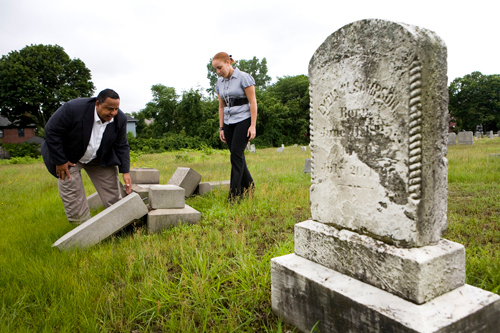
That’s the theory, at least, behind a new summer employment program for 14 Providence and Cranston high school dropouts of American Indian descent who within a few weeks will begin cleaning up the Locust Grove Cemetery in South Providence, an initiative launched by the nonprofit Rhode Island Indian Council Inc. and funded with a $72,000 state grant.
“Our hope is to find all of these young people jobs afterwards,” said V. Darrell Waldron, executive director of the Indian Council headquartered on Broad Street. “We hope to get these young people interested in taking on different aspects of this project as trades they could learn, such as landscaping, horticulture [and] monument work.
Repairing headstones is not something you can go get trained in. We’re hoping to spark an interest in them,” he said.
“I am looking forward to it,” said Amanda Hall, a 24-year-old Providence resident who had been searching for a job for months because she has six children to take care of, two of her own and four of her fiancé’s. “I’ve been looking for work, but it’s hard out there. All I’ve been doing is staying home and waiting for phone calls [from potential employers].”
Hall likes the idea that she will be outdoors. “You’re out in the open, not cooped up in some little office,” she said. “And I like cleaning and picking up. I can see opportunities. If this goes well, I can see myself doing this kind of work in the future.”
Ranging in age from 16 to 24, the workers will receive minimum wage and health benefits for working part-time during the summer program, which Waldron said should continue until mid-September. They will be issued matching T-shirts, will walk to and from the cemetery each day a few blocks from council headquarters, and will eat lunch there. The workers will be in charge of planning the daily details of their own assignments.
“Hopefully, they’ll find out a lot about themselves in the process and this will help them build some self-esteem,” he said.
As part of their jobs, the young people will work with professional contractors, landscapers and masons, whom the council will retain on a temporary basis to provide advice. The Indian organization intends to bring in expert speakers to talk to the youths about such issues as financing and banking, job readiness, how to build partnerships and how to plan and implement a project, according to Waldron.
He came up with the idea of cleaning up the cemetery. Every day, when he’d leave the office to get a sandwich for lunch, Waldron would pass by the cemetery, a neighborhood landmark at Elmwood and Potter avenues, and silently deplore the sorry state of the graveyard, its grass overgrown and dozens of headstones toppled. City crews took care of the cemetery when they could, but Waldron said it seemed the grass was mowed just once a year, for Memorial Day.
Locust Grove Cemetery was established without church affiliation in 1848 by Elmwood real estate speculators, according to information on the Rhode Island Historical Cemeteries Web site (www.rihc.info/). The cemetery was extensively planted with shrubs and a hedge around it but, by the end of the 19th century, sales of plots declined and maintenance deteriorated. Approximately 5,500 people are buried there, according to the historical cemeteries group, and the graveyard remains in use today. Birth-date inscriptions go back to 1793. Many graves are unmarked, but some have “grand monuments,” Waldron said, with “beautiful art work.”
“There is a bunch of Indians buried there,” he said. “That’s the amazing part.” Waldron said he does not know exactly how many American Indians are interred there, but he thinks some may be ancestors of the same youths who will clean the graveyard. The American Indian community is a tight-knit one, where virtually everyone is related, and “I know the families,” Waldron said.
Waldron’s vision for this project, however, goes beyond American Indians to the community as a whole.
“The idea is to get young people from the community to restore the cemetery and teach them respect for cemeteries,” he said. “But we’re also hoping people who live in the community and have loved ones buried at Locust Grove will see the young people out there every day and they’ll help out. We’re hoping to start a city movement to get people to take care of their communities, especially the cemeteries.”
The Indian Council is located in Algonquin House, a former home for the aged now housing more than 40 private nonprofit organizations, and serves the approximately 33,000 American Indians living in Rhode Island, Connecticut, Delaware and New Jersey. Algonquin House also functions as a community center for American Indians.
Working with a $608,000 federal grant, the council’s major mission is to help American Indians in the four states obtain employment, with a goal of finding jobs for 300 adults annually, Waldron said. The council will pay the cost of training eligible employees, as long as companies guarantee jobs for them when training is over. The council has a staff of 12 employees in the four states, most of them full time. •