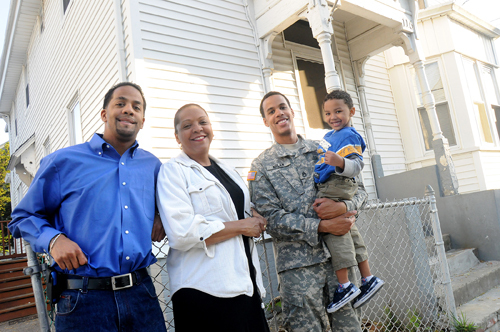
In December 2008, Bank of America legally owned Rafael Milan’s Providence home. It had filed the foreclosure papers, taken title to the deed and sent trucks to move out Milan and his family. Then Milan had a conversation with the bank mediated by the Urban League of Rhode Island and Bank of America did the unthinkable: it reversed the foreclosure, lowered Milan’s mortgage interest rate and handed him back the deed to the house.
Milan said it all happened because he had a conversation with the bank with a trained counselor at his side. Three Rhode Island cities now want to ensure, through law, that all homeowners facing foreclosure have a similar opportunity. Cranston, Providence and Warwick have passed ordinances that require banks to mediate with a borrower on the brink of foreclosure or prove the borrower did not respond to offers of a meeting. Lenders who do not do so cannot file the necessary foreclosure paperwork at City Hall and face fines.
Champions of the ordinances, including Providence Mayor David N. Cicilline, say they keep people in their homes. Critics, including three banks that have sued Providence over the ordinance, complain that it contradicts state and federal law, constitutes a “private nuisance” and provides only vague guidelines for complying.
A Providence Superior Court judge is considering whether to allow the three cases brought by Bank of New York Mellon, Deutsche Bank and Wells Fargo to move forward. Whatever the decision, it will hold implications for similar ordinances and impact the lending industry, said William Farrell, a lawyer and lobbyist for the Rhode Island Bankers Association, which is not involved with the lawsuits.
“There’s no way you can say this isn’t going to have consequences,” Farrell said.
Farrell said banks, upon learning of the ordinances, may choose to withdraw from markets because compliance with the ordinances could prove costly and time consuming. Nor, he said, do they want to learn 39 different foreclosure processes in an already small state.
He also questioned the success of mandated mediation. Farrell said many homeowners ignore requests to mediate. People who do reach the mediation table are often facing dire economic straights and it’s unlikely they can reach an agreement so late in the process, Farrell said. Some of the borrowers may be sitting down for the second time, after a prior counseling session failed.
Out of the 75 mediation conferences held, 55 homeowners reached an agreement that allowed them to stay in their homes. (Put another way, mediation stopped about 6 percent of foreclosures.) As of March 31, another 31 homeowners were working with lenders and seven were unable to reach an agreement and foreclosed.
“When people participated in this mediation, it worked,” Cicilline said.
In Cranston, 21 homeowners participating in conferences reached agreements with banks since the city’s ordinance went into effect on Dec. 23, according to Rhode Island Housing. Another 11 were working on agreements as of March 31. No homeowner who went through a conference had gone to foreclosure as of March 31.
In neighboring Warwick, an ordinance modeled after Providence came into effect on April 26 after the City Council overrode a veto by Mayor Scott Avedisian, who worried that it contradicted state law. State law requires only that lenders notify homeowners facing foreclosure that counselors are available, but leaves initiating the meeting in the hands of homeowners, not banks.
Warwick City Councilwoman Helen Taylor, who shepherded the city ordinance though its passage, said she introduced it after calling banks on behalf of constituents facing foreclosure and urged the banks to talk to their customers.
“They said to me, ‘We are in the business of making money, not making friends,’ ” Taylor said.
Milan, the homeowner, thought he had been working with a housing counselor for months before Bank of America filed for foreclosure. It turned out the supposed counseling agency was a scam. And Bank of America was unforgiving until he brought in the Urban League as a mediator on the advice of his uncle. Milan said the Providence ordinance, which would have required the process, could have helped him avoid the scam by pointing him to a certificated counselor who could steer him through a loan modification.
“It works a lot,” Milan said. “They give a small person like me a voice.”
The Urban League said that of about 150 similar conferences held last year, 98 percent ended with homeowners reaching an agreement with their banks and staying in their homes. League CEO Dennis Langley said that’s why the league supports ordinances along the lines of the one adopted in Providence.
“It raises a consciousness of banks taking the extra step to educate their own clients on resources available in their own communities,” Langley said.
Cicilline expects the number of homeowners entering mediation to grow as the ordinance starts catching people earlier in the foreclosure process, when the time for negotiation is ripe. And he dismissed complaints from banks that mediation drags out the foreclosure process and that a law unique to one city creates confusion for the industry.
“I certainly don’t think it creates an extraordinary burden on lenders to learn if there’s a mediation process available,” Cicilline said.
At least two local banks, The Washington Trust Co. and Pawtucket Credit Union, said they considered the ordinances a nonissue. Paul Cappello, senior vice president of lending at Pawtucket Credit Union, said community banks tend to be more willing to work with customers one-on-one than larger banks.
“I would think the local institutions are already trying to do that,” he said.
At Washington Trust, Michael Rauh Jr., executive vice president of sales, service and delivery, said the bank was not facing a wave of foreclosures and hence not impacted by the ordinances.
Both bank executives said they would rather avoid foreclosure to begin with, if for no other reason than it’s an expensive process and banks do not want to become landlords of vacant properties. •