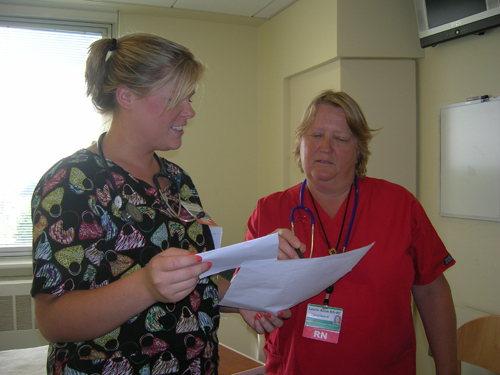
When nurses at Newport Hospital change shifts, they don’t hand each other a pile of charts, maybe toss in a warning about the man in room 103 being a little cranky. Instead, one by one, they go over their patients – from medical issues, to who’s there to support them.
They don’t use a checklist, but it feels as if they did. The outgoing nurse briefs her colleague in a very specific order: the patient’s name, age, diagnosis, any advance directives, any events during her shift, a head-to-toe health assessment, any technical issues.
They’ll go over the patient’s mood, any personal concerns, any upcoming tests or procedures. At the end, they confer with the patient and any family members present, answering questions and setting goals for the coming eight hours.
“It’s a very structured system,” said Cheryl Chandler, an assistant nurse manager. “What it does is it organizes it. You’re not saying one thing five different ways – you’re presenting a complete, accurate picture of the patient to whomever you’re handing off to.”
Nurses at Newport Hospital have been doing their patient handoffs like this since 2006, after designing the system with Maureen Dufault, a professor of nursing at the University of Rhode Island and research consultant for the hospital.
Nurses and patients alike embraced it, and now Dufault has taken the Newport approach to The Miriam Hospital and Rhode Island Hospital, where it’s being tested in a randomized trial.
“About 95 percent of errors – of ‘sentinel events’ – at hospitals occur as a result of lack of communication or faulty communication,” said Dufault, citing an Institute of Medicine report. “We were interested in really improving that.”
Patient handoffs are a particularly sensitive time, Dufault noted, because information can easily be missed or grasped incorrectly, leading to potentially deadly errors. So Dufault, a group of her students, and Newport Hospital’s nurses did extensive research on best practices elsewhere, then developed and tested the new system, making adjustments over time.
“It has a lot of potential,” she said. It could be used for handoffs from the emergency room, or from hospitalists to doctors in the community. It’s also a “great opportunity for patient teaching,” she added, to explain the purpose of each device, and what every pill does.
Not only does that help patients prepare for when they’re discharged, she said, but “they can also become a safety watchdog for their own care.”
Think about this: When was the last time you heard medical experts talk about making great strides in … communication? Not the technology part – not electronic records and data exchanges, or wireless devices, but just how people talk with one another.
In a high-tech era when a full medical chart can be pulled up with a few keystrokes, when advanced imaging and lab tests can answer countless questions without a word exchanged, it might seem almost quaint. Yet behind the scenes, communication is getting a lot of attention.
“A lot of information has come out over the past few years that substantiated what all of us have always believed, which is that [good] communication makes a safer environment for a patient,” said Dr. Mary Reich Cooper, chief quality officer for Lifespan, the health system that includes Newport, Miriam and Rhode Island Hospital.
Not only is it important for providers to communicate well with one another, Cooper added, but there’s a growing recognition that engaging with patients is crucial, because it helps providers understand the social and cultural context, makes the patients feel respected (and thus more comfortable and satisfied), and provides vital information.
Maysel Kemp White, a Hartford-based consultant who works on communications with Lifespan and is vice president of education at the American Academy on Communication in Healthcare (AACH), said studies have shown if patients are well-informed about their care, expected symptoms, etc., they have shorter hospital stays and need fewer drugs. Outcomes are also better when hospital doctors make good handoffs to community physicians.
Efforts are also under way to improve communication in doctors’ offices, with patients urged to bring written questions or a checklist. But some doctors dread that, a recent survey by AACH found, because they’re afraid it will make visits longer. They’re mistaken, White said.
It’s “very prevalent” for patients to end a visit without having gotten their questions answered, she said, yet doctors also waste time on explanations the patient might not need, or that are just off-point. “Research shows the better they listen, the shorter the visit.”
White works with providers to help them better interact with patients and with colleagues, so their conversations are more on-point and effective, using well-tested methods.
“I’ve seen a lot of different hospital systems across North America, and I’m really convinced that this skill set is at the core of everything we do,” she said. “If we don’t change the culture, all the technology in the world won’t save us.” •