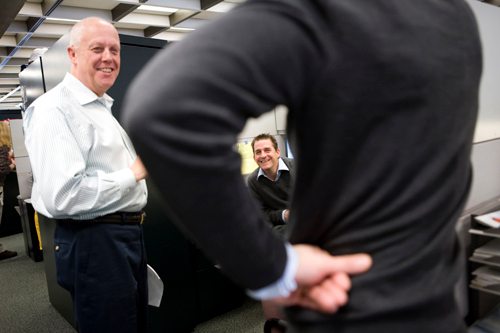
At FM Global, one of the largest private companies in Rhode Island with approximately 5,000 employees and $4.6 billion in 2007 revenue worldwide, the average retention rate for its 5,000 employees is 13 years. An employee who works out of the company’s Norwood, Mass., office recently celebrated 50 years of employment with FM Global, says Steve Zenofsky, assistant vice president and manager of public relations for the Johnston-based firm.
Most of the senior management team members at FM Global have been with the company for at least 25 years, Zenofsky said. Open and honest communication “is the only way to do business,” he said. “Transparency with your employees, your clients and any stakeholder is fundamental to business success.”
The company clearly knows how to retain top-performing employees – the topic of a recent survey developed by Robert Half International that also discussed how to tell if workers are looking to jump ship. Conducted by an independent research firm, the survey is based on interviews with 150 senior executives from 1,000 of the nation’s largest companies.
Management is the key, the survey found, with 35 percent of the respondents citing “unhappiness with management” as the most likely reason good employees quit their jobs. That compares to only 23 percent in a similar 2004 survey. The second reason cited was “limited opportunities for advancement,” chosen by 33 percent of those surveyed. Other reasons were lack of recognition (13 percent), inadequate salary and benefits (13 percent) and bored with the job (1 percent).
In spite of the high unemployment rate in Rhode Island, which means lots of people are looking for work, companies should not take it lightly when top-performing employees depart for other jobs. “When you lose a top performer, it is not that easy to replace that knowledge,” said Jack Fellers, regional vice president for Robert Half International.
“Employers may not realize what they’re losing until it’s out the door,” he said, suggesting that any person can be replaced, but long-time employees who have amassed years of experience at a certain company or profession often have “inherent” knowledge not always replaceable.
To keep top-performing employees on board, Fellers said his first recommendation would be that managers keep the lines of communication open with staff, a step he called “fundamental” because staff members “need to know that we’re [managers] aware of what’s going on in the marketplace.” Open and honest communication on a regular basis “creates trust,” he said, “and that’s really important in any employer/employee relationship.”
A second strategy is to promote from within or, if that is not possible, to work with employees on career counseling, training and mentoring, so employees know that the manager is there to help them succeed and advance professionally, according to Fellers.
Open, honest managers who help workers improve performance are the key. “One of the main reasons people stay at a job is because they have strong managers,” he said. “You really need to have a strong management team in place, especially to weather this economy.”
At FM Global, every employee, including the 1,700 in Rhode Island and nearby Massachusetts, will receive an extra week’s pay as a result of the company’s success in 2008, according to Zenofsky.
“Opportunity” is the reason most workers stay, he said. In Rhode Island, where FM Global has facilities in Johnston and Glocester, and in Massachusetts, with Norwood and Waltham sites, “it’s the opportunity to work for a local and stable company,” Zenofsky said, noting that a company’s stability is increasingly important in tough economic times. FM Global was founded in 1835.
Secondly, it’s the opportunity “to work for a world leader,” he said. One of every three Fortune 1000-sized companies in nearly 130 countries are customers of FM Global, he noted.
Although many companies had a difficult year in 2008, FM Global “due to our employees’ efforts” actually did well, Zenofsky said, so for the sixth year in a row each will receive an extra week’s salary in 2009. ‘It’s remarkable, given the economy,” he said of the company’s 2008 performance. At the same time, FM Global added employees last year, “so we continue to grow,” Zenofsky said.
Although he declined to specify compensation rates, Zenofsky said FM Global employees enjoy top-notch benefits, including both pension plans and 401(k) accounts.
The Robert Half International group in its survey found that most workers looking for a new job will send out warning signals. According to a prepared release, Half identified the following red flags that supervisors should be aware of:
• A noticeable change in attitude. “A formerly enthusiastic staff member may seem withdrawn and indifferent.” Look for changes in an individual’s performance and behavior in team settings.
• Longer lunch breaks and frequent absences, signs perhaps that an employee is using the time for job interviews or is bored.
• Missed deadlines and increased errors. Numerous errors from a previously conscientious employee are a sign of disengagement and may signal lost interest and an impending departure.
• More professional attire, where an employee who shows up wearing suits when the company has a casual dress policy may be going on job interviews.
• Drop in productivity. A decline in performance or work quality and increased forgetfulness about deadlines, meetings and appointments could indicate a worker is gradually disconnecting from the job. •