Since the economy has plunged, David Kellogg, a banking and financing consultant operating as Kellogg Associates in Providence, hasn’t changed the way he markets his services, but he has seen a shift in demand.
“I do find that certain aspects of what I can offer to the market are more or less attractive,” said Kellogg, who provides a CEO-type service to small and mid-sized private companies. He’s been consulting for about eight years and had been a banker with Fleet Bank for 16 years.
In down economies, many companies have trouble raising capital and maintaining relationships with banks, so managing those existing relationships becomes more important than creating new relationships, he said.
“During better times, it’s more oriented toward managing the growth of the business, toward bringing in capital, which is easier to obtain during those better times,” he said. “But you have to work a lot harder to bring in that capital when the credit markets are tight like this.”
When the economy shrinks, the role of an outside consultant can change – either in its practices or the way those practices are packaged – but at least a few consultants in Providence said recently that their services are no less necessary.
“Certainly you have to be flexible,” Kellogg said. “And that’s the great thing about being an independent consultant. You can react very quickly to what the needs of the market are.”
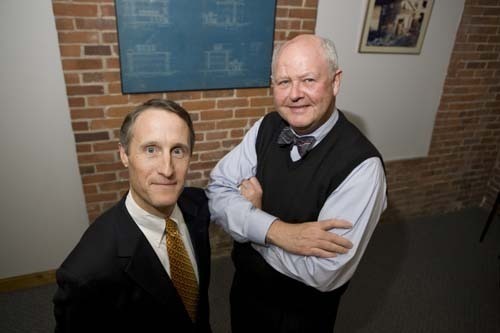
At Austin & Stanovich Risk Managers LLC, co-founder and Principal William K. Austin said they’ve created a new package, dubbed “A&S Risk Assist,” that’s intended to draw in clients who are tightening spending. Because his firm is small, competing against larger firms, he and co-founder Craig F. Stanovich created the flat-rate package that’s not based on hourly rates.
“We’re in a recession and in past recessionary environments some of the larger projects that we’re involved in get pushed off for a while as companies try to maintain their profit margins,” Austin said.
So the creation of A&S Risk Assist was an attempt to retain some smaller jobs that normally would be part of large consulting jobs. “It allows us to do something that we basically already do, but to call it something different,” Austin said. “That allows us to … get across to clients that we can work on a lot of things. Because of our size, we’ve done Fortune 100 work and we’ve done local work with smaller companies.”
Szostak Partners LLC President and CEO Ann Szostak provides strategic consulting to companies in human resources, executive coaching and succession planning. She has about 35 years of experience in the banking world, working with Industrial National and Fleet Bank, until just after its acquisition by Bank of America.
“I do see a bit of a trend, because a lot of companies are under a lot of pressure right now to increase revenue, decrease expenses and keep their companies afloat,” she said.
Szostak is seeing senior management look to consultants who have experience weathering financial cycles, she said.
“They want someone with experience, someone to think through the strategy of motivating people when they don’t have the same level of bonuses or raises or other ways to motivate them,” she said. “I do see a shift in that.”
And right now businesses are expecting consultants to bring in “pragmatic methods, stuff that works” and that’s been proven, she said.
Szostak offered the example of a senior employee whose working day and night trying to keep a company on track, but who might forget to communicate the company’s directives and intentions to its employees. That can be a mistake and can dampen employee moral, because downturns are when those conversations are “needed the most.”
“Without any communication, it tends to go to a worse place,” she said. “He or she doesn’t need to say everything, but at least some news that gives employees context.” •