
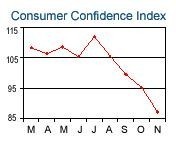
NEW YORK – Confidence among U.S. consumers fell in November for the fourth consecutive month, to the lowest level since just after Hurricane Katrina, according to a preliminary report today by The Conference Board.
The Consumer Confidence Index plunged 7.9 points this month to 87.3 (1985 = 100 points) from October’s revised level of 95.2 points. That was nearly twice the 4.6-point decline that was the mean prediction from a survey of 67 analysts by Bloomberg News.
The cutoff for today’s preliminary report was Nov. 19. The Consumer Confidence Index is based on a monthly survey of 5,000 households nationwide that is conducted for The Conference Board by TNS.
The share of consumers who see current conditions as “good” fell to 22.3 percent from 23.2 percent in October, while the share seeing conditions as “bad” rose 2.5 percentage points to 19.1 percent. Jobs were seen as “hard to get” by 21.3 percent, down from 22.8 percent in October, while jobs were seen as “plentiful” by 23.2 percent, down from 24.1 percent the month before.
“This month’s deterioration in confidence was due primarily to the sharp decline in the Expectations Index,” reflecting what consumers think the economy will do over the next six months, said Lynn Franco, director of the board’s Consumer Research Center.
“Consumers’ apprehension about the short-term outlook is being fueled by volatility in financial markets, rising prices at the pump and the likelihood of larger home heating bills this winter,” Franco said. “In fact, consumers’ inflation expectations have surpassed the spike experienced this spring, and a larger percentage than last month expect stock prices to decline.”
The share of consumers expecting business conditions to worsen over the next six months rose to 16.7 percent this month from last month’s 13.9 percent, while those expecting business conditions to improve fell to 12.4 percent from October’s 14.0 percent.
Their outlook for the labor market also waned, with only 10.8 percent expecting jobs to become more plentiful over the next half year, down from last month’s 13.9 percent, while 23.1 percent expect jobs to become scarcer, up from last month’s 20.2 percent. And the proportion of consumers expecting their incomes to shrink in the months ahead rose to 11.0 percent this month from 9.1 percent in October.
“This is a strong indication that consumer spending growth is going to slow sharply,” Nigel Gault, chief U.S. economist at Global Insight Inc. in Lexington, Mass., told Bloomberg News. “The message to the Fed should be that they need to keep cutting rates.”
Yet, Franco said, “The Present Situation Index – despite losing ground – still suggests the economy is expanding, albeit slowly. [And] despite this rather bleak outlook, consumers have not lost their holiday spirit and anticipate spending more on gifts this season than they did last Christmas.”
The Conference Board is a nonpartisan, nonprofit business membership and research organization with offices in New York City, Chicago and abroad. Additional information is available at www.Conference-Board.org.












Every day, more Economists like Robert J. Shiller are expressing concern that the threat of a recession is coming, but there are plenty of other clues that we are facing unprecedented risks.
Consider publicly traded Real Estate Investment Trusts (REITs). Over the last few years, most REITs performed extremely well. But the fundamentals are deteriorating and the trading values that took years to build could potentially be wiped out in as many months by the those nasty stock market vultures and fast-buck artists commonly known as “short sellers.”
Take Equity One (ticker: EQY) as an example of the perfect storm. Equity One is traded on the New York Stock Exchange. While Equity One’s exposure is nationwide it is based in Florida and so is a huge chunk of its portfolio. The double whammy facing Equity One is that, unlike a diversified REIT, it primarily invests in “retail” real estate.
Equity One disclosed in the latest supplement to its quarterly report that its overall vacancy rate is already over 6%, but the shocker is the fact that the rate almost doubles (to a little over 12% vacancy) when the tenant’s shop is less than 10,000 sq ft. The real danger for Equity One is that this group of tenants represents over 70% of Equity One’s shopping center revenue. When you consider that less than 30% of Equity One’s current shopping center tenants are Anchors (defined as having over 10,000 sq ft.), you really get goose bumps, because at least the bigger retailers have the capital reserves to weather the storm.
And you thought only Realtors and builders had it bad. ?